Introduction
Utah lands at the top of many rankings of state performance across America. But the Beehive State is perhaps best known for its top rankings on the economic front. Utah’s economy is widely seen as the best in the nation. The “Utah economic miracle” – marked by exceptional economic growth, a favorable business climate, and high rates of economic mobility – has garnered attention across the nation and helps explain why Utah’s economy ranks No. 1 among all 50 states, according to U.S. News & World Report. 1
But while Utah’s sky-high economic performance has gotten a lot of attention, the state has also gotten high marks when it comes to happiness. Numerous surveys of happiness put Utah in the top 10 states for emotional well-being.2 In fact, Gallup ranked Utah No. 1 for “well-being” in a recent study focusing on the emotional health, life evaluation, healthy behaviors, physical health and work environment of men and women across the nation.3 These rankings suggest that Utah has pioneered a unique state path combining prosperity and happiness in the 21st century
The strength of the Utah way can be attributed, no doubt, in part to the state’s unique civic, religious and political endowments, including unusually high levels of social capital and low levels of government regulation. But Utah’s material and emotional success is also attributable to the strength and stability of its families.
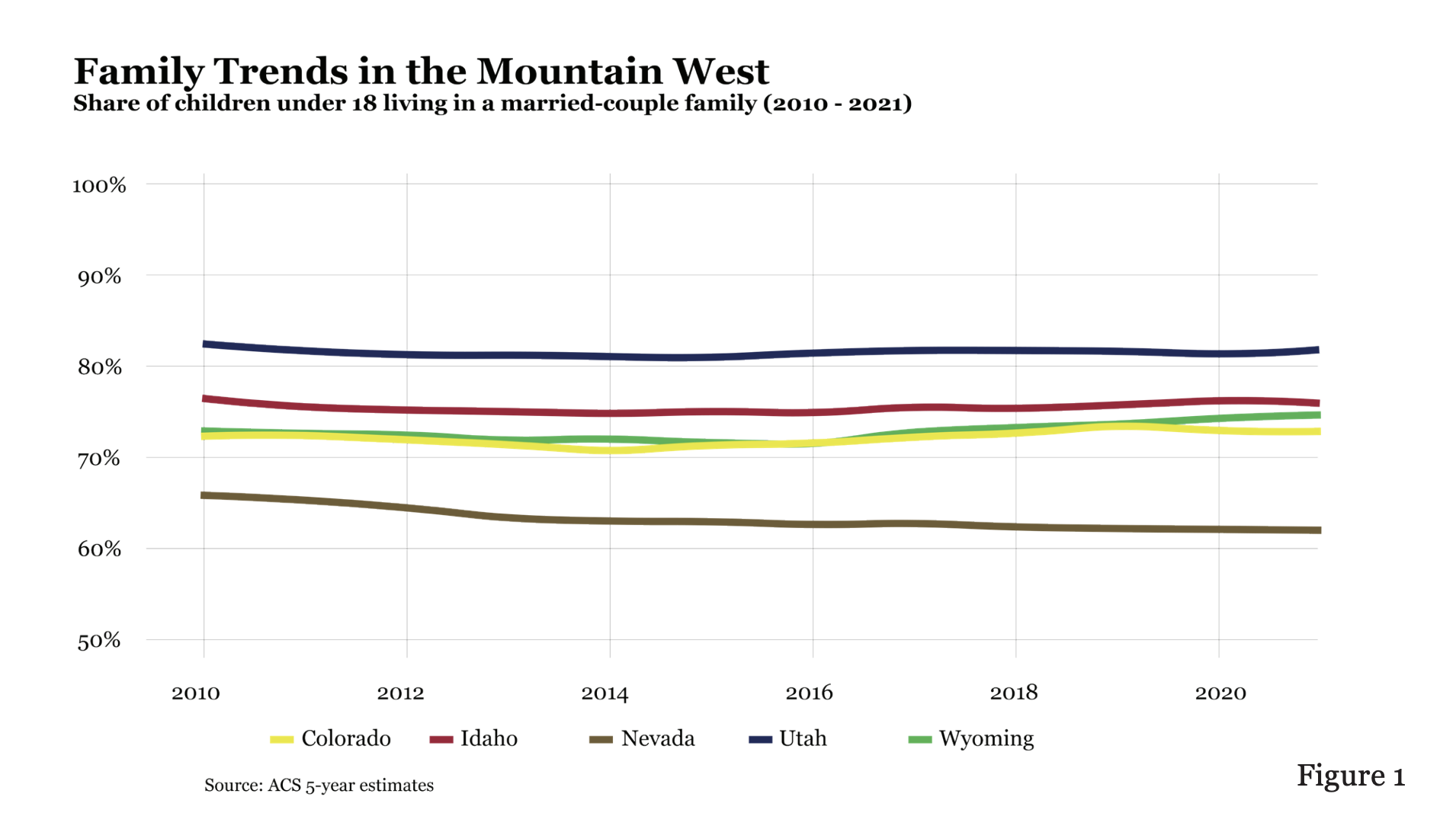
No state in the Union has as many men, women and children in married households as the Beehive State. In 2021, 55% of adults in Utah (age 18-55) were married and 82% of its children were living in married-couple families.4 This compares to 45% of adults married and 75% of kids living in married families nationally.5 Utah’s regional family strength is visible in Figure 1, which shows how the state compares to other states in the region on the latter outcome.
What could be called the “Utah Family Miracle” matters because social science tells us that one of the strongest predictors of state economic success is strong families. Recent research by economists Joseph Price at Brigham Young University and Robert Lerman at the Urban Institute, as well as Brad Wilcox at the University of Virginia, indicates that one of the top predictors of economic performance across the states is the share of married parents in a state. In their words, “the percentage of parents who are married in a given state is typically a stronger predictor of the state’s economic mobility, child poverty, and median family income than are the education level, racial makeup, and age composition of its population.”6
Likewise, Harvard economist Raj Chetty and his colleagues found that the Salt Lake City metro area has some of the highest rates of economic mobility for poor children across America. One key reason for that finding is that the region has more two-parent families than other metro areas across the nation. Poor children in the Salt Lake area, for instance, are much more likely to be raised in a two-parent family and to be surrounded by peers from two-parent families than poor kids in other metro areas. In fact, in their research, Chetty and his colleagues found that “the strongest and most robust predictor [of children’s economic mobility] is the fraction of children [in the community] with single parents.”7 These are but two empirical indications that Utah’s economic miracle depends in no small part on the strength and stability of its families.
Although we do not have any direct empirical evidence that Utah’s high marks for happiness are derived from the strength of its families, lots of indirect evidence points in that direction. Studies tell us that men and women who are married are more likely to be flourishing psychologically in general, and happy in particular.8
In fact, research indicates the most powerful predictor of adult happiness in America is the quality of men’s and women’s marriages.9 The “estimated contribution of marital happiness is far greater than the estimated contribution of [other] kinds of satisfaction, including satisfaction with work,” noted sociologists Norval Glenn and Charles Weaver.10 Research like this suggests that the emotional health of the Beehive State is linked to the strength of its families.
Recent Trends in Marriage Fertility and Family Structure in Utah and the West
In the United States, Utah has long been known for its strong families and its high marriage and fertility rates – what we are calling here the Utah Family Miracle. But recent trends suggest that as the state has grown, its status as a family outlier may be starting to converge with national norms. Much of Utah’s population growth is being driven by new residents: a sign of the state’s economic health and cultural vitality no doubt, but one that suggests the state is not immune to a broader national tendency to delay marriage and postpone or defer childbearing.
In fact, marriage and fertility rates are falling across the state – save in one exceptional county – in ways that suggest Utah’s distinctive family culture is in danger of looking more like its peers in the Mountain West. Still, the Beehive State’s remarkably high rate of family stability remains strong, suggesting that Utah children will continue to benefit from the advantage of growing up in a two-parent household.
Fertility Within Utah
Within Utah, the highest population growth has been in Utah County, growing at over 2% a year for the past decade, and surging even higher postCOVID. That’s due to a mix of natural population growth and in-migration; the number of children under 18 in Utah County grew by nearly 50,000 from 2011 to 2021, even as the birth rate in the county dipped, a sign that the county is attracting young families as well as making it affordable to have children. While the overall birth rate has fallen over the past decade, Utah County remains an outlier compared with the rest of the state, with roughly 12.5 births among every 100 married women in 2021.11
Salt Lake County, despite having its overall population grow 15% over the past decade, saw its under-18 share of the population fall from 29.1% to 26.8%. Utah County, by contrast, saw its under-18 share remain nearly steady, dipping from 34.7% to 33.2% over that time. (The national share of the population under 18 is 22.5%.) To put that in concrete terms, while Salt Lake County has added over 173,000 residents since 2010, only 23,800 of those new residents are children under 18.
Similarly, the rural counties in the northern half of the state have seen marked population growth but a decline in the number of births, suggesting a high percentage of in-migration, while the population in the southern counties has remained largely stagnant, with the notable exception of Washington County (though Washington County, while growing, has gone from having a higher share of its population under 18 than Salt Lake County a decade ago, to fewer [25.8%] last year).12 Utah’s traditionally high rates of fertility are trending toward national levels in Salt Lake County and more rural areas.13
Family Structure Within Utah
With over four in five children being raised in a married-couple family, Utah remains the national leader in giving children the advantage and promise of a stable home environment. The rate is almost unfathomably high in Utah County, where nearly 9 in 10 children are raised in a two-parent married household (nationally, about two-thirds of parents raising children are married). Indeed, no mid- or large-size county in America has as many kids being raised in married-parent families as Utah County
Nearly half – 47% – of all households in Utah County have children under 18 present, outpacing the rest of the state (38.5%) and far outstripping the national average (28.4%).14 The benefits and social stability of a culture in which 90% of children grow up in a two-parent household cannot be overstated – and are a large part of what has driven the Utah Family Miracle for so many years. Recently, Salt Lake County has also seen a slight uptick in the share of children being raised by married parents as non-marital childbearing continues to fall in that county.
Marriage Trends in Utah
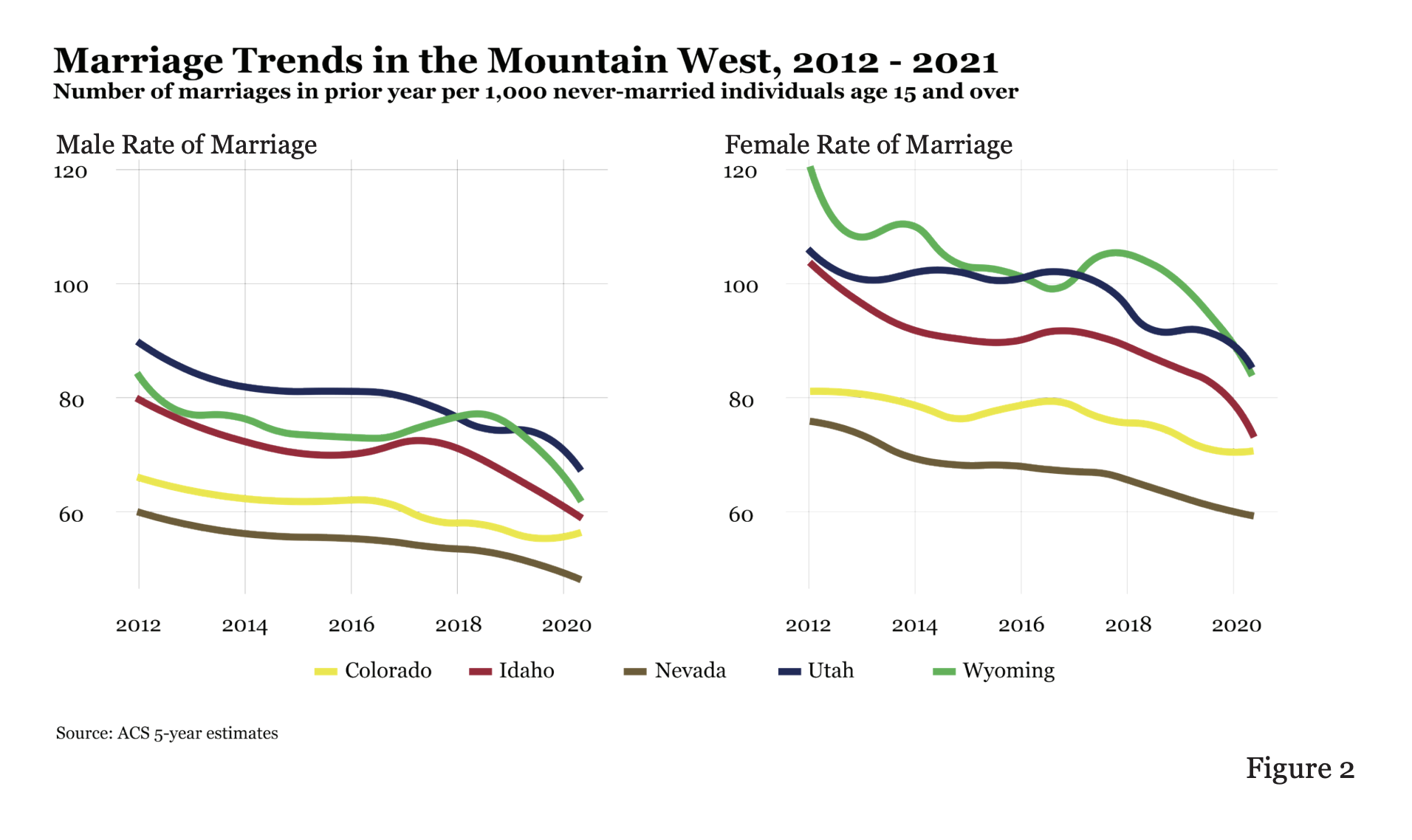
Perhaps most notable for the future, however, is that Utah has not been immune to the national trend of declining marriage rates. Unlike Wyoming and Idaho, which both saw a slight increase in marriage rates during the strong economy of the late 2010s, Utah’s marriage rate ticked steadily down before plunging in the wake of COVID-19.
In 2012, the equivalent of 89 out of every 1,000 never-married males over age 15, and 106 out of every 1,000 females, in Utah would tie the knot. In 2021, those rates were down to 67 males and 84 females getting married per 1,000; notably, the decline predated the shock of the COVID-19 pandemic. The drop in the marriage rate was strongest in Salt Lake and the southern counties and more muted in Utah County.15
In sum, in looking at demographic trends in the state, the historically strong picture for family formation in Utah shows some clouds on the horizon. On the one hand, Utah’s distinctively high commitment to marriage and childbearing is softening at this moment. But at the same time, the state continues to lead the nation in affording children the gift of married parents and maintains its position as a pioneer in making it possible to start and raise a family.
Family Impact Perspective
Marriage Trends in Utah
Utah’s continued progress will depend on sustaining the character of the Utah Family Miracle. To meet that challenge, agencies that analyze policy proposals to help inform public policy debate should adopt a “Family Impact Perspective” where all state laws, regulations and initiatives are assessed by reference to their impact on Utah families.16 Policies that strengthen families would be advanced, whereas those that weaken families would be recommended for further review.
Specifically, the Family Impact Perspective would focus on whether policies:
- Strengthen marriage – measured in terms of both the rate and stability of marriage;
- Encourage couples to have the children they wish to have;
- Make family life affordable for ordinary working families;
- Enable husbands, wives, children, and especially parents to maximize their time with their families; and,
- Increase the quality of family relationships by increasing positive and reducing negative (e.g., domestic violence) interactions in families.
We offer five sets of recommendations designed to sustain the Utah Family Miracle consistent with this Family Impact Perspective.
Five Policy Focus Areas to Strengthen Utah Families
1. Require Reporting by Family Structure
Good family policy depends in part on metrics. You need to measure what is happening in families and how family dynamics are tied to key state outcomes. Such efforts make it possible for policymakers and other key stakeholders across the state – parents; schools; religious, civic and business leaders; and the press – to determine how families are influencing key domains of life across Utah.
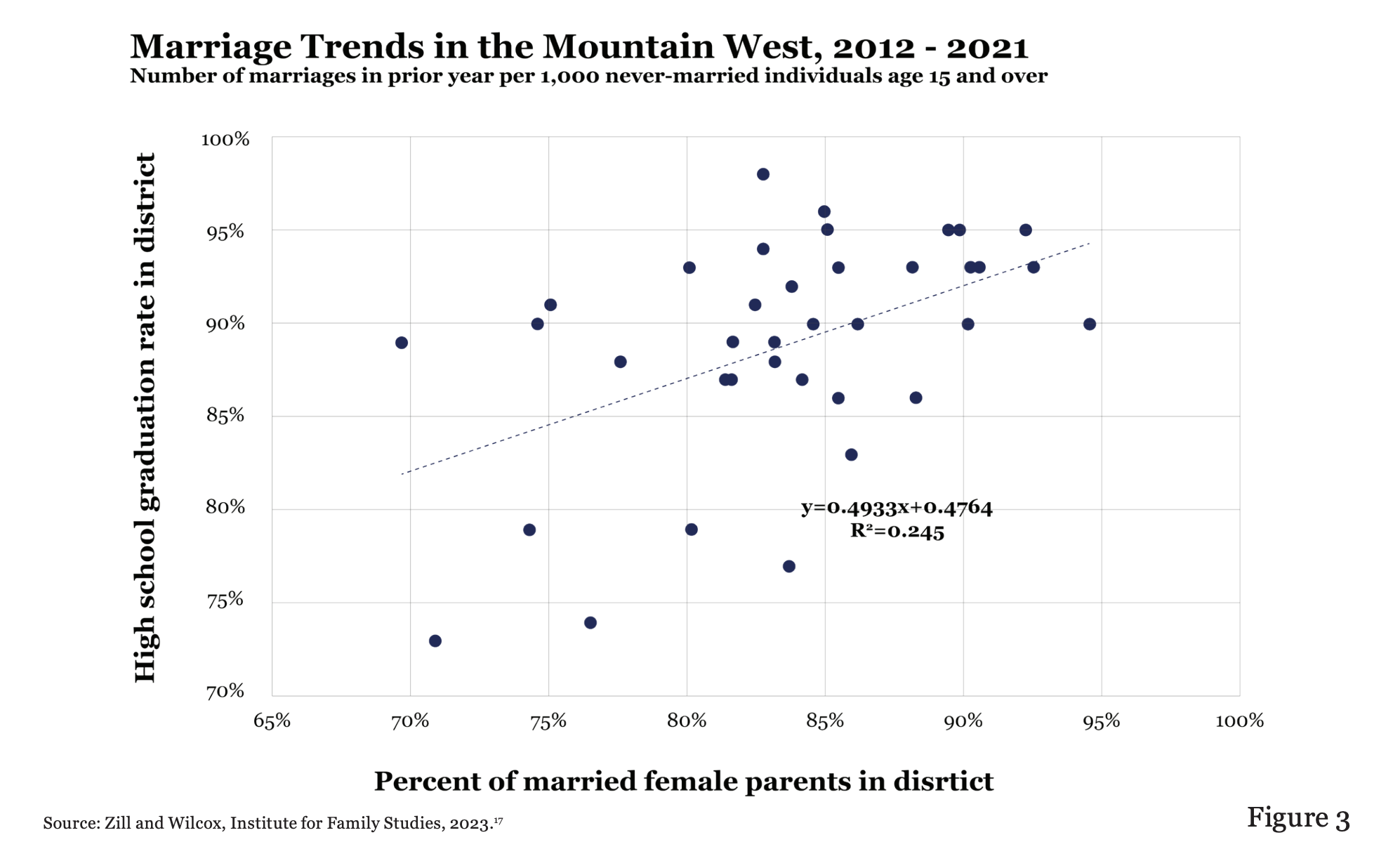
For instance, recent research by psychologist Nicholas Zill indicates that counties across the state that have more married parents have higher rates of high school graduation.18 And child poverty is higher in single-parent families. In Utah alone, 29% of households made up of never-married parents are categorized as in poverty, compared to 5% of married-couple households with children.19
Patterns like these suggest that strong families in Utah boost the educational and economic fortunes of children across the state. But it would be very helpful for the state to track the relationships between family structure and child, adult, and family outcomes across a range of state agencies.
In particular, the State Board of Education (SBOE), Utah Economic Council, Utah Tax Commission, and the Utah departments of Health and Human Services, Public Safety and Workforce Services should release regular information on the ways in which family structure is connected to key outcomes under their purview. They should specifically report:
- How family structure is linked to child outcomes in school, physical and emotional health, poverty, and criminal justice;
- How adult family status is linked to adult outcomes in physical and emotional health, poverty, criminal justice, and labor force attachment;
- How spending on adult, family and child services is linked to family structure; and,
- How tax revenues are linked to adult family status.
Collecting and reporting this data would help policymakers, parents, leaders and journalists understand how strong families are connected to the welfare of children, adults and the state.
2. Incorporate the “Success Sequence” into Public School Curriculum and Premarital Education Across Utah
Growing numbers of young adults across America are moving into adulthood without a durable connection to two core institutions and classic markers of adulthood: work and marriage. This is worrisome because both work and marriage advance the financial, social, and emotional welfare of young adults and any children that they have. One likely reason that young men and women are working and marrying in lower numbers than they once did is that they may not know or sufficiently value how much two factors matter for their welfare: work and marriage – especially marriage prior to having children.20
The science tells us, however, that education, work and marriage are crucial to realizing the American dream and human happiness.21 One path that traverses these three institutions is the “success sequence,” which encourages young adults to (1) get at least a high school degree, (2) work full time in their 20s, and (3) marry before having any children. Although young men and women in Utah are more likely to follow the sequence than their peers across the nation, we are witnessing an erosion of commitment to the latter two steps even in the Beehive State.
In Utah, as in the rest of the U.S., there has been a decline, for instance, in the share of young men engaged in full-time work. The share of men ages 20-40 who worked full time for the whole year fell by four percentage points over two decades, from 91% in 2000 to 87% just prior to the pandemic.22
This is worrisome, in part because young adults who do not follow the success sequence are more likely to experience poverty and less likely to realize the American dream as they move into their late 20s and early 30s. Specifically, young men and women are 60% less likely to be poor if they put marriage before the baby carriage. In addition, 97% of young adults who get at least a high school degree, work full time, and marry before having children avoid poverty in their late 20s and early 30s. And 86% of them reach the middle class or higher at this point in their lives.23
Young men and women deserve to know how much the success sequence matters for their lives – and for the lives of any children they may have. To that end, there are multiple ways the sequence could be incorporated into schools across the state.
Utah school districts could create curriculum modules sharing the statistical outcomes of the success sequence to incorporate as a unit in relevant middle school and high school courses. Alternatively, the SBOE could incorporate a family life standard into curriculum standards – perhaps as part of the required general financial literacy course – that would do three things. It would teach the ways that:
- A high school graduation, full-time work, and having children after marriage are linked to less poverty and greater prosperity for adults;
- Sequencing marriage before parenthood is associated with greater family (and thus financial) stability;
- A stable, married family is linked to better educational, social and emotional outcomes for parents and children, many of which are associated with more positive financial outcomes.
In addition, when couples make a decision to marry, they should be encouraged to invest in premarital education to strengthen the foundation of their marriage and reduce the risk of divorce. Utah has an official policy (Utah Code: 30-1- 30) of encouraging premarital education and/or counseling “to enhance the possibility of couples to achieve more stable, satisfying, and enduring marital and family relationships.” Since 2018, Utah couples have had the option of getting a discount on their marriage license if they invest in at least six hours of premarital education and apply for their marriage license online. Research shows that premarital education can strengthen couple relationship skills and reduce the risk of divorce.24 Accordingly, the Utah Legislature should fund an ongoing media campaign, administered by the Utah Marriage Commission (Title 63M-15), to have engaged couples (a) understand the value of the success sequence for their own financial well-being, (b) appreciate the value of premarital education/ counseling in forging strong marriages, (c) be made aware of available premarital education/counseling resources, and (d) be provided with instructions on how to take advantage of the marriage license discount. The Utah Marriage Commission, as part of its ongoing operations, should make available online premarital education courses that incorporate the success sequence and keep a list for the public of other premarital education/counseling resources in the state.
3. A State Child Allowance
Strong families depend upon strong financial foundations, and parents of young children bear unique financial burdens. From diapers to formula and child care to strollers, parents of young children incur many new expenses at a time when their family’s earnings often drop or become less predictable. To address this, Utah should provide an allowance of $100 per child under 5 per month for working- and middle-class families to help make family life more affordable in the state.
To be eligible for the full benefit, families would meet an earnings threshold of $10,000 in the previous year (adjusted for inflation). The benefit would be half for those with no income and phased in toward the full benefit as earned income rose to $10,000. This child allowance would pay out $100 per month per child under 5 for families with an income of between $10,000 and $100,000 for married couples and between $10,000 and $50,000 for single parents.25 For families with joint child custody, the benefit would be split 50- 50. A back-of-the-envelope calculation suggests the net cost for such an approach would be roughly $170 million.26 To put that figure in context, the 5% compensation increase given to state employees last year was estimated to cost the state $174 million.27
There are a number of advantages to structuring a child allowance along these lines. Because the rising costs of family life have hit working and middle-class families harder than upper-income families, this allowance would target them.28 Because families and children generally do best when a parent is engaged in the labor force,29 this allowance would encourage families to have at least one earner, though widows with small children would be exempt from the income threshold.
These payments would not be intended as a replacement for other policies geared at making child care, energy or groceries more affordable. Instead, a straightforward child allowance like this would allow parents to use those funds to meet the unique needs of their particular financial and family circumstances.
Some might choose to put it toward a children’s museum membership or preschool tuition; others, to pay for day care or to help reimburse a relative for the mileage incurred providing informal child care. The Utah way has always been to empower parents in their capacity to make choices about how to best care for their children, and a child allowance would make more choices financially possible for families with young children.
4. Address Families’ Cost of Living
Policymakers should set a policy goal of supporting parents to feel more financially secure at the end of every month. For most families, the largest monthly chunk from their paycheck goes toward housing, either in the form of a rent check or a mortgage payment. The population boom that Utah has experienced in the last decade, accelerated by the post-COVID reshuffling, has placed upward pressure on house prices.
Since the beginning of 2013, the quarterly house price index for Utah has increased 2 ½ times, as Figure 4 indicates.
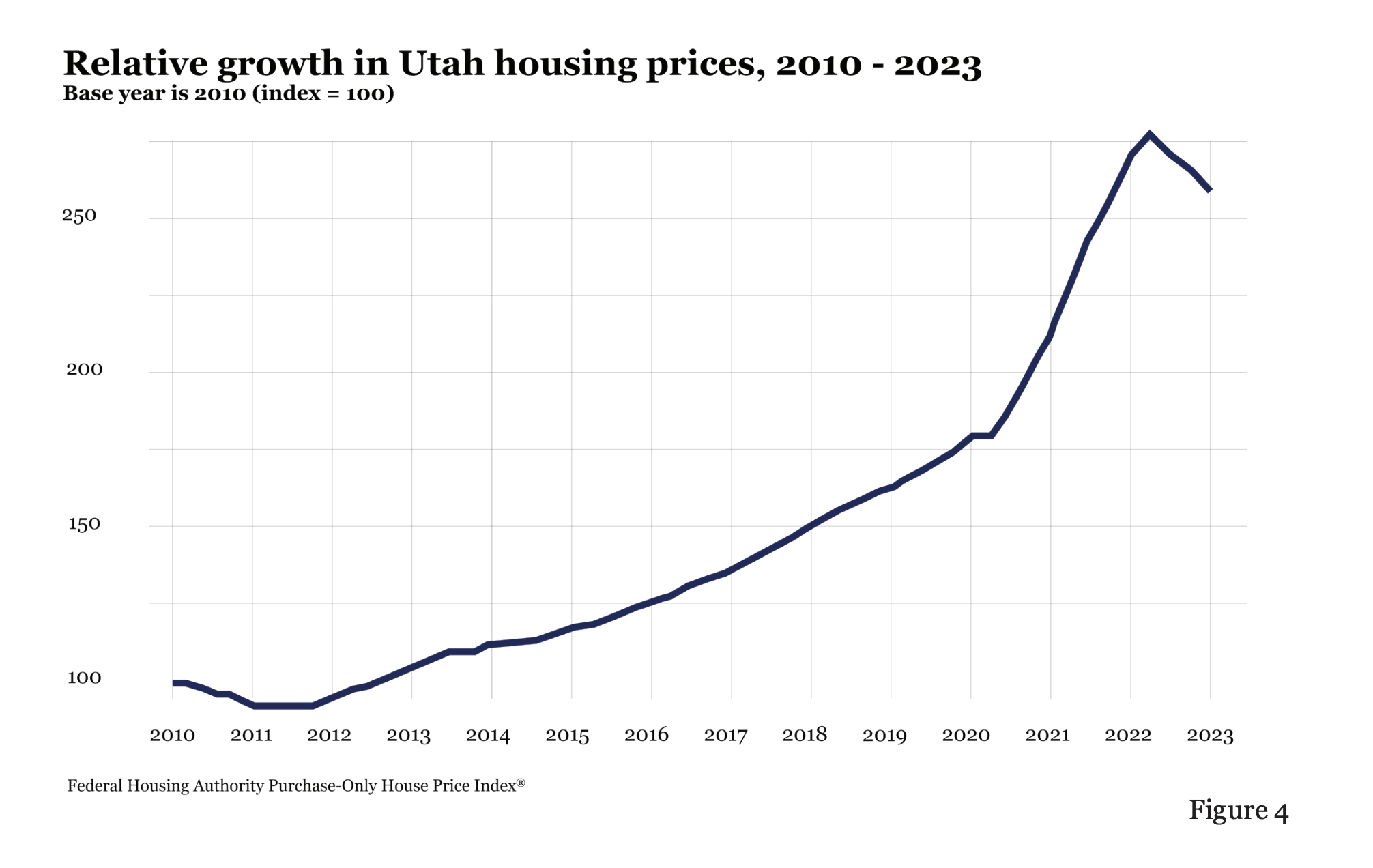
This is a boon for longer-tenured homeowners – they can sell their house for more than they paid for it, in some cases much more. But for renters or couples looking to buy their first home, this upward pressure in house prices can be a significant barrier to family formation, and by extension to the community and societal benefits that the prosperity of those families could generate. And research shows that increases in housing prices have a direct impact on family formation.
A paper by the Federal Reserve’s Lisa Dettling and University of Maryland economist Melissa Kearney found that, on average, a $10,000 increase in a home’s price leads to a 5% increase in fertility rates among owners and a 2.4% decrease among non-owners. If house prices appreciate, owners making mortgage payments feel richer, and apparently more confident to take the plunge and become a parent. Renters, however, see the dream of a down payment getting more and more out of reach as home prices increase, so they feel more financially unstable and less likely to transition into parenthood. More recent work from Australia and Denmark finds similar patterns internationally.30
This dynamic has specific relevance for young parents. When young adults are in their 20s and 30s, their earnings are on an upward trajectory. But high and rising house prices make it more likely that their household finances will benefit by delaying marriage and parenthood until they are closer to their peak earnings potential. A housing market that relies on persistent high prices makes it difficult for young earners, particularly young families, to afford a down payment.
The issue of housing affordability can’t be addressed with a single silver bullet. Conventional affordable housing programs aren’t always pro-family in practice, as many cohabiting couples can be eligible for benefits that they would lose were they to marry. Enabling the market to work more freely, while keeping in mind the reasonable concerns of both current homeowners and developers, would likely lead to the production of more affordable homes for young families.
Utah has already shown a willingness to invest in policies that will meaningfully alleviate the burdens on families. The state became a national leader in expanding educational choices for parents when it created the Utah Fits All scholarship program earlier this year. Starting March 1, 2024, parents will be able to apply for $8,000 of public funding to apply to any non-public school expense, including private schooling, tutoring, microschooling or home-schooling expenses, with priority given to lower-income families. To maintain eligibility, students will be assessed or submit a portfolio of completed work. While all students will be eligible, the initial year of this approach will be limited to around 5,000 students given current appropriation levels.
Utah also maintains a policy of open enrollment in public schools, so students can enroll in the school of their choice, space permitting.31 These proposals should be expanded so that every parent has the ability to choose the school that provides the right educational environment and values for their children.
Other policies could help families afford the cost of living. Utah has been at the forefront of a national movement to make food more affordable by eliminating the state’s tax on groceries. Thanks to a bill passed by the Legislature earlier this year, voters will be asked in 2024 whether to pass an amendment to the Utah Constitution that will end the state’s 1.75% tax on food starting in 2025. (Local food taxes, which are 1.25%, would be untouched by the provision.)
5. Create a State Commission on Men and Boys
Strong labor markets, good marriages, a dynamic economy, and robust social capital all presuppose the ability of young men and women to be formed into adults capable of participating in those institutions. While Utah policymakers should seek to create opportunity and stability for everyone, young men face a number of cultural and economic challenges that merit deliberate attention.
Young men are now less likely to graduate from high school or college than women.32 In 2019, the dropout rate among Utah male high school seniors was 40% higher than for female seniors.33 Men, especially single or divorced men, are more likely to die from suicide or opioid-related causes.34 And these social dynamics are associated with delayed marriage, deferred parenthood, and a rising share of young men35 who are categorized as neither working nor in education or training.36
The cultural and economic factors driving these trends can’t be solved overnight. But a state Commission on Men and Boys would offer a focused, serious effort to rejuvenate policy and cultural efforts aimed at helping young men flourish and become better workers and good family men, and address the risk factors that push too many young men toward a path marked by idleness, drug and alcohol abuse, criminality, and deaths of despair.
The commission would look across the lifespan but focus on young and middle-aged adults who are struggling the most today. It would focus on cultural, educational, job and social supports. Its efforts would include programs to reduce the number of absentee fathers, working with religious and nonprofit organizations to develop outreach efforts to ensure dads have a relationship with their children.
The commission would also catalyze conversations about policy and cultural approaches to ensure young men can embrace a healthy model of masculinity, forge respectful relationships, and avoid abusive behavior in family life, school, college and the workplace. It would review the state’s approach to career and technical education or apprenticeships, allowing more young men the ability to enter the workforce without having to log hundreds of hours in a classroom. And it would spark much-needed conversations about how to catalyze our K-12 education system in ways that engage boys and young men rather than leave too many males on the sidelines.
A Commission on Men and Boys would not come at the expense of women and girls. Rather, it would work alongside the Women in the Economy Commission created by an act of the Legislature in 2014, with the intent to support individual women as contributors to Utah’s culture and economy, protect women’s interests to use their skillsets – paid and unpaid – to support their families, and promote women’s access to and completion of higher education.37
The alarming increase in the educational achievement gap for boys, as well as the increased proportion of men not working full time, merits the creation of a commission focused on the distinct problems facing boys and young men. Such an effort need not draw time or resources away from efforts focused on the welfare of women and girls. Rather, its purpose should be to ensure that boys and young men have the tools they need to contribute to society and become dependable citizens, husbands and fathers.
Conclusion
The Utah Family Miracle has played a signal role in advancing the welfare of the men, women and children of the Beehive State. The strength and stability of the state’s families have played a central role in its emotional and economic success. But Utah is not immune to national trends deemphasizing family life. In recent years, Utah’s distinctive commitment to marriage and children has softened. Sustaining the character of the Utah Family Miracle will depend upon public and private efforts to adopt laws, regulations and initiatives that strengthen families across the Beehive State.
To that end, we recommend adopting a Family Impact Perspective according to which all policies are evaluated as to how they strengthen the rate and stability of marriage, encourage couples to have the children they wish to have, make family life affordable, enable families to maximize the time they spend together, and increase the quality of family relationships.
Consistent with this Family Impact Perspective, we recommend the following policies: require the reporting of family structure by key state agencies to identify how family dynamics are tied to key state outcomes; add the outcomes of following the success sequence to required public school curriculum; create a state family allowance for families with young children; address families’ cost of living; and create a State Commission on Men and Boys to address the distinct problems facing boys and young men that are contributing to reduced educational achievement and workforce participation.
Adopting these measures will help the state renew and revive the Utah Family Miracle, a miracle that has played a central role in fostering Utah’s exceptional successes.
Endnotes:
1. Codella, P., “Utah at Top in Nation for Upward Income Mobility,” Utah.gov Government’s Office of Economic Opportunity (2015).; McKellar, K., “Utah Ranks No. 1 in the Nation for GDP Growth – Despite the Pandemic,” Deseret News (2021); “Rankings: Economy – States with the Best Economies,” U.S. News and World Report (2023).
2. “The Happiest State in the U.S.,” Amerisleep (2021).
3. Mendes, E., “Wellbeing Rankings Reveal State Strengths and Weaknesses,” Gallup (2009).
4. Ethics and Public Policy Center (EPPC) Analysis of American Community Survey 5-year estimates, via IPUMS.
5. “Parents With Coresident Children Under 18, by Living Arrangement, Sex, and Selected Characteristics: 2022,” U.S. Census Bureau (2022).
6. Wilcox, B.W., Price, J., Lerman, R. I., “Strong Families, Prosperous States,” American Enterprise Institute/Institute for Family Studies (2015).
7. Chetty, R., Hendren, N., Kline, P., Saez, E., “Where is the Land of Opportunity? The Geography of Intergenerational Mobility in the United States,” The Quarterly Journal of Economics 129, No. 4 (2014): 1553-1623.
8. Waite, L. J., Gallagher, M., “The Case for Marriage: Why Married People Are Happier, Healthier, and Better Off Financially,” Broadway Books (2001).
9. Finkel, E. J., “The All-or-Nothing Marriage: How the Best Marriages Work,” Dutton (2018); Glenn, N. D., & Weaver, C. N., “The Contribution of Marital Happiness to Global Happiness,” Journal of Marriage and Family 43, No. 1 (1981): 161–168.
10. Glenn, N. D., and Weaver, C. N., “The Contribution of Marital Happiness to Global Happiness,” Journal of Marriage and Family, 43, No. 1 (1981): 161–168.
11. EPPC Analysis of American Community Survey 5-year Estimates, via IPUMS.
12. Kem C. Gardner Institute, “Utah long-term planning projection summary – Washington County,” January 31, 2022, at https://gardner.utah.edu/wp-content/ uploads/Washington-Proj-Feb2022.pdf?x71849.
13. EPPC Analysis of American Community Survey 5-year Estimates, via IPUMS.
14. Ibid.
15. Ibid.
16. Our thinking here is indebted to the work of the Family Impact Institute: “Family Impact Institute: Using Research to Build Better Public Policy for Families,” Purdue University (2021).
17. Zill, N. and B. Wilcox, “More Marriage, Better Educational Outcomes, Even in Utah,” Family Studies (2023).
18. Ibid.
19. EPPC Analysis of American Community Survey 5-year Estimates, via IPUMS.
20. Eberstadt, N., “Men Without Work: Post-Pandemic Edition,” Templeton Press (2022); Collins, L., “Young People’s Attitude Toward Marriage is Changing. Here’s Why It Matters,” Deseret News (2021).
21. “Opportunity, Responsibility, and Security,” AEI Brookings (2015); Brooks, A. C. & Winfrey, O., “Build the Life You Want: The Art and Science of Getting Happier,” Rider (2023).
22. EPPC Analysis of American Community Survey 5-year Estimates, via IPUMS.
23. Wilcox, W. B. and Wang, W., “The Millennial Success Sequence: Marriage, Kids, and the ‘Success Sequence’ Among Young Adults,” American Enterprise Institute/ The Institute for Family Studies (2017).
24. Engl, J., Thurmaier, and Hahlweg, K., “Prevention of divorce: Results of a 25-year follow-up study,” Verhaltenstherapie, 32, 96-106 (2019), https://doi. org/10.1159/000502393; Fawcett, E., Hawkins, A., Blanchard, V., & Carroll, J., “Do premarital education programs really work? A meta-analytic study,” Family Relations, 59, 232–2 (2010), https://doi.org/10.1111/j.1741-3729.2010.00598.x
25. Wilcox, B. and King, W., “After Roe: What Policies Can Help Families and Pregnant Women?” Deseret News (2022).
26. Roughly 47% of households with children under 18 have incomes between $10,000-$100,000 for married couples or $10,000-$50,000 for single-parent households. If we assume 47% of the 296,500 children age 5 and under in Utah would be eligible for the full amount of the allowance, the total cost would be $168 million. Expanding the program to be fully refundable, with an upper threshold of to $60,000 and $120,000, respectively, would put the estimate around $229 million. The new program could be partially offset by rescinding the recent expansion of the exemption for young children, estimated to cost the state $9.6 million.
27. “Budget of the State of Utah and Related Appropriations: Fiscal Years 2023 and 2024,” Executive Appropriations Committee, Utah State Legislature (May 2023), https://le.utah.gov/interim/2023/pdf/00002644.pdf.
28. Sawhill, I. and Reeves, R., A New Contract with the Middle Class – Money (brookings.edu)
29. Jones, L. P., “The effect of unemployment on children and adolescents,” Children and Youth Services Review; but see Heinrich, C.J., “Parents’ Employment and Children’s Wellbeing,” Future of Children.
30. Dettling, L. J. and Kearney M. S., “House Prices and Birth Rates: The Impact of the Real Estate Market on the Decision to Have a Baby,” Journal of Public Economics 110 (2014): 82-100; Atalay, K., Li, A., Whelan, S., “Housing Wealth and Fertility: Australian Evidence,” Economics Working Paper Series (2017); Daysal, N. M., Lovenheim, M., Siersbæk, N., Wasser, D. N., “Home Price, Fertility, and Early-Life Health Outcomes,” Journal of Public Economics 198 (2021).
31. Open Enrollment, R277-437, Utah (2019).
32. Reeves, R. V., Smith, E., “The male college crisis is not just in enrollment, but completion.” Brookings (2021).
33. “Utah 2020 Graduation Rates,” Utah State Board of Education (2021).
34. Brown, P. T., “Opioids and the Unattached Male,” City Journal (2022).
35. Lee, M., “Inactive, Disconnected, and Ailing: A Portrait of Prime-Age Men Out of the Labor Force,” Social Capital Project (2018).
36. Eberstadt, N. N., “Men Without Work,” Templeton Press (2022).
37. “Women in the Economy Commission,” Utah.gov Governor’s Office of Economic Opportunity (2022).
About the Authors:
Brad Wilcox, a visiting scholar at the Sutherland Institute, is a professor of sociology at the University of Virginia, director of the National Marriage Project, and the Future of Freedom Fellow at the Institute for Family Studies.
Jenet Erickson is an associate professor at Brigham Young University and a research fellow of the Wheatley Institute and Institute of Family Studies.
Patrick T. Brown is a fellow at the Ethics and Public Policy Center and a former staff member for Congress’ Joint Economic Committee under then-chairman Sen. Mike Lee.