ABOUT THE DATA
Findings in this report are based on two main data sources: the American Time Use Survey (for fathers who live with their children) and the National Survey for Family Growth (for fathers who live apart from their children).
American Time Use Survey (ATUS): Launched in 2003 by the Bureau of Labor Statistics, the ATUS provides nationally representative estimates of how Americans spend their time. It is the nation’s largest survey on time use and the only federal survey providing such data.
Different from the standard survey questions that ask people to estimate how much time they spend doing different activities, time use surveys (also called “time diaries”) record respondents’ activities sequentially, including the starting and ending times for each, over a specific period (usually 24 hours). This approach helps to reduce the social desirability bias given that respondents who complete the diaries have no reason to think certain times (e.g., their time with children) would be a focus of data analysis. Also, the time respondents spend in all activities must add up to 24 hours, which minimizes opportunities certain activities may be overestimated.
The ATUS sample is drawn from the Current Population Survey (CPS). The ATUS interviews randomly selected individuals ages 15 or older from a subset of the households that complete their eighth and last interview from the CPS. Interviews are conducted over computer-assisted telephone interviews (CATI). For more information on the ATUS methodology, see http://www.bls.gov/tus/atususersguide.pdf.
For analyses in this report, ATUS data from 2021 to 2022 were pooled to increase the sample sizes for fathers in different types of families. The sample size for fathers ages 18+ with children under age 18 at home is 3,096 in 2003 and 2,027 in the combined data of 2021 and 2022. The data are weighted to adjust for nonresponse, oversampling and the weekend and weekday distribution.
National Survey for Family Growth (NSFG): The NSFG has been collecting data on pregnancy and births, marriage and cohabitation, and other aspects of family growth since 1973. It was originally designed to focus on women of childbearing age but started to include men in 2002 and has expanded the age range for both women and men from 15-44 to 15-49 since 2015. The NSFG samples are designed to be nationally representative of the age groups, and the interviews are conducted in person, with questions of sensitive nature answered privately via self-administration. For more information on NSFG data, see https://www.cdc.gov/nchs/nsfg.
Executive Summary
American fathers are more involved in their children’s lives than ever. Fathers in America now spend an average of 7.8 hours per week taking care of their children at home, up by 1 hour per week in just about two decades. (Mothers’ child care time remains stable during this period.) However, this rise in fathers’ parenting time does not apply to all dads. New time diary data from the federal government show that fathers whose time with their children has increased the most in the past two decades are college-educated, partnered, white, or Asian.
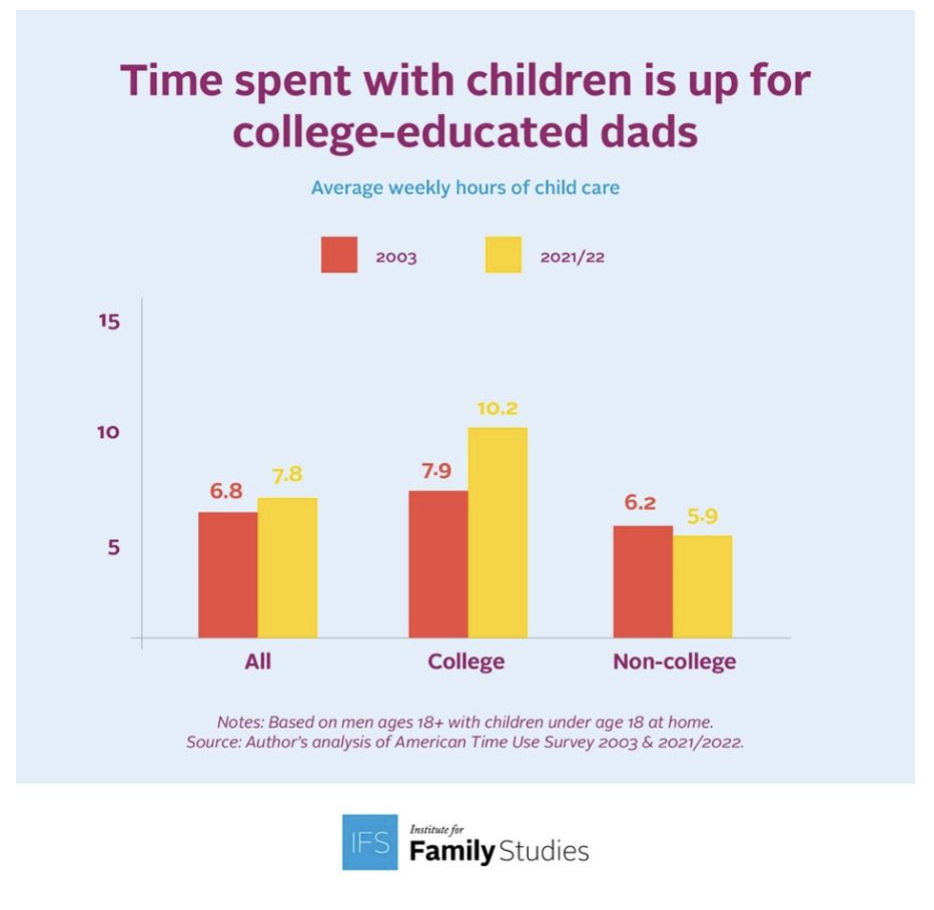
College-educated fathers with children under age 18 at home now spend an average of 10 hours, 12 minutes a week on child care, up by more than 2 hours a week since 2003. At the same time, married fathers’ time with their children increased from 6.8 hours a week in 2003 to 8 hours a week in 2021/2022. 1 (Cohabiting fathers’ time is up from an average of 5.1 hours to 6.7 hours a week.) Finally, child care time rose by about 1.8 hours per week for white fathers, and 2 hours per week for Asian fathers in the past two decades.
On the other hand, parenting time has been stagnant or even in decline for other dads. Fathers without a college degree now spend an average of 5.9 hours a week doing child care activities, down from 6.2 hours per week in 2003. Hispanic fathers’ time with their children decreased by about 1.2 hours per week in the past two decades. There is a small increase in child care time for black fathers since 2003, by about 20 minutes per week. There is barely any change in single fathers’ time with their children during the same period.
With these trends in place, the gap in fathers’ parenting time has widened by fathers’ education, marital status, and race/ethnicity. For example, college-educated fathers now spend almost twice the amount of time with their children as fathers without a college degree (10.2 hours per week vs. 5.9 hours per week). Back in 2003, the child care time difference between the two groups of fathers was less than 2 hours (7.9 hours vs. 6.2 hours per week).
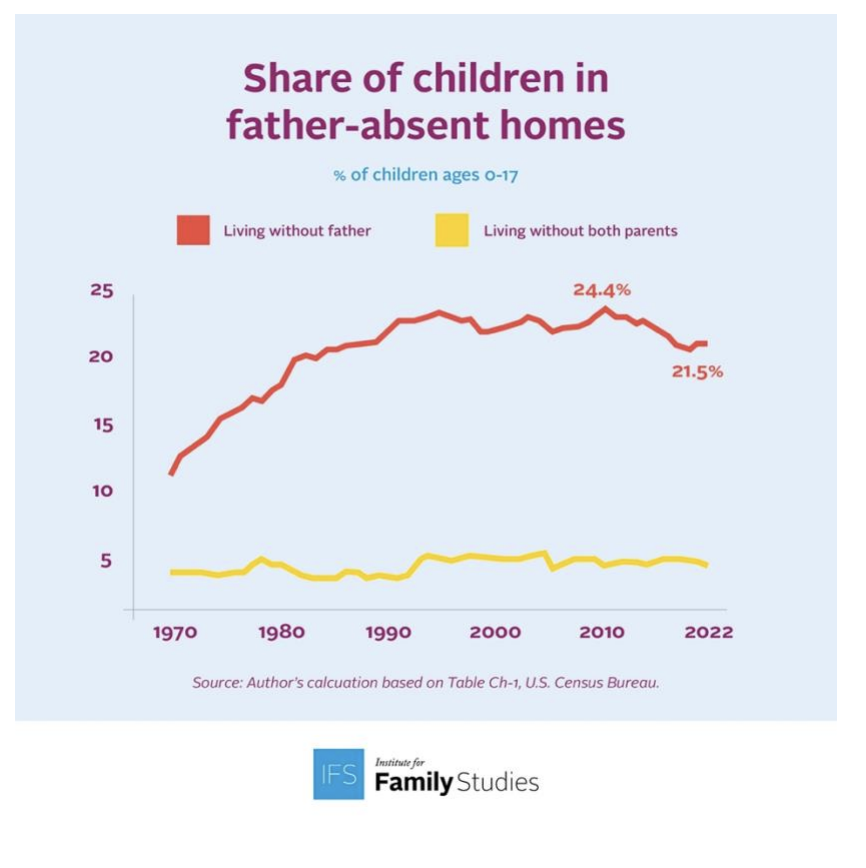
Another recent trend for fathers and children in America involves a modest decline in the number of children living in father-absent homes. Over the past decade, the number of children under age 18 who lived without a father or both parents decreased from 20.6 million in 2012 to 18.4 million in 2022, according to data from the U.S. Census Bureau. The share of children living without a father (but with a single mother) dropped from 24.4% to 21.5 % between 2012 and 2022. The share of children who live without both parents remained stable, but the share living with both parents increased from 68% to 70% during the same period.
Likewise, the share of fathers who live apart from their children also experienced a slight decrease. Some 27% of fathers had (at least) one child under age 18 who didn’t live with them in 2006-2008; the share is down to 23% in 2017- 2019, according to other federal data collected by the National Center for Health Statistics.2
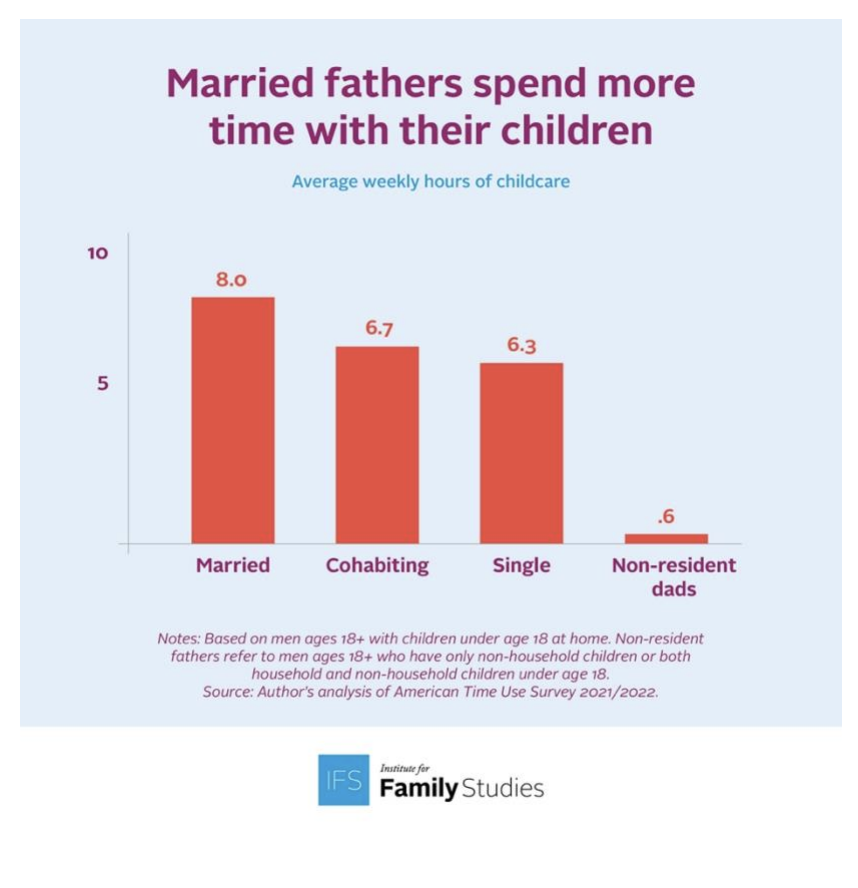
The time non-resident fathers spend with their children is only a fraction of that spent by residential fathers. Time diary data suggest that non-resident fathers spent an average of 0.6 hours (36 mins) per week with their children in 2021/2022, compared with 7.8 hours per week for fathers who live with their children. Estimates from a traditional survey asking about frequencies of specific activities of fathers with their children also suggest that fathers who live with their children are more involved in their children’s lives than non-resident fathers.3
Whether or not fathers live apart from their children has a lot to do with fathers’ marital status. The majority of never-married fathers (61%) as well as divorced fathers (53%) live separately from their children, compared with 36% of cohabiting fathers and only 11% of married fathers.
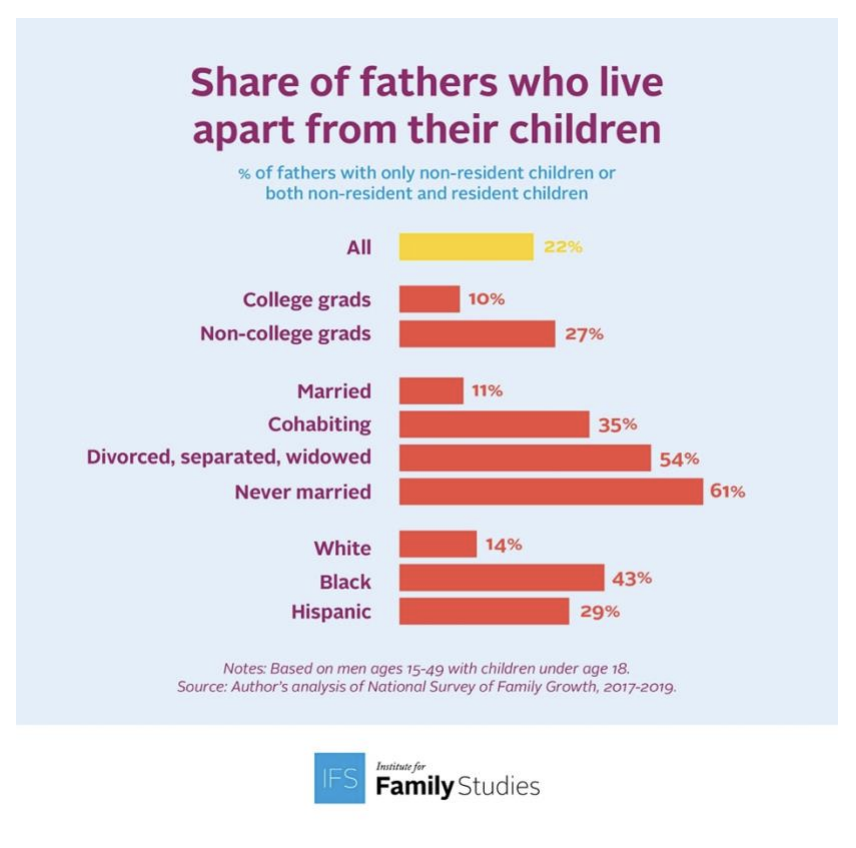
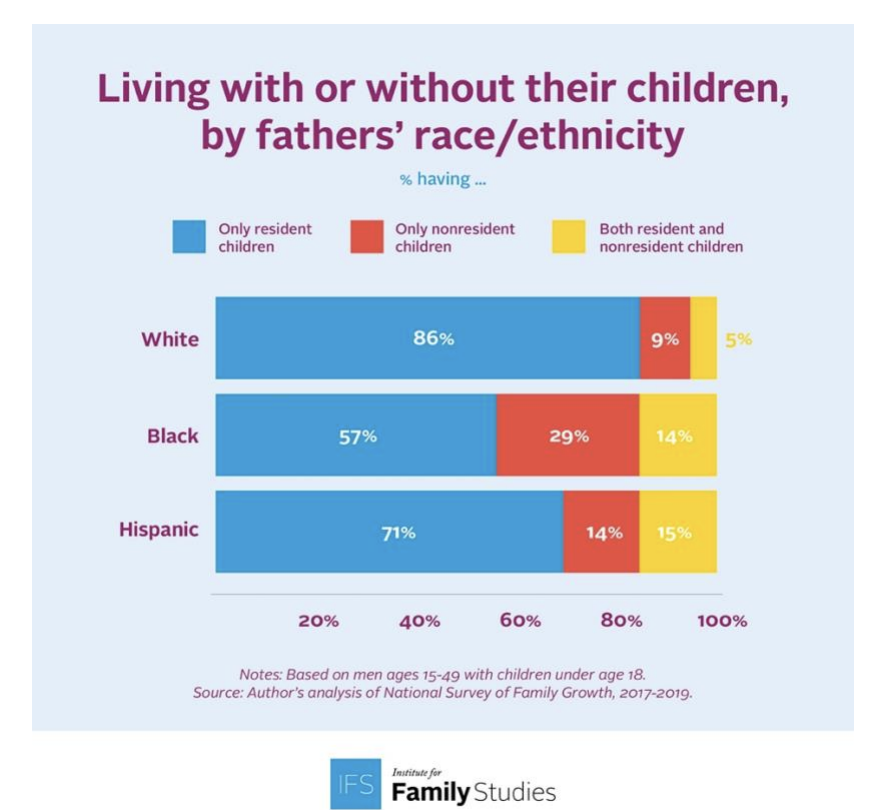
Fathers’ educational level and race/ethnicity are also linked to the likelihood of living apart from their children. Fathers without a college degree are three times more likely than college-educated fathers to live apart from their children (27% vs. 10%). Black fathers are much more likely to have nonresident children than white fathers (43% vs. 14%), and the share of non-resident Hispanic fathers is in the middle (29%).
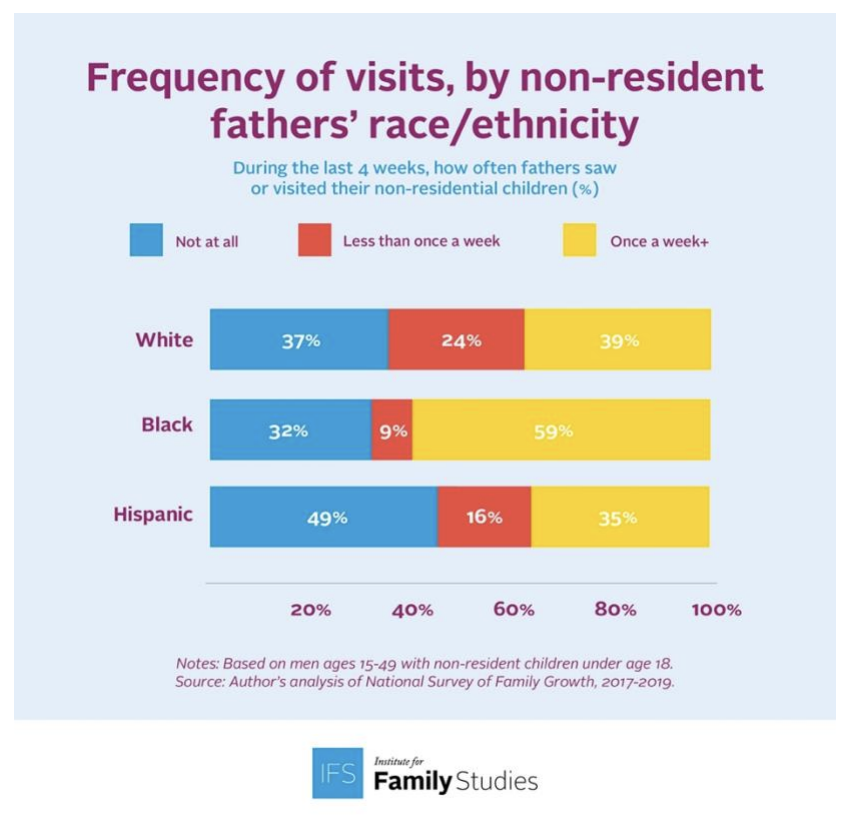
Overall, 44% of nonresident fathers reported that they saw or visited their children regularly in the past month (at least once a week). Black non-resident fathers (59%) are more likely than white (39%) or Hispanic fathers (35%) to see their children regularly. College educated fathers are also more engaged with their non-resident children than noncollege educated fathers (56% vs. 42%).
In contrast, fathers who are currently married or living with a partner are less likely than fathers who are either divorced or never married to see their non-resident children on a regular basis. This may be linked to their relationship with their nonresident children’s mother as well as to their responsibilities to their new family. In fact, currently married or cohabiting fathers who have non-resident children are less likely than their never-married or divorced peers to say that they and their (nonresident) children’s mother are a good parenting team. In addition, married or cohabiting non-resident fathers are more likely than never-married or divorced nonresident fathers also to have children who live at home with them, which splits their time and attention in parenting.
Among the other key findings:
- The child care gap between college and non-college educated fathers is more pronounced in interactive activities such as playing, talking, and reading to children as well as activities related to children’s basic needs (e.g., diapering and feeding). College-educated fathers spend an average of 4.2 hours per week in interactive activities, compared with 2.6 hours per week for fathers without a college degree. Their time taking care of children’s physical needs is also significantly higher than their peers without a college degree (3.7 hours per week vs. 1.9 hours per week).
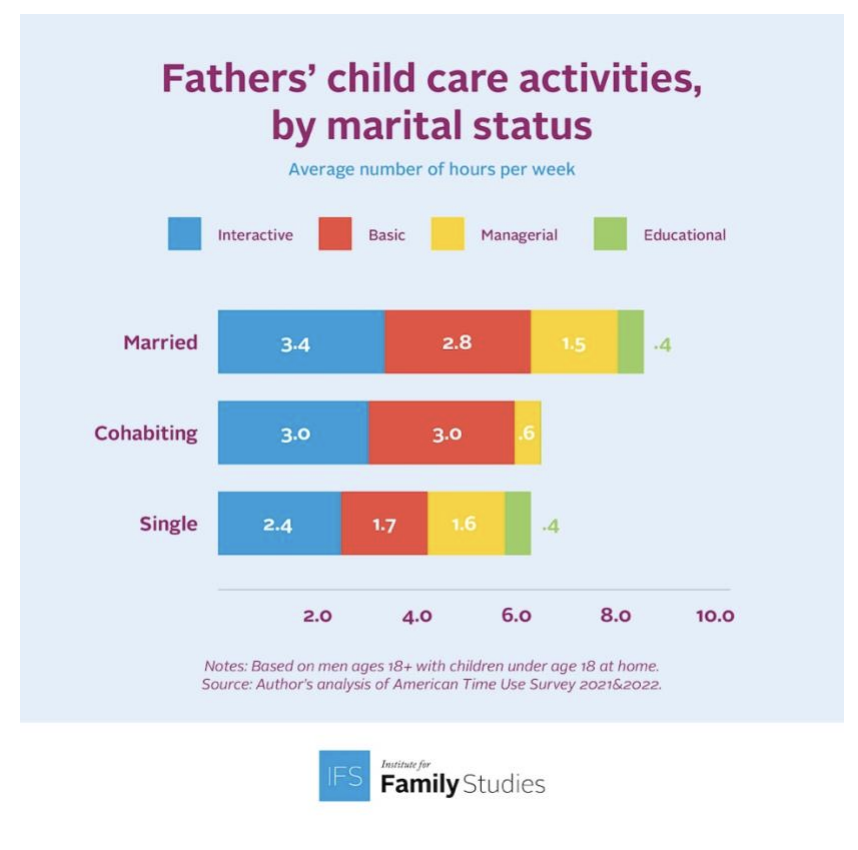
- Married fathers spend twice as much time in managerial child care activities, such as planning activities and picking up/dropping off their children, than cohabiting fathers (1.5 hours per week vs. 0.6 hours per week). In addition, married fathers also spend more time than cohabiting fathers helping with their children’s homework or other school activities.
- Asian fathers spend more time in all child care activities than do other fathers, especially in basic child care activities. Asian fathers spend an average of 4.7 hours per week taking care of their children’s basic needs, compared with 2.8 hours per week for white fathers, 2.3 hours per week for black fathers, and 1.9 hours per week for Hispanic fathers.
- More than 7-in-10 non-resident fathers reported paying child support on a regular basis. College-educated, married, or divorced non-resident fathers are more likely than other non-resident fathers to pay child support on a regular basis. Non-resident fathers of different races and ethnicities are about equally likely to pay child support.
- The combined data of resident and non-resident fathers show that collegeeducated dads and married dads are more likely to be highly involved, with about 90% of dads in each of these two groups seeing their children daily. In contrast, only half of never-married fathers see their children at least once a day.
Growing Divide in Child Care Time Among Resident Fathers
American fathers have become much more involved in their children’s lives in recent years. Fathers in America now spend an average of 7.8 hours per week taking care of their children at home, up by 1 hour per week in just about two decades. Compared with fathers’ childcare time in the 1960s (2.5 hours per week), fathers’ time in child care activities has more than tripled.4
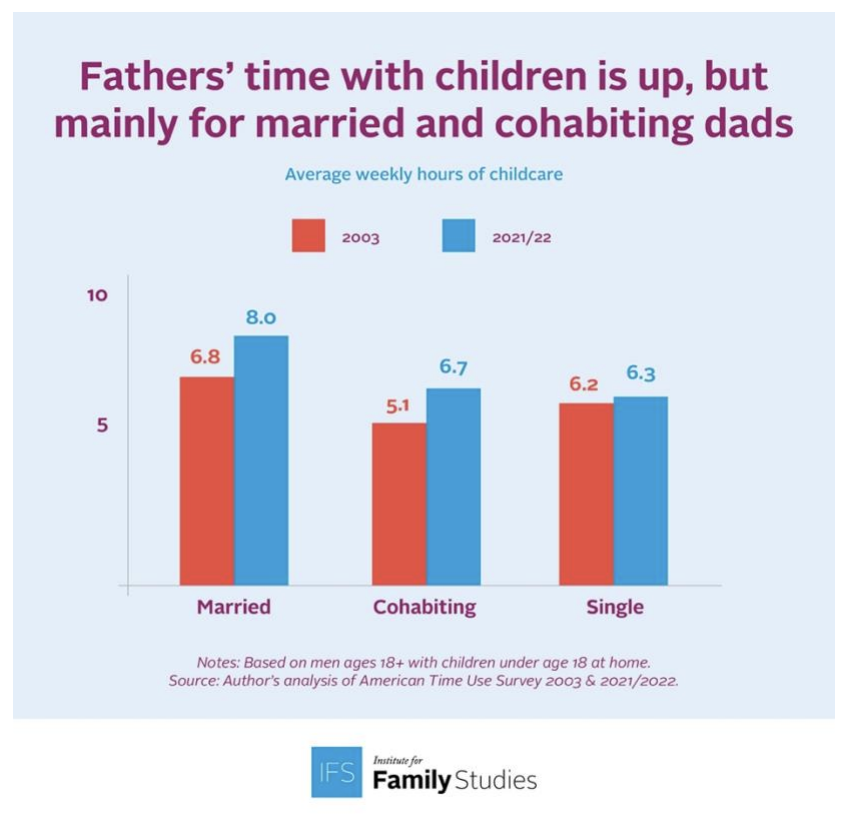
However, the rise of fathers’ parenting time in the past two decades is uneven across different groups. The group of fathers with the most gain in their time with children are collegeeducated, partnered, white, or Asian dads. In contrast, parenting time has been in decline for fathers without a college degree and Hispanic fathers.
College-educated fathers with children under age 18 at home now spend an average of 10 hours and 12 minutes a week taking care of their children, up by more than 2 hours a week since 2003. However, fathers without a college degree now only spend an average of 5.9 hours a week doing child care activities, down from 6.2 hours a week in 2003. As a result, the gap in child care time between college-educated fathers and those without a college degree is widening, and college-educated fathers now spend almost twice the amount of time with their children as fathers without a college degree (10.2 hours per week vs. 5.9 hours).
Among fathers who live in different family settings, married fathers spend the most amount of time taking care of their children. Married fathers spend an average of 8 hours per week on child care activities, compared with 6.7 hours per week for cohabiting fathers and 6.3 hours per week for single fathers. It is worth noting that there has also been a significant increase in child care time among cohabiting fathers in the past two decades, but the gap between married fathers and cohabiting fathers remains large (see Appendix).
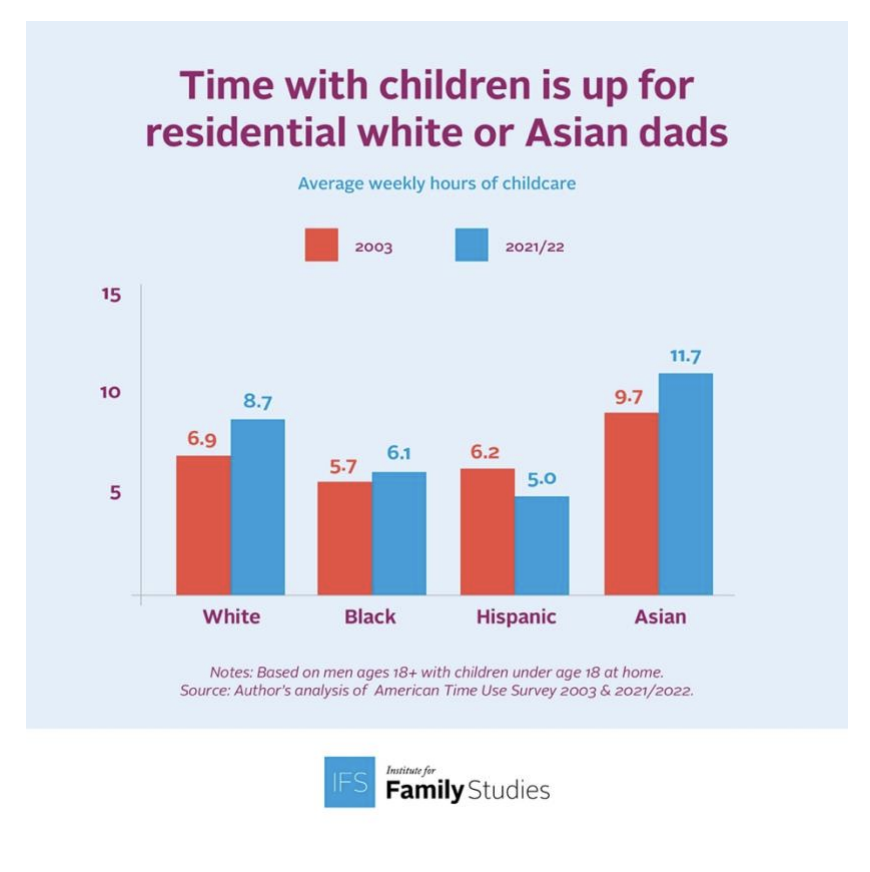
Child care time also varies by fathers’ racial and ethnic background. Asian or white fathers generally spend more time than black or Hispanic fathers caring for their children. This gap has also grown over the past two decades. Since 2003, child care time has increased by about 1.8 hours per week for white fathers and 2 hours per week for Asian fathers. But the change is much smaller (up by 24 minutes per week) for black fathers and is negative for Hispanic fathers (down by 1 hour, 12 minutes per week).
Overall, Asian fathers now spend nearly 12 hours per week on child care, followed by about 9 hours per week for white fathers. Child care time for black or Hispanic fathers is lower, at around 6 hours and 5 hours per week, respectively (see Appendix for details).
How Fathers Spend Their Time With Children
Child care encompasses a wide range of activities from basic care (e.g., diapering and feeding), to interactive care (such as talking, reading, playing), to educational involvement (such as helping with homework or attending school meetings). In addition, the time parents spend managing their children’s lives – planning activities, dropping them off and picking them up – is also considered as child care time.5
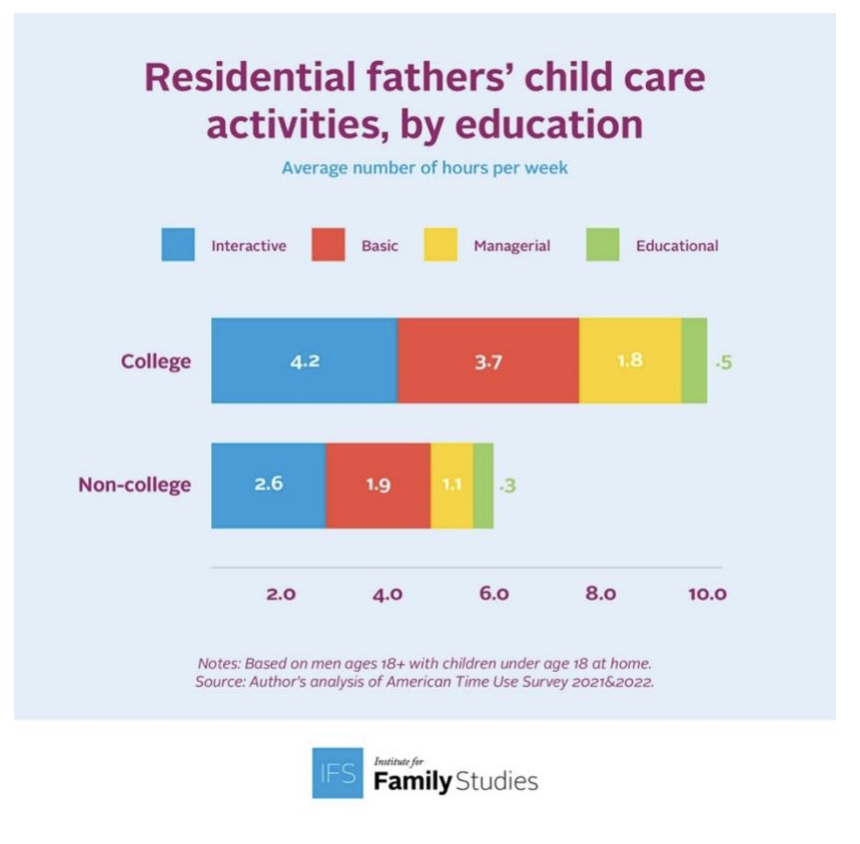
The gap in child care time between college-educated and non-college-educated dads is more pronounced in interactive activities and basic care activities. College-educated fathers spend an average of 4.2 hours per week in interactive activities— which includes reading, talking or listening to children, and playing games or sports with children—compared with 2.6 hours per week for fathers without a college degree. They also spend significantly more time taking care of children’s basic needs than do their peers without a college degree (3.7 hours vs. 1.9 hours per week).
Compared with single fathers, married or cohabiting fathers spend much more time on activities that are either interactive or related to children’s basic needs. The child care difference between married fathers and cohabiting fathers is mainly in managerial or educational activities. Married fathers spend twice as much time in planning activities and picking up/dropping off their children compared to cohabiting fathers (1.5 hours per week vs. 0.6 hours per week). In addition, married fathers also spend a short amount of time helping with their children’s homework or other school activities, something on which cohabiting fathers generally spend minimum time6 (see Appendix).
Looking into child care activities by fathers’ race/ethnicity, we see that the biggest difference between Asian fathers and white fathers is in basic child care activities. Asian fathers spend an average of 4.7 hours per week taking care of their children’s basic needs, such as dressing/bathing, feeding, or getting children ready for bed, which is 2 hours more per week than the time white fathers spend on these activities (2.8 hours per week). Asian fathers also spend 0.8 hours (about 50 mins) per week on activities related to their children’s schooling, while white fathers spend 0.3 hours (about 20 minutes) per week on the same activities.
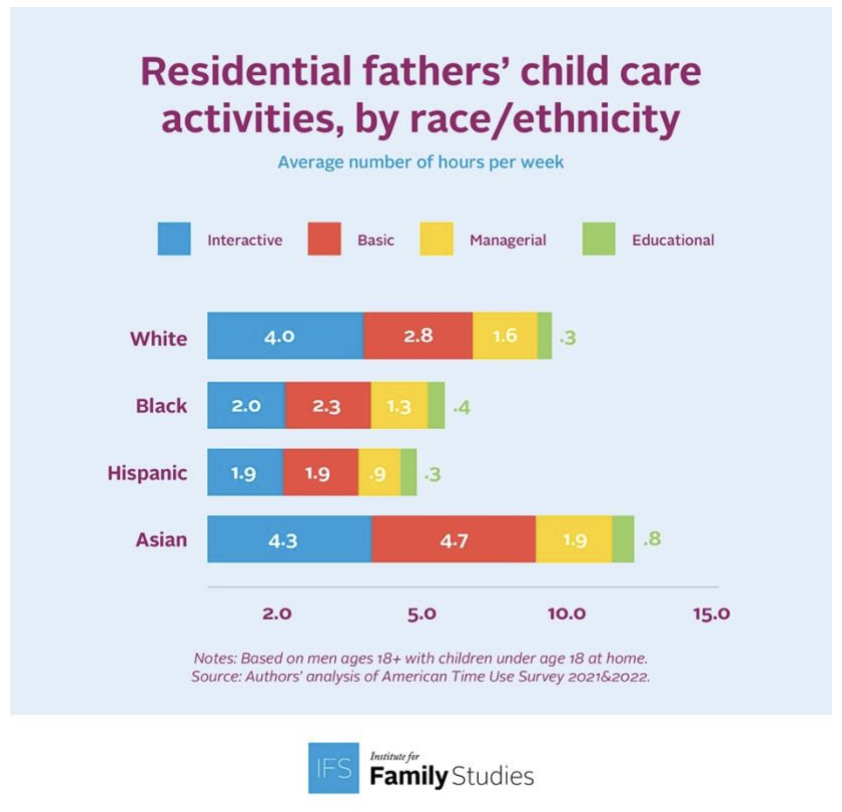
Black fathers and Hispanic fathers spend significantly less time than Asian or White fathers on interactive or basic care activities. These two groups of fathers are similar in the way of allocating their children’s time, with the exception that black fathers spend a little bit more time (about 20 mins more per week) on basic child care activities, as well as on managerial care activities, than Hispanic fathers.
Fathers Who Live Apart From Their Children
The share of American children who lived in a father-absent home reached its peak about 10 years ago, and it has been on a modest decline since. Still, about 1-in-5 children today live in homes without their fathers.
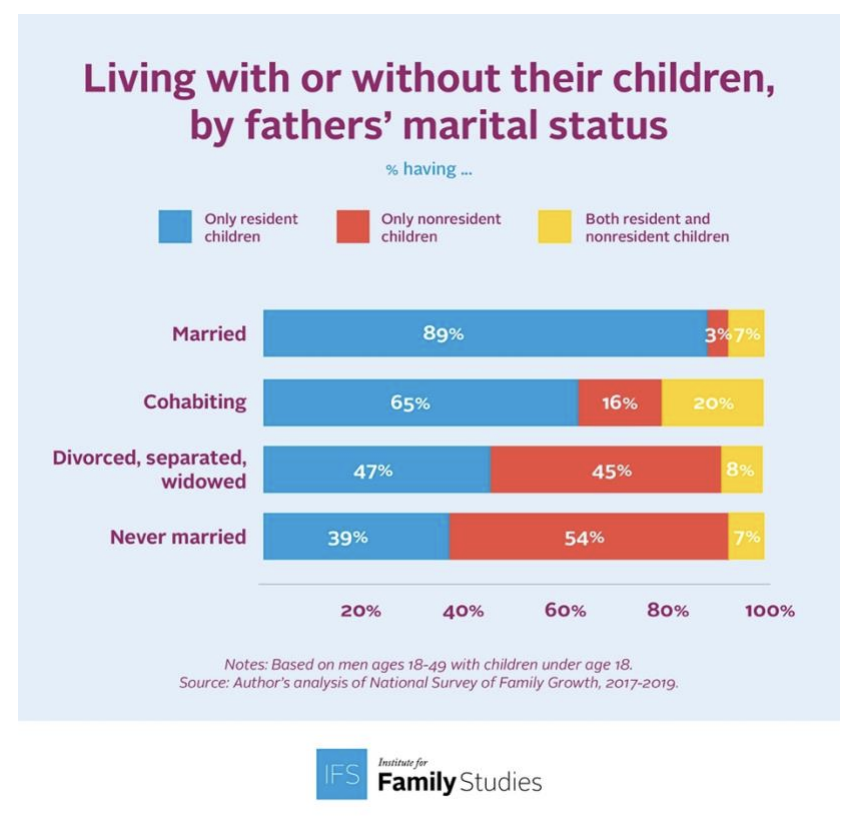
Overall, 22% fathers reported having children under age 18 who don’t live with them, according to the latest data from National Survey of Family Growth.7 A father’s marital status is highly associated with the chance that he lives with his children. Nearly 90% of married fathers live with their children, with only 3% having only non-resident children and 7% having both resident and nonresident children. On the other end, only about 40% of never-married fathers live with their children. A majority of never-married fathers live apart from either all (54%) or at least one of their children (7%). Cohabiting fathers and divorced fathers fall in the middle, but cohabiting fathers are more likely than other fathers to have both resident and non-resident children. About 1-in-5 cohabiting fathers are in this situation.
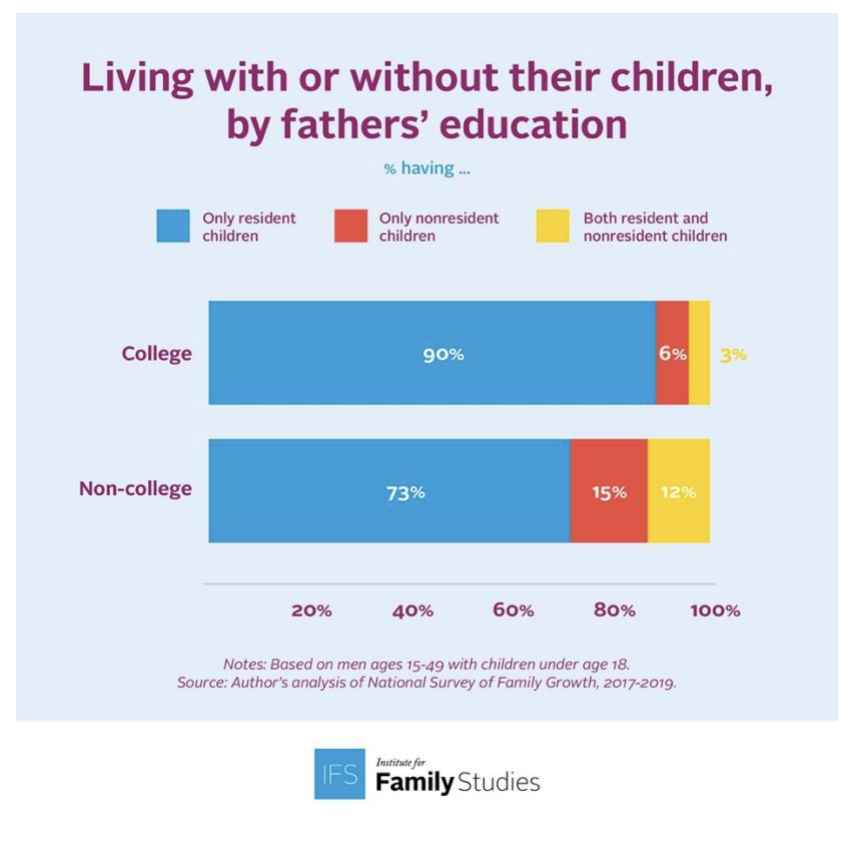
A father’s educational level is also linked to the chance of living apart from his children. Fathers without a college degree are three times more likely than collegeeducated fathers (27% vs. 9%) to live apart from either one or all of their children (see more details in Appendix).
Compared with white fathers, black fathers are much more likely to live apart from their children. About 4-in-10 black fathers live apart from their children (29% have only non-resident children and 14% have both resident and non-resident children). In comparison, 14% of white fathers have children who do not live with them. The share of Hispanic fathers who live apart from their children falls in the middle at 29%8 (see Appendix).
Child Support, Visitation, Relationship With Children’s Mother
There are many unique challenges for non-resident fathers who want to maintain a close relationship with their children. Non-resident fathers’ parenting tasks often include financial support, visits, as well as being part of a good parenting team with their children’s mother.
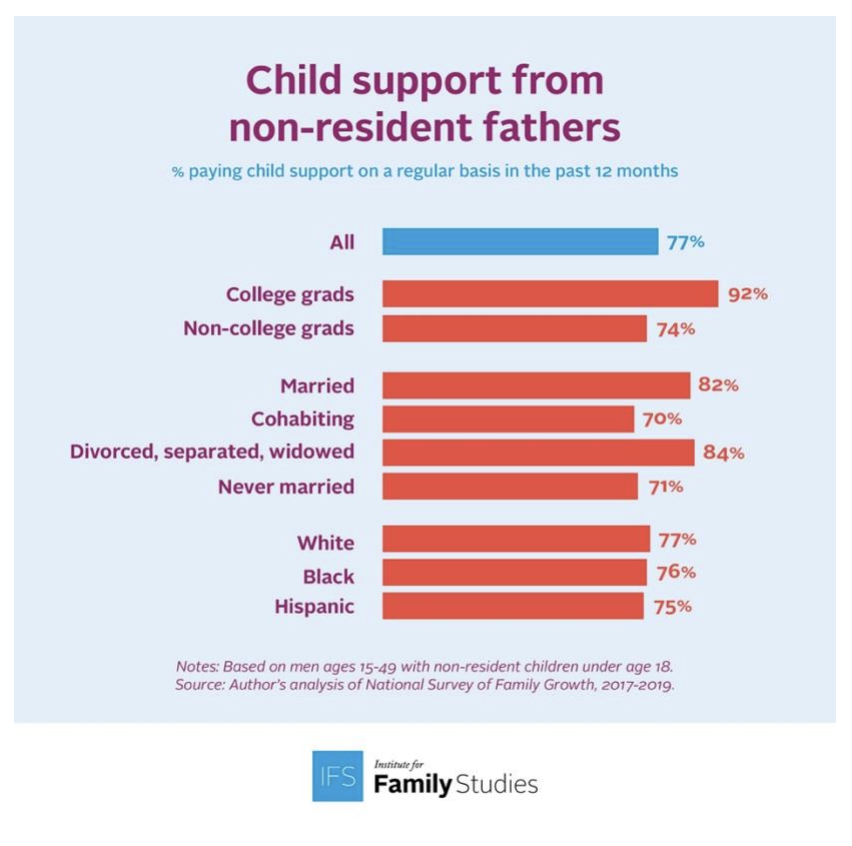
A majority of fathers (77%) who live apart from their children pay child support on a regular basis.9 Collegeeducated non-resident dads are more likely to do so than their non-collegeeducated peers (92% vs. 74%).
The marital status of fathers also makes a difference. Currently married fathers as well as divorced fathers are more likely than cohabiting or never-married fathers to pay regular child support to their children who live apart from them.
The racial difference in child support is small. Black non-resident fathers are about equally likely to pay child support on a regular basis as white or Hispanic fathers. When it comes to time with their children, 44% of non-resident dads reported that they saw or visited their children at least once a week in the last 4 weeks.10 Another 17% of fathers saw their non-resident children less often than that, and 39% of fathers reported they didn’t see their non-resident children at all in the past 4 weeks.
Never-married fathers and divorced fathers are more likely than partnered fathers to see their non-resident children on a regular basis. More than 6-in-10 fathers in these two groups saw their non-resident children at least once a week in the past 4 weeks, compared with only about 3-in-10 married or cohabiting fathers. On the other hand, about half of married fathers (51%) and 47% of cohabiting fathers didn’t see their non-resident children at all in the past 4 weeks, compared with about a quarter of never-married or divorced fathers.
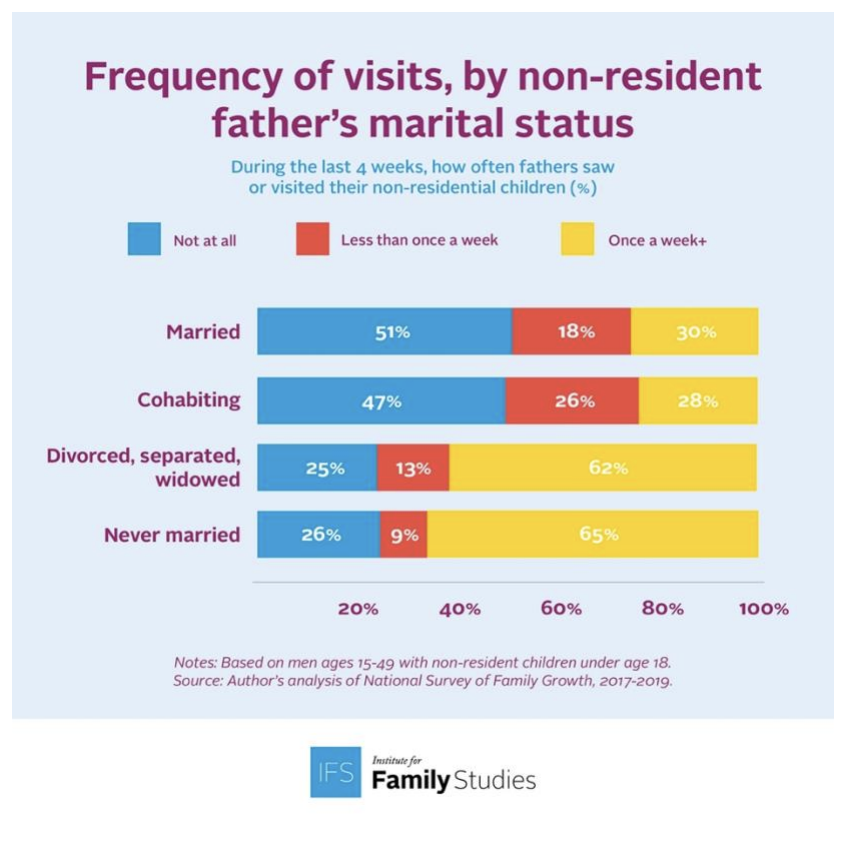
A possible reason may be that married and cohabiting non-resident fathers are more likely to also have children who live at home with them, which splits their time and attention in parenting. Specifically, 69% of married non-resident fathers also have children living at home, and the share is 56% for nonresident fathers who are currently living with a partner. In contrast, only 12% of non-resident fathers who have never married and 15% of divorced nonresident dads also have children who live with them.
Black fathers who live apart from their children are more likely than other fathers to see their non-resident children regularly. Nearly 60% of black fathers who live apart from their children reported that they saw their kids at least once a week in the past 4 weeks, compared with 39% of white fathers and 35% of Hispanic fathers. At the same time, non-resident Hispanic fathers are the least likely to see their children on a regular basis. About half reported that they didn’t see their kids at all in the past month, and the share is 37% for non-resident white fathers and 32% for non-resident black fathers.
College-educated fathers who live apart from their children are more likely than their peers with less education to see their children regularly. More than half of collegeeducated non-resident dads (56%) saw their children at least once a week in the past month, compared with 42% of non-college educated dads. And the share of collegeeducated non-resident fathers who didn’t see their children at all is also lower than that of non-college educated dads (31% vs. 40%).
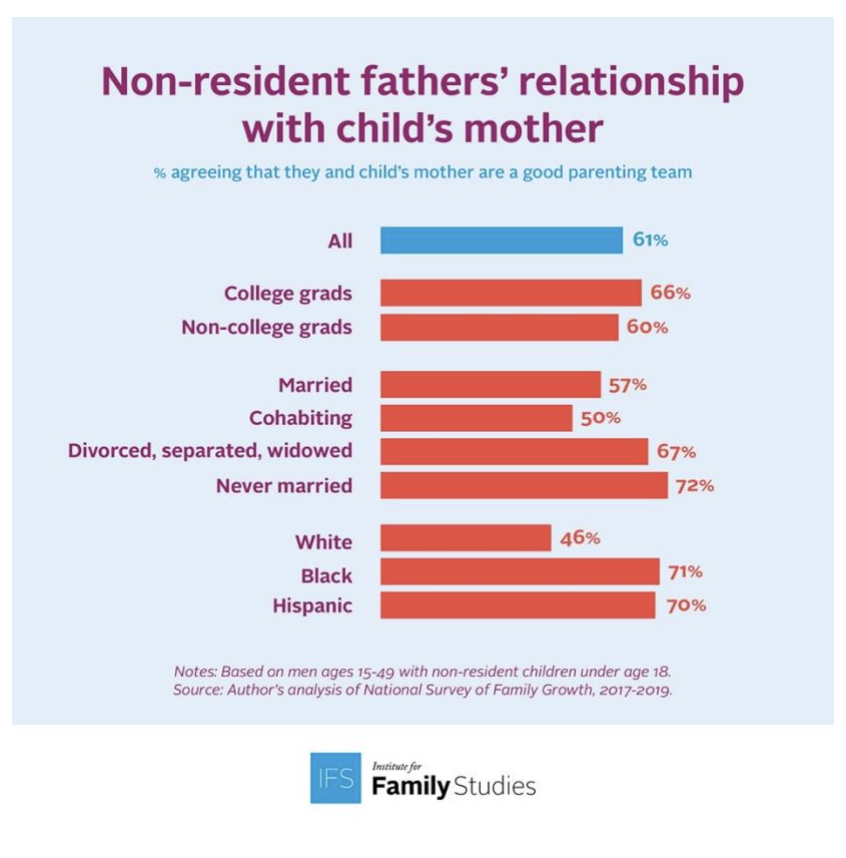
Another unique challenge for non-resident fathers involves coparenting with the child(ren)’s mother who resides with the children and takes primary responsibility for their daily lives. A mother in this situation could act as a “gate-keeper” and affect the relationship between a child and his or her nonresident dad. According to data from NSFG, some 61% of non-resident fathers agree that they and their child’s mother are a good parenting team, 18% are not sure, and 20% disagree.
Divorced or never-married non-resident fathers are more likely than their partnered peers to say that they are on good terms with their children’s mother when it comes to parenting. More than 7- in10 never-married fathers (72%) say so, compared with only 50% of cohabiting fathers and 57% of married fathers. Black or Hispanic non-resident fathers are more likely than non-resident white fathers to say that they and their children’s mother are a good parenting team.
Sidebar: All Fathers’ Involvement With Their Children (Resident and Non-Resident Combined)
Because of the unique challenges non-resident fathers face, comparing the level of involvement between resident and non-resident fathers can be difficult. For fathers who live with their children, seeing their children is expected, whereas for nonresident fathers, it is often a scheduled activity and not guaranteed. Indeed, the question regarding the frequency of seeing their children was only asked of nonresident fathers, but not of resident fathers in NSFG.
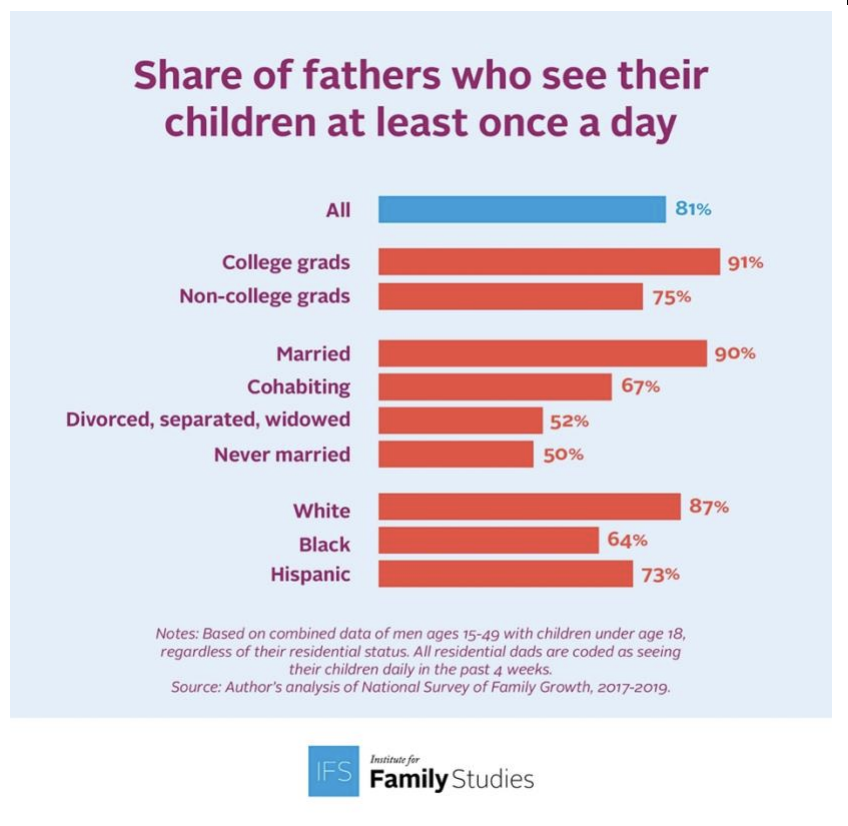
To provide an overall estimate of the engagement level across all fathers, I combined the NSFG data for resident and nonresident fathers by categorizing fathers who live with their children as those who see their children at least once a day in the past 4 weeks. The combined data show that overall, 81% of American fathers under age 50 (with children under age 18) see their children daily.
The differences by education, marital status, and race/ethnicity remain. College-graduated dads and married dads are more likely to be highly involved: Some 90% of dads in each of these two groups see their children daily. In contrast, only half of never-married fathers see their children at least once a day. A vast majority of white fathers (87%) see their children daily, compared with 73% of Hispanic fathers and 64% of black fathers.
Conclusion
In summary, fatherhood is undergoing a transformation in America. Fathers overall are taking on more and more caregiving responsibilities for their children. However, fatherhood in America has been increasingly divided along educational, marital, and racial and ethnic lines. While fathers’ time with their children has increased for college-educated, partnered, white, or Asian fathers, it has been stagnant or even in decline for other fathers in the past two decades.
Despite a modest decline in children who live in father-absent homes, the gaps between fathers who live apart from their children remain. Black fathers are three times more likely than white fathers to have children who do not live with them (43% vs. 14%). While a majority of never-married fathers (61%) live apart from their children, only 10% of married fathers are in the same situation.
Fathers play an irreplaceable role in their children's lives. The increased father involvement, especially among fathers living with their children, will have positive impacts on children’s cognitive, social, and emotional development. However, the growing gap in a father’s time based on his education and marital status as well as race/ethnicity indicate a more unequal childhood for American children in the foreseeable future.
Appendix:
Endnotes:
1. Based on American Time Use Survey data, 2021 and 2022 data were pooled to increase the sample size for fathers in different groups.
2. This is based on fathers ages 15-44 for both periods in National Survey of Family Growth (NSFG). The share of fathers ages 15- 49 with non-resident children under age 18 in 2017-2019 was 22%.
3. See Jones J, Mosher WD. “Fathers’ involvement with their children: United States, 2006-2010” National Health Statistics Reports; No.71. National Center for Health Statistics. 2013.
4. Child care time in the 1960s was from Table 5A.1-2 in Bianchi, Suzanne, etc. 2006. “Changing Rhythms of American Family Life.” New York: Russell Sage Foundation.
5. The total amount of child-care time reported here does not account for time spent multitasking, for example, cooking dinner while keeping an eye on the children or taking a child grocery shopping.
6. A similar share of cohabiting fathers (53%) and married fathers (49%) had school-age children (ages 6-17) in 2021/2021 ATUS.
7. Non-resident fathers refer to fathers with non-residential biological or adopted children under age 18 in this analysis.
8. Asian fathers were not identified separately in the published data from 2017-2019 National Survey of Family Growth.
9. Not all payments for child support from non-resident fathers are court ordered. In fact, only about half of non-resident dads (49%) say the money they provided to their children is related to a child support order, according to NSFG 2017-19.
10. Specifically, 8% of non-residential fathers saw their children at least once a day, 23% saw their children several times a week, and 13% saw their children about once a week, according to data from NSFG 2017-2019.
About the Author:
Wendy Wang is director of research at the Institute for Family Studies
Acknowledgments:
The author would like to thank Brad Wilcox for his insights and feedback on this research, Alysse ElHage for editing and formatting this report, and David Bass for designing the figures.