Highlights
It seems like nearly every week we encounter a new headline about the struggles facing boys and the decline of men. As awareness has spread, it has led to increasing appeals for the development of programs and policies that will better support young men. Often these calls focus on educational programs, increased vocational training, access to mental health services, boundaries on harmful technologies, and other initiatives to better assist young men in transitioning into adult roles. These are all worthwhile efforts that deserve our collective attention and serious investment.
However, there is one part of the conversation about how to help young men thrive that needs more attention—and that is how the falling rates of dating and marriage are playing a significant role in undermining young men’s capacity to flourish in life. Currently, when the topic of marriage is discussed in relation to men’s life trajectories, the focus is typically on a lack of “marriageable men” in our society and how this trend is contributing to a retreat from marriage by women. From this perspective, men’s developmental trajectories (or the lack thereof) are the “cause,” and the retreat from marriage is the “effect.”
While there is certainly some truth to this observation, the reverse is also true. The retreat from marriage is contributing to the decline of men. The collective decline of marriage in our society is diminishing—and in some cases erasing—one of the primary motivational mechanisms of young men’s growth and development.
How is this happening? Human development scholars have long recognized the significance of a developmental process known as “anticipatory socialization.” The concept was introduced in 1949 by sociologist Robert K. Merton, to explain how individuals adjust to expected social roles, particularly when entering new stages of development. Anticipatory socialization is the process of learning and practicing the values, norms, and behaviors of a new social role before fully entering it. Anticipatory socialization eases developmental transitions and role changes by providing knowledge, skills, and expectations in advance. This developmental process also fosters identity development, increases competence, and provides a sense of socially-validated meaning and purpose.
There is a compelling body of research that shows that marriage has traditionally been, and continues to be, one of the primary motivators of adult development in young men (and this is true of young women as well). The clear prospect of marriage has long been a critical form of anticipatory socialization that promotes active marriage preparation years before a wedding takes place. And we know that the eventual results of this developmental trajectory lead to significant differences in the behavior of single and married men—with married men experiencing a “marriage premium” of well-documented advantages including higher income, better health, and greater happiness compared to their single counterparts. But the research also shows that these benefits begin to accrue years before marriage if the prospect of marriage is clearly “on the horizon” in a young man’s plans.
Marriage Delayed
The median age of marriage in the United States has increased over the last 50 years and has reached historic highs, with men generally marrying at age 31 and women at age 29. However, the good news is that most single adults still desire to marry, with Pew Research reporting that nearly 7 in 10 young adults ages 18 to 34 say they want to get married one day and only 8% say they don’t want to get married. Notably, nearly 1 in 4 of young adults (23%) say they are “not sure” if they want to marry. Men and women are about equally likely to say they want to get married.
Despite these delays, it is important to remember that not all young adults are postponing marriage until their 30s or beyond. In fact, currently in the United States, 23% of women and 20% of men have married by age 25. With a portion of their peers marrying in their early 20s, most young adults are acquainted with friends, classmates, or others in their generational cohort who are getting married or starting to consider marriage. Within this setting, young adults form marriage paradigms made up of whether they desire to marry or not, their ideal age of marriage, the type of person they would like to marry, and their sense of personal readiness for marriage.
The collective decline of marriage in our society is diminishing—and in some cases erasing—one of the primary motivational mechanisms of young men’s growth and development.
Marital Horizon Theory
For the last 20 years, I have developed and tested a marital horizon theory of young adulthood. This theory begins with a simple, but underappreciated premise: young adults’ perceptions of marriage—its importance, its timing, and the needed preparations for it—do not merely reflect their developmental stage, they actively shape it.
Marital horizon theory acknowledges that optimal development doesn’t just build on its foundations, it hangs from its apex. We must begin with a vision of flourishing and then work backward to understand what developmental conditions and milestones make that flourishing trajectory possible. For young adult men (and women), the data is clear that one of the most consequential factors of their developmental trajectories is the clarity or uncertainty of their marital horizons.
Here are three ways that marital horizons shape young men’s developmental trajectories.
1. The Motivation to Work
An awareness of the benefits of marriage has been growing over the last 25 years. Thanks to dozens of studies and a number of high profile books such as The Case for Marriage, The Two-Parent Privilege, and Get Married, our collective understanding of the emotional, physical, economic, and sexual benefits of marriage to individuals and society is at an all-time high. However, what is less appreciated is the research on the motivational power of marriage – how marriage does not merely select people who already have these benefits but actively motivates and provides people with a framework to create these benefits.
A primary example of the motivation of marriage is found in research on men’s labor market dynamics. For example, data from the Current Population Survey show that married men consistently work 20% to 30% more hours than their never-married counterparts—a gap that translates to roughly 400 to 600 additional hours worked per year. And a recent study from Vanderbilt University and the Federal Reserve Bank of Richmond found that in terms of aggregate impact, the decline in marriage rates between 1970 and 2018 explains fully 72% of the decline in total hours worked by prime-age men.
The primary question that arises is whether this work-marriage relationship is simply a matter of selection—that is, whether more productive men are simply more likely to get married—or whether marriage itself changes men's behavior. The recent analyses from Vanderbilt and the Federal Reserve Bank of Richmond is notable precisely because it addresses this directly in a series of analyses where they conclude that “many of the additional hours worked by married men can be attributed to an increase in work in the years leading up to marriage.”
That study further concluded that the eventual gap in hours worked between married and single men is primarily driven by increases in the hours around the time when men first marry, especially during the 5 years prior to marriage. They explain:
Married men work substantially more hours than men who have never been married. Much of this gap is accounted for by an increase in work at the individual level in the years leading up to marriage... Selection into marriage explains only a small part of the increase in hours around marriage. Instead, the primary driver of the increase in hours is an altruistic "mouths-to-feed" effect, wherein men internalize the utility that their spouses and children receive from consumption.
This is a remarkable finding. Married men work harder not merely because marriage selects for productive men—but also because marriage gives men something worth working for. Marital horizons, when they are clear and proximate, provide young men with a powerful developmental orientation toward maturity, responsibility, and provisioning. When that horizon recedes or disappears entirely, so does much of the motivational scaffolding that has historically supported men's productive engagement with society.
Marriage doesn’t have to be a distant capstone. Rather, it can be a developmental cornerstone that motivates, shapes, and guides young men's adult development.
2. The Motivation to Engage in Less Risk
The developmental consequences of close or distant marital horizons are not limited to labor force participation. Research also shows that young men with more proximal marital horizons are substantially less likely to engage in a range of risky and self-undermining behaviors.
Consider binge drinking. According to the National Institute on Alcohol Abuse and Alcoholism, 26% of young adult men between the ages of 18 and 25 reported binge drinking in the last month. Our research at the Wheatley Institute, using data from the National Dating Landscape Survey, finds a clear relationship between young men’s marital horizons and their binge drinking rates (see Figure 2). The further out a young man places his expected age of marriage, the more likely he is to engage in binge drinking.
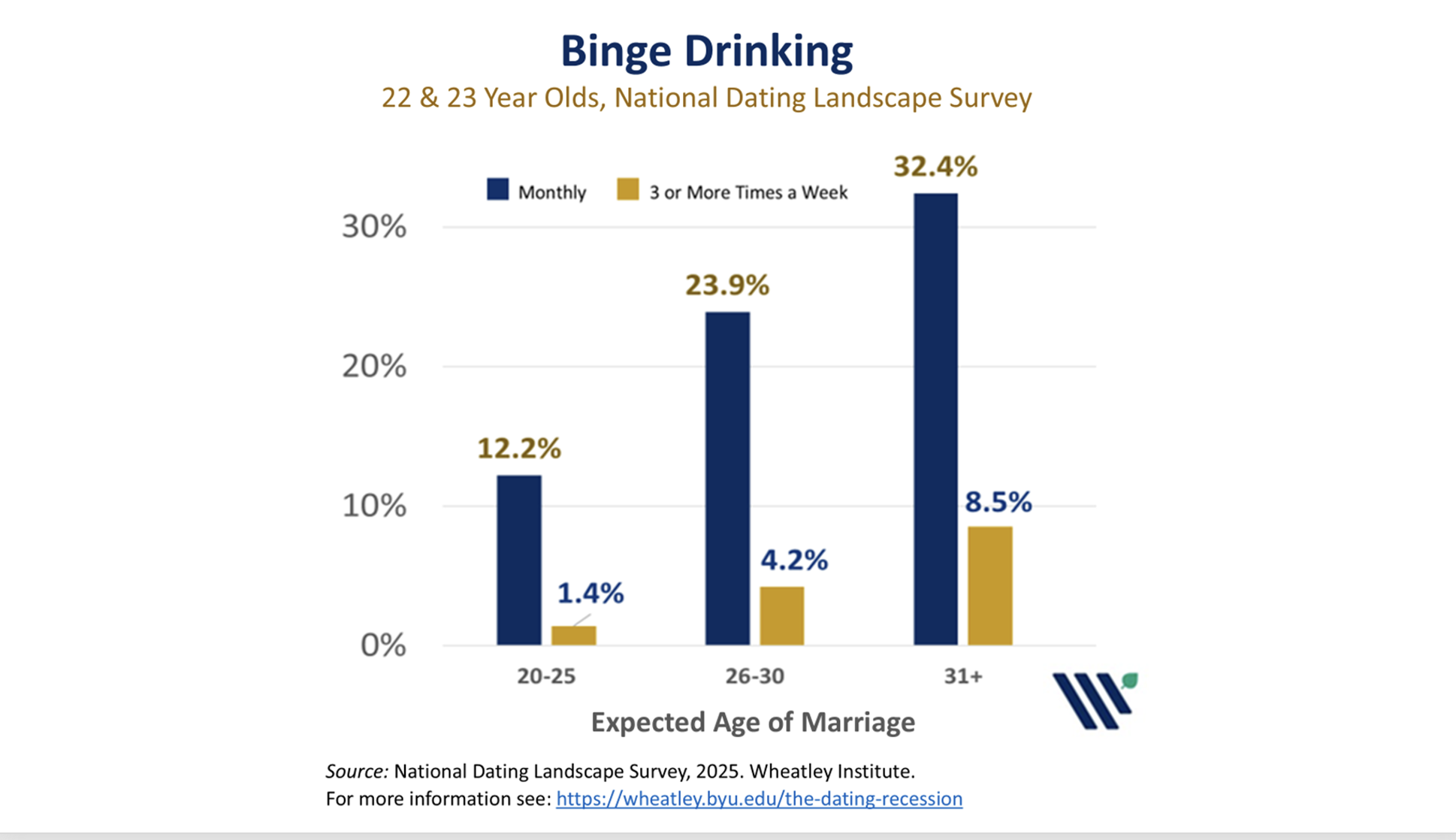
Binge drinking, however, is only one indicator in a broader pattern. Extended or eroded marital horizons are also linked to increased rates of drug use, risky sexual behavior, problematic pornography use, and other risk behaviors. The pattern is consistent across outcomes: young men who see marriage as a near-term developmental goal are more likely to regulate their behavior accordingly. Those who do not see marriage on the near horizon—or who have disengaged from the aspiration of marriage altogether—lack that same gravitational pull toward responsible behavior.
This is not simply a moralistic observation but a developmental one. The marital horizon functions as a behavioral organizer. It shapes what young men pay attention to, how they invest their time and energy, and how they weigh short-term pleasures against long-term flourishing. When that organizing horizon is distant, undefined, or absent, the developmental trajectory becomes, quite literally, unmoored.
3. Fostering Marriage Readiness
A third way that clear marital horizons benefit young men is that they safeguard them from many of the strongest premarital risk factors of later divorce. One of the most consistent findings in research on modern marriage readiness is the rise of marriage preparation paradoxes. A paradox is a proposition that, despite apparently sound reasoning, leads to a conclusion that is senseless or self-contradictory. In our culture today, we have cultivated a set of widely held beliefs about how young people should prepare for marriage—beliefs that are, in fact, producing the opposite of what they intend.
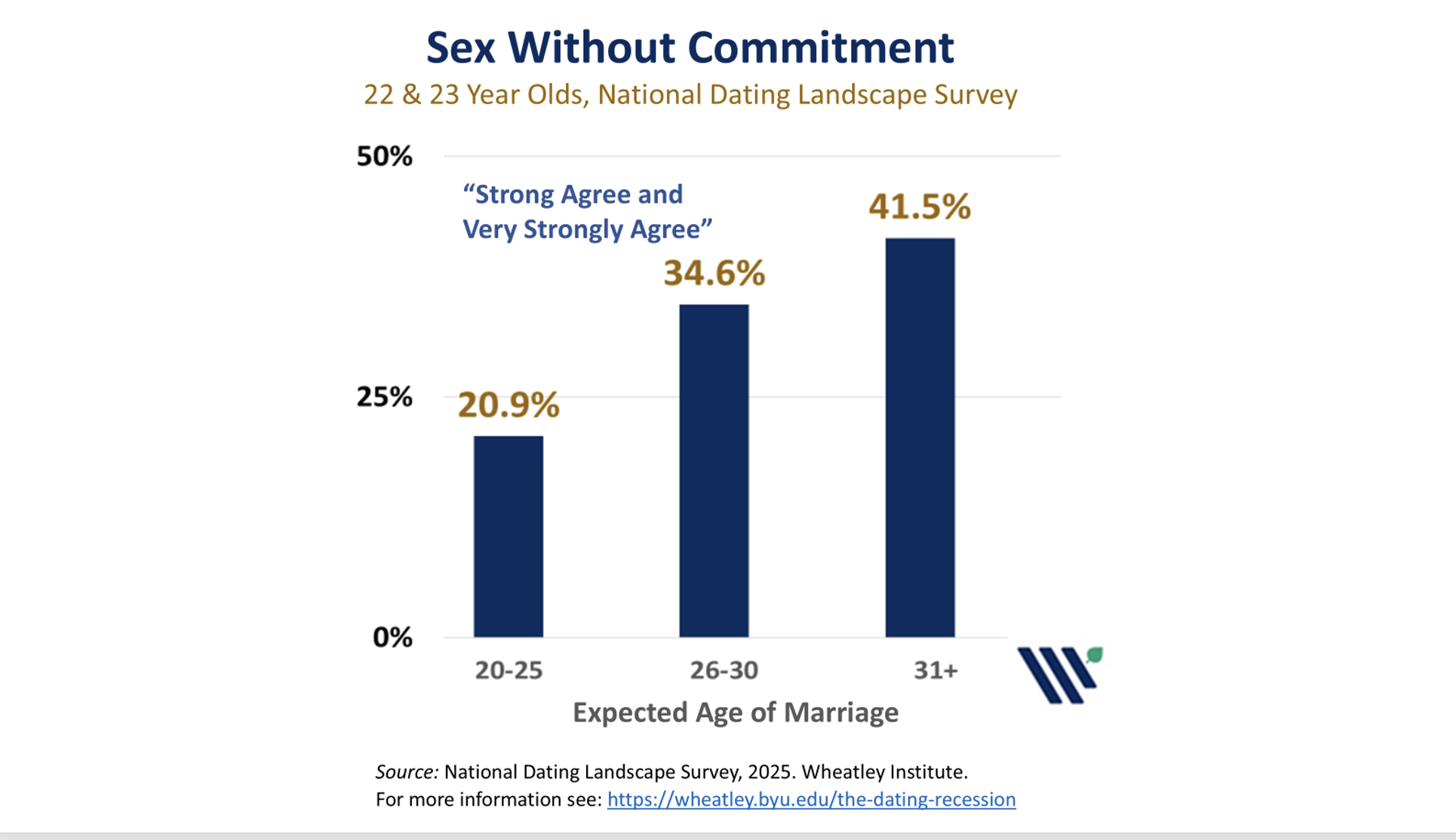
This is perhaps most visible in terms of trends of sexual behavior before marriage. Research has repeatedly found that having multiple sex partners before marriage is associated with lower marital quality and higher rates of divorce. In new analyses from the National Dating Landscape Survey, we find that young men with closer marital horizons are significantly less likely to engage in casual sex and more likely to approach dating with higher levels of commitment (see Figure 3). Whereas those who have a later marital horizon are more likely to engage in sex without commitment, a pattern which will lead to the accumulation of more lifetime sex partners.
The cohabitation paradox is another prominent example. For decades, the primary rationale offered for premarital cohabitation has been that it serves as a 'test drive'—a way to reduce the risk of divorce by screening out incompatible relationships before marriage. However, 30-plus years of research have consistently shown the opposite: cohabitation prior to marriage is associated with higher, not lower, rates of later marital instability. Yet 70% of couples in the U.S. live together before marriage, a pattern that is more likely to occur when marriage is pushed later in the life course.
What is happening here? Why are so many well-intentioned young adults preparing for marriage in ways that make their marriage less likely to succeed? The answer lies, in part, in a fundamental confusion about what makes someone truly ready for marriage. Many young adults and their parents have come to believe that marriage readiness is primarily a function of age—that one must simply be “old enough” to get married. But research shows that many young adults are actually increasing their risk of divorce by extending their marital horizons into the distant future and embracing marriage preparation paradoxes.
We would do better to promote a greater understanding of the individual and couple factors that have been proven to be strong predictors of marital quality and encourage young adults to pursue high-quality relationships as soon as possible, rather than waiting for an arbitrarily selected age of marriage. Over 80 years of research on premarital predictors of marriage outcomes tell us that the foundational factors of personal maturity, emotional readiness, commitment, forgiveness, religious devotion, sexual restraint, communication skills, and the management of conflict are far stronger predictors of marriage trajectories than a person's age at marriage.
Intentional Preparation
The picture that emerges from reviewing the research on marital horizons is both sobering and hopeful. It is sobering because it reveals how much is at stake in supporting the developmental trajectories of young men—and how much the dating and marriage recession is costing them and society at large. But it is also hopeful because it reminds us that most young men today still desire to marry and have a family. It also reminds us that many young men are still actively preparing for and succeeding in forming loving and healthy marriages. However, too many of their peers who share these desires for marriage are not on a path of preparation and direction that is well aligned with these aspirations.
What difference would it make if we could help more young men see marriage as a genuine developmental horizon that is within their reach? To help them see more fully that the vision of marriage can be a purposeful orientation that organizes their efforts, motivates their growth, and calls them toward their best selves. That marriage doesn’t have to be a distant capstone waiting for them after everything else has fallen into place. Rather, it can be a developmental cornerstone that motivates, shapes, and guides their adult development.
George Akerlof, the 2001 Nobel Prize winner in Economic Sciences, recognized this marital horizon dynamic more than two decades ago when he observed that marriage functions as a rite of passage— a formal transition from one stage of life to another. His conclusion, though blunt, is supported by decades of subsequent research: “Men settle down when they get married; if they fail to get married, they fail to settle down.” And we are learning more and more that this process of developmental maturation begins even sooner when marriage is on the horizon in a young man’s life.
Jason S. Carroll, Ph.D. is the Director of the Marriage and Family Initiative at the Wheatley Institute at Brigham Young University. He is also a Senior Fellow at the Institute for Family Studies. Dr. Carroll is a past recipient of the Berscheid-Hatfield Award for Distinguished Scientific Achievement given by the International Association for Relationship Research.
*Photo credit: Shutterstock