
Highlights
- Liberals may be more likely to have an egalitarian marriage, but they’re less likely to get married and have families than conservatives in the first place. Post This
- The rosy picture Reeves paints has quite a grimy underbelly, and seems a dubious solution for falling marriage and fertility rates, and the sex-based political polarization that fuels online sex wars. Post This
The generation growing up in married households may soon have many more trips to the park and games of catch to memorialize in Father’s Day messages, if surveys showing the current crop fathers are accurate. Time spent “dadding” has tripled since the days of Mad Men, with Millennial men reporting surging child care hours.
That men have “stepped up” at home in a way long demanded by feminists doesn’t seem to have taken any of the edge off the sex wars in the public arena, but some are making the case that the shifting landscape of the modern two-income household should. For example, Richard Reeves, head of the American Institute for Boys and Men (AIBM), asserts that the gender wars are a mostly online phenomenon, while back on planet touch grass, the sexes are proceeding apace towards a more equitable and cooperative world.
If you consider all the work that contributes to the household—paid work, child care, and domestic chores—men and women actually do about the same amount of work, on average. According to Reeves, dads even slightly edge out moms in work hour totals, spending about 60 hours a week on those three tasks cumulatively.
Cracks in the Egalitarian Model
This egalitarian model, though, has some cracks, and those averages cited by Reeves do indeed hide some important differences. Moms’ hours are longer than dads in dual-income households; dads’ hours are longer when mom is either home full-time with the kids or works only part-time. The differences in those respective models tend to spin off their own cultural grievance Tik Tok wormholes, with working moms complaining about dirty countertops and provider dads complaining that their wives have it easy.
The left, of course, has invented an entire language for the specifically female side of these grievance wars that seems to have accelerated, not calmed, in the wake of increased male domestic efforts: “double shift,” “emotional labor,” “taking ownership” [of tasks]. Their enthusiasm for what used to be good-natured sex difference griping (“he never picks up his socks!”) has now deepened into hostility, and doesn’t seem much dampened by the shifting norms Reeves notes. Even so, the egalitarian model of marriage is certainly the culturally approved model (if one must) of the arrangement Betty Friedan famously labeled a “comfortable concentration camp.”
The rise in marital equity [Reeves spotlights] might be downstream of marriage itself becoming a balkanized feature of the (liberal) upper middle class.
It’s worth considering, however, whether this egalitarian model makes us happy. There’s some evidence that it does; marital happiness has a u-shaped curve along ideology, with both traditional conservatives and dedicated liberals reporting higher satisfaction than those in the muddled middle. And it’s easy to see why that would be so: under both a traditional and dedicated egalitarian model, both partners are presumably going into things with aligned perspectives of their roles in a way that at the very least, avoids mismatch of expectations.
One of the biggest cracks, though, is that babies simply refuse to be very egalitarian. The New York Times, therefore, recommends trying to educate those babies as soon as possible, to the point of suggesting that intentionally dropping breastfeeding in favor of formula might help balance the scales.
The Fatherhood Slide
And then, for those who would usher in the egalitarian vision, there’s the big confounding effect: the increasing egalitarian nature of marriages today, whether or not that’s the model we should be striving for, may simply be a reflection of the changing population that is actually managing to get married and have children. In other words, parallel to the double-edged phenomenon of declining divorce rates, Reeves’ rise in marital equity might be downstream of marriage itself becoming a balkanized feature of the (liberal) upper middle class; an institution that simply leaves out a larger swath of America.
A new essay from Brad Wilcox and Grant Bailey highlights the IFS report, “The Vanishing American Father,” noting that the percentage of men ages 25-45 who can actually claim the mantle of fatherhood has dropped from two-thirds to just over half in the last four-plus decades, with childless men in that prime-age cohort rising to a recorded high in 2024.
For a growing cohort of men, Father’s Day will remain theoretical altogether.
Working-class men, in particular, are experiencing the fatherhood slide, with a 13 percentage-point drop from the 1980s, compared to a more modest 8 percentage-point drop among college-educated men. While its possible some portion of college-educated men are delaying, rather than excluding themselves from fatherhood, that explanation is less likely to be the case for working-class men.
Ideology matters greatly as well. Liberals may be more likely to have an egalitarian marriage, but they’re less likely to get married and have families than conservatives in the first place. Liberal men have seen their rate of fatherhood decline by the sharpest percentage of the lot—a full 21 percentage point slide from the 1980s.
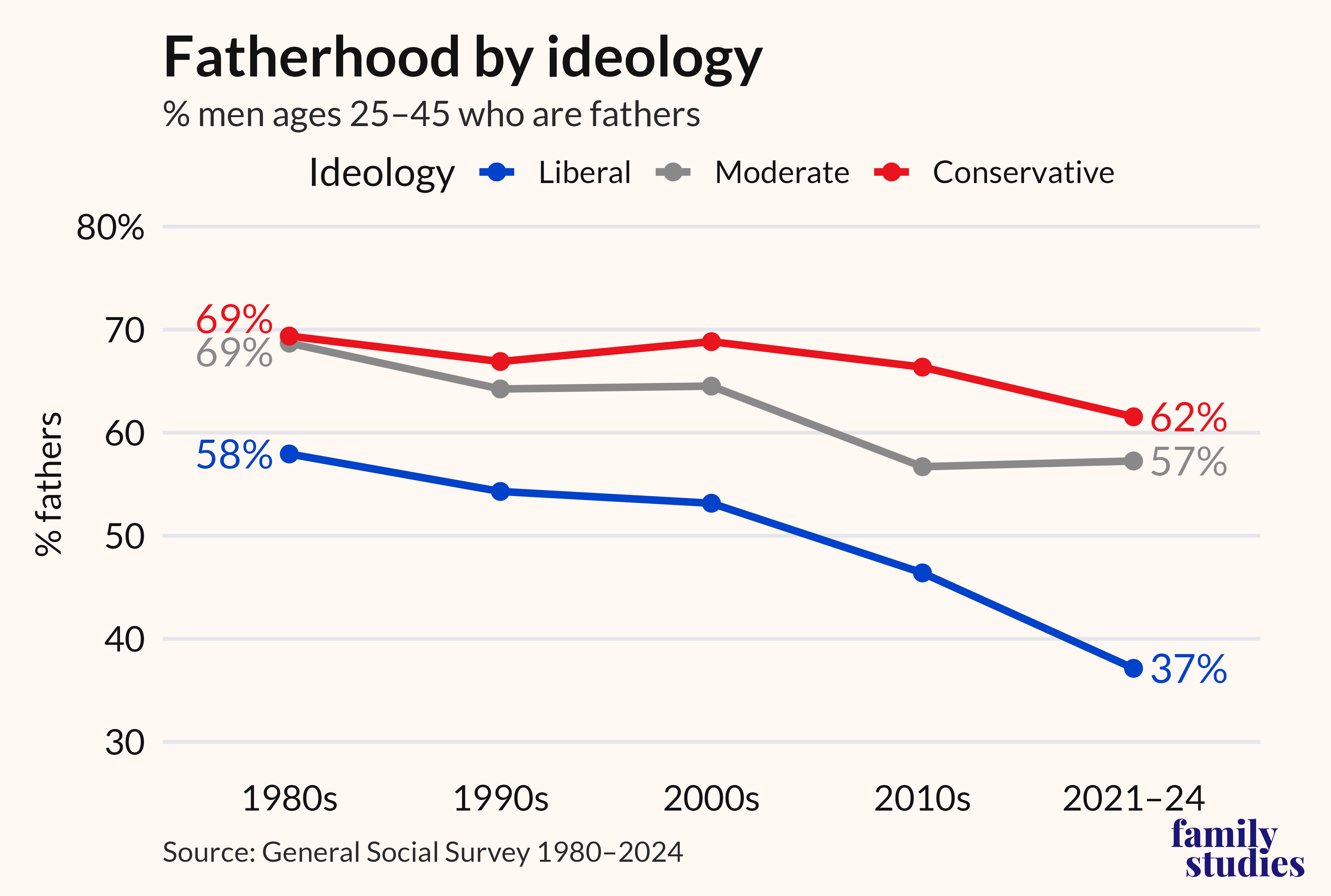
All of this is to say, the rosy picture Reeves paints (perhaps the future is not female, but equal?) has quite a grimy underbelly, and for all the reasons, seems a dubious solution for falling marriage and fertility rates, and the sex-based political polarization that fuels the online gender wars.
That modern fathers are spending more time with their children can only be for the good, but we should be careful to remember that Millennial dadding is not the only way to be a good father. Fathers can still provide invaluable guidance and moral example to their children without logging perfectly equal playtime hours to mom (although it is much, much harder for them to do so if they are not married to the mothers of their children and do not live in the same house). Even as Millennial dads are praised for spending significantly more time fathering than their own dads, it must not be forgotten that the vast literature on the unique and crucial contributions of fathers were measuring the efforts of the previous generation—those who often spent more time at the office than at the park.
Father’s Day, for all the modern dissembling and problems with basic biology, is about the unique contributions of fathers—contributions that can’t be duplicated by even very loving, hardworking mothers. And even if one considers our moves towards more egalitarian marriage the cause of unadulterated celebration, that success increasingly leaves out too many working-class men, liberal men, and the huge share of fathers outside the child-protective bonds of marriage. For a growing cohort of men, Father’s Day will remain theoretical altogether.
Color me less copacetic than Reeves on the state of the gender wars and the future of Father’s Day.
Inez Stepman is a senior legal analyst at Independent Women.
Editor's Note: The opinions expressed in this article are those of the author and do not necessarily represent the views, policies, or positions of the Institute for Family Studies.
*Photo credit: Shutterstock


