
Highlights
- Men's age preferences align closely with findings from evolutionary psychology, per data from Keeper. The pattern is very different to the pattern for women. Post This
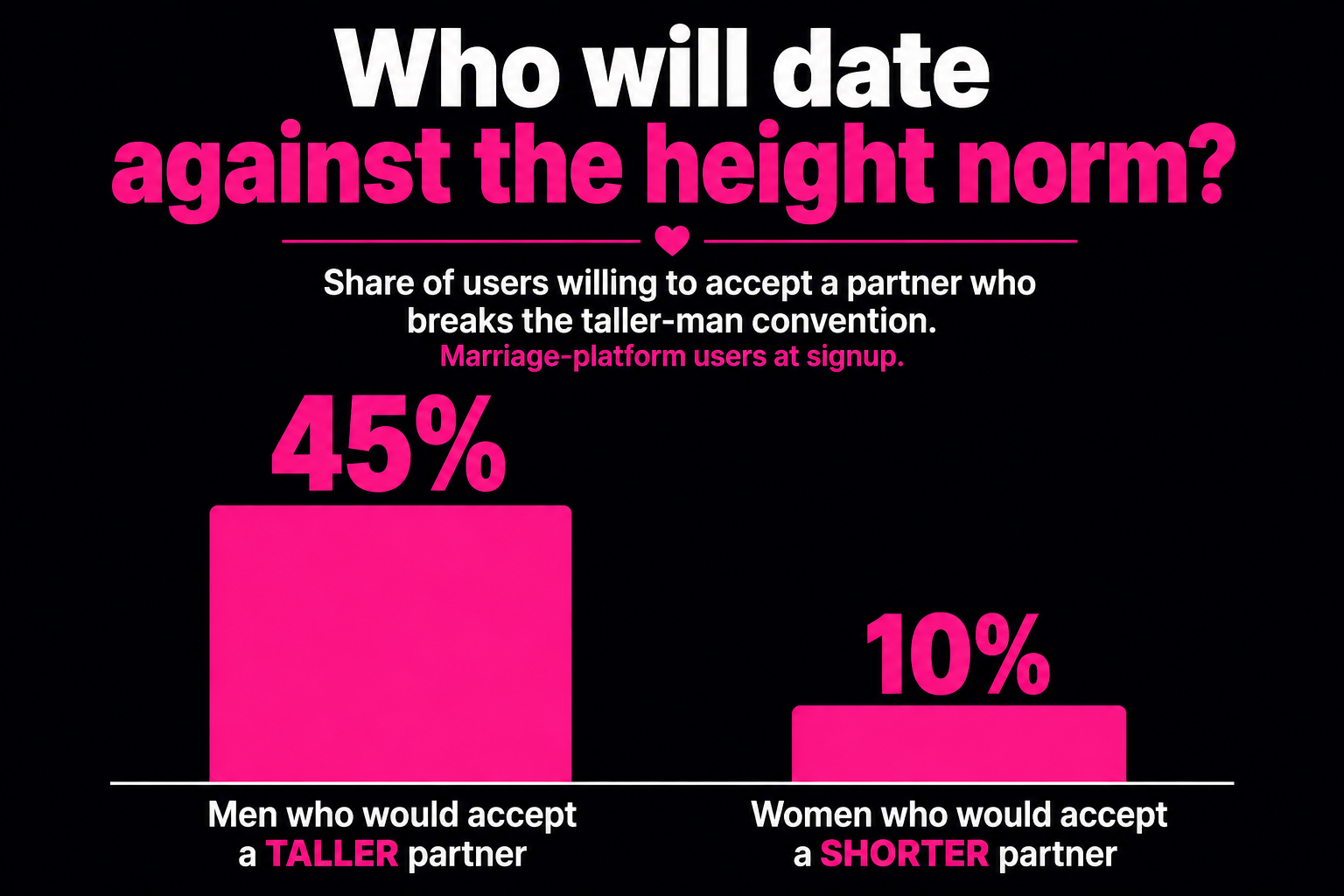
- Nearly 45% of men using the Keeper app report that they would accept a wife who is taller, whereas only 10.2% of women say they would accept a husband who is shorter. Post This
In the chaotic modern dating world, where dating apps often prioritize swipes, sparks, and short-term thrills, Keeper.ai stands out as something different: a matchmaking platform built explicitly for people who want marriage and family, not just another weekend. The numbers tell a revealing story right away: women complete the Keeper on-boarding process more than men by roughly 5 to 1 (243,183 women versus 45,900 men).1 This imbalance speaks volumes about who is actively seeking long-term commitment in today’s dating landscape. Yet thousands of men are there, too, deliberately choosing a site that filters for serious intentions rather than casual encounters. So, what are these marriage-minded men looking for in a wife?
What Men on Keeper Want in a Wife
Men's top 10 desired characteristics—based on their own description of what they are looking for in a marriage partner—are quite similar to women’s (we will cover more about Keeper women in a separate article tomorrow). Ranked from most frequently to least frequently mentioned, these characteristics are 1) values, 2) relationship dynamic, 3) communication style, 4) sense of humor, 5) intelligence, 6) physical health, 7) lifestyle, 8) ambition, 9) intimacy, and 10) interests. These preferences necessarily exclude age, height, location, ethnicity, personality, and appearance because they are addressed separately in the Keeper onboarding process.
The one characteristic appearing on the men’s top 10 list but not women's is "interests”; women, by contrast, mention "hygiene." Men, it seems, are less concerned about a prospective spouse's hygiene than women are about men's. Another notable difference is that men place less emphasis on a sense of humor: only 17.7% identify it as important, compared to 28% of women. Men are also somewhat more likely than women to mention physical health (15.6% versus 11.2%) and lifestyle (15.3% versus 11.3%).
During the onboarding process, users are asked not only to describe what they seek in a spouse but also to specify preferences regarding height, age, appearance, location, and ethnicity. Responses concerning height reveal a striking sex difference. Nearly 45% of men using the Keeper app report that they would accept a wife who is taller than they are, whereas only 10.2% of women say they would accept a husband who is shorter (see graphic).
Source: Keeper.ai
Men's age preferences align closely with findings from evolutionary psychology (see Figure 1).
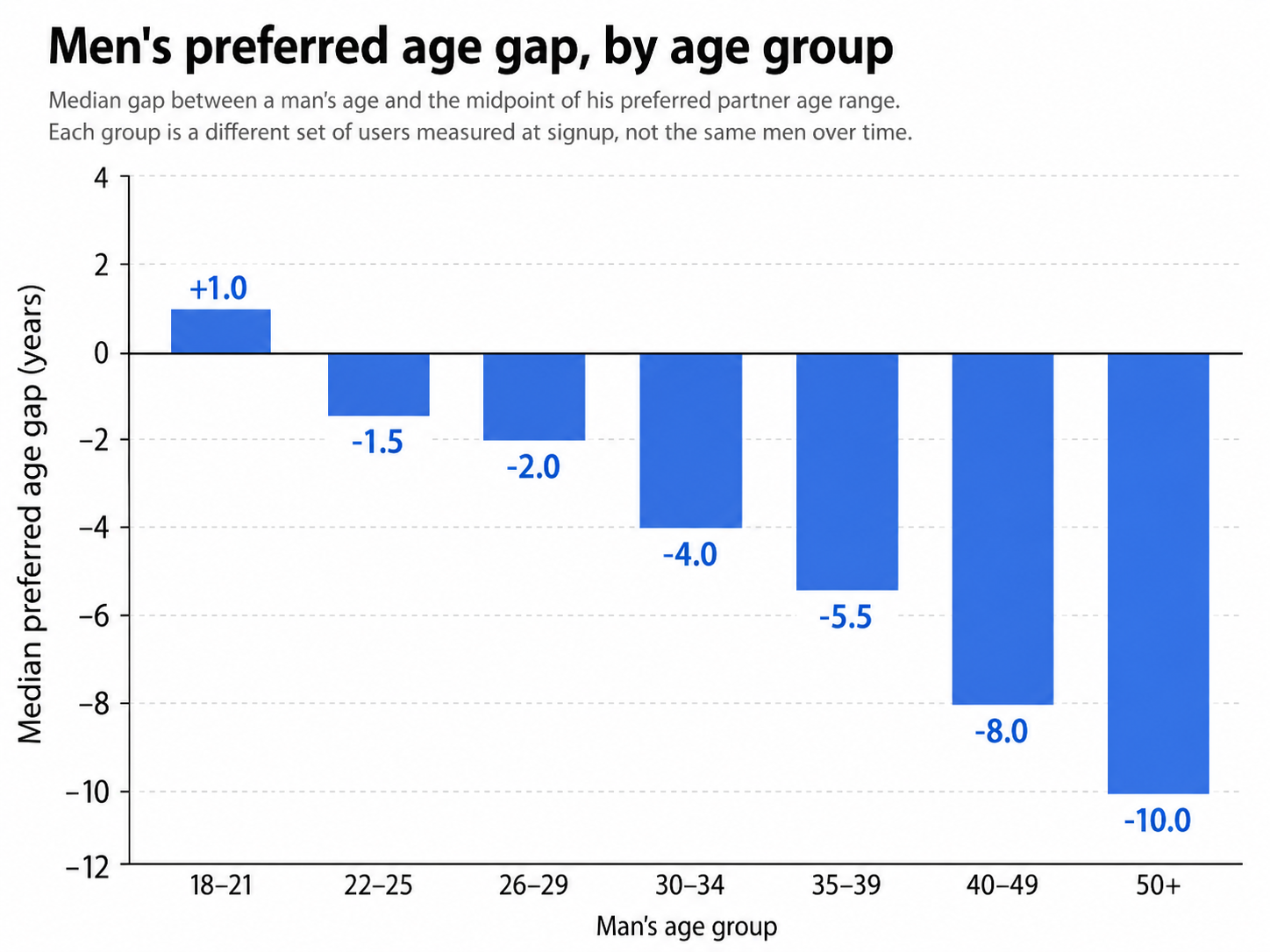
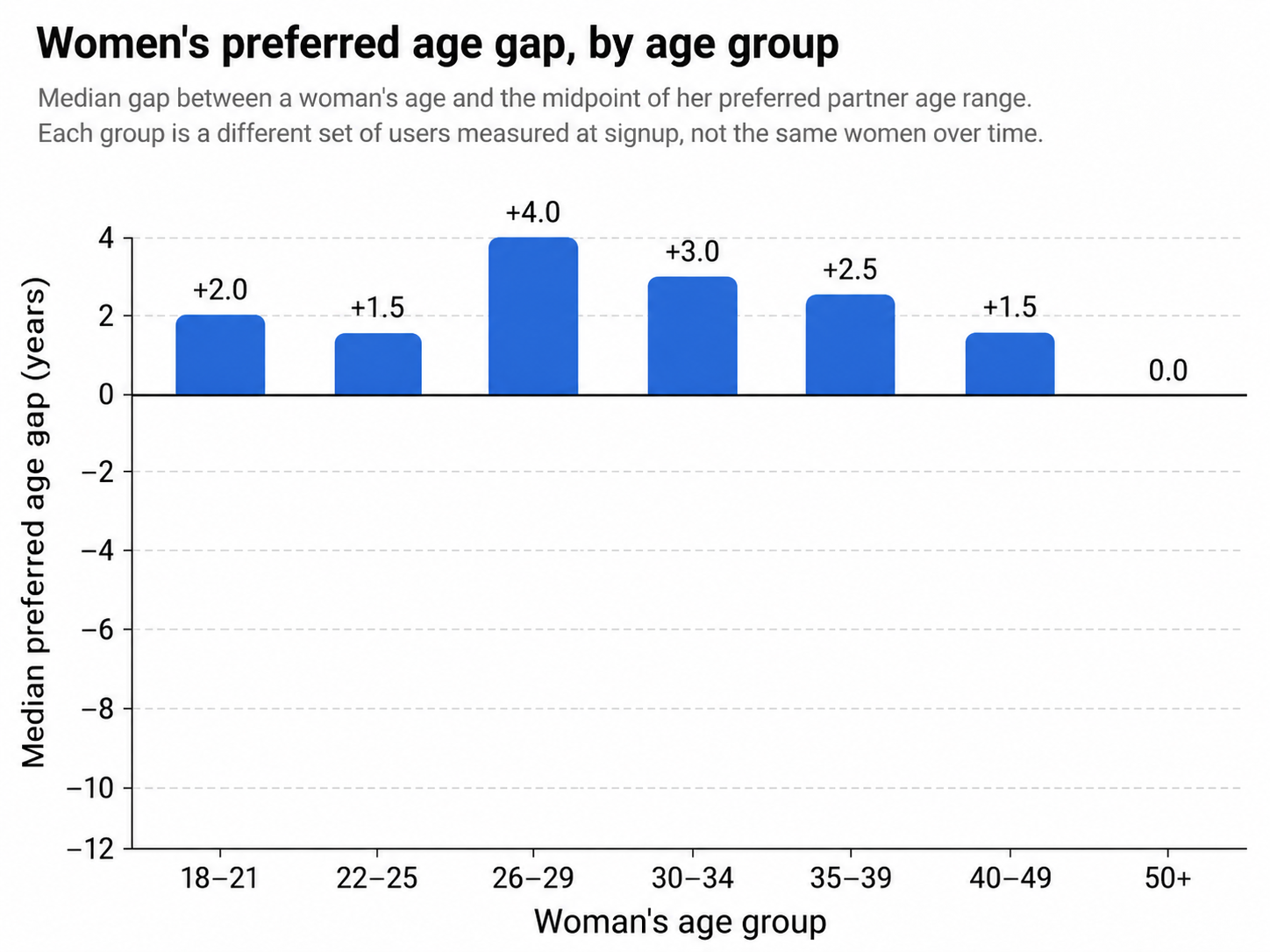
The youngest men on the platform (ages 18–21) tend to prefer slightly older partners. Beginning in the 22–25 age group, older men on the platform prefer comparatively younger partners, and the older they are, the larger the preferred age gap. The median preferred age gap ranges from approximately 1.5 years younger among men ages 22–25 to about 10 years younger among men ages 50 and older. This pattern is very different to the pattern for women (see Figure 2).
Regarding appearance, women are more likely to specify particular traits such as height, build, hair, or eye color. The major exception is body figure: men are more than five times as likely as women to identify this characteristic as important (8.2% versus 1.5%).
There is also a sex difference regarding geographic mobility. Men are more likely than women to indicate that they would not relocate for a partner. About 26.7% of men say they are unwilling to relocate, compared with 14.0% of women. Men are a little less likely than women to express a preference for a particular ethnicity. Only about 26% of women and 23% of men indicate a preference for a spouse of a specific ethnicity.
Users who complete the Keeper onboarding process may proceed to an optional second stage in which they can classify various characteristics as "nice to have," "very important," or "non-negotiable." While not all users complete this stage, overall, men are approximately 11 times more likely than women to classify age as either very important or non-negotiable (16.1% of all men flag it vs. only 1.4% of all women). A smaller sex difference appears for appearance, with 56% of all men and 50.9% of all women classifying it as very important or non-negotiable.
What Men on Keeper Don’t Want
Some users also specify characteristics they explicitly do not want in a spouse. About 25.9% of men do so, compared with 30.6% of women. In general, men are less specific in what they state compared to women. The major exception is “overweight,” which is the undesirable characteristic most frequently mentioned by men. Approximately 8.7% of all the men on the Keeper app indicate that they do not want a spouse who is overweight, compared with 5.8% of all the women. The third most frequently mentioned undesirable trait among the men is “ugly,” a characteristic that does not appear on the women’s top 10.
Men are more specific about what they want in a wife when it comes to her age and appearance.
Taken together, this data from Keeper suggests that men and women seek most of the same qualities in a long-term partner. Both prioritize shared values, good communication, a positive relationship dynamic, intelligence, and a sense of humor. The principal difference is that men are generally less specific in what they state than women across a wide range of characteristics.
Men are more specific about what they want in a wife when it comes to her age and appearance. Men are much more likely than women to view age as an important criterion and generally prefer a spouse who is younger than they are, and older men on the site prefer comparatively younger women. When it comes to physical appearance, more men than women classify appearance as very important or non-negotiable, although men are less likely to list the physical features they prefer (except for body figure). It is likely that men have difficulty saying precisely what constitutes beauty in a prospective spouse, although they recognize it when they see it. The notable exception is body figure, where men are more likely to be specific about wanting a woman who is not overweight.
Conclusion
In sum, both men and women who use Keeper want many of the same things in a long-term partner, while the women tend to be more specific in what they are looking for overall. The exceptions here also align with predictions from evolutionary psychology: men state stronger preferences for youth and beauty. The evolutionary rationale for the preference for younger partners is that youth is associated with female reproductive potential, and men who historically preferred younger partners would, on average, have been more likely to leave descendants, thereby promoting the selection of traits for such a preference. Beauty is also associated with youth and health, as beauty tends to decline with age and ill-health, so a male preference for beauty was also likely adaptive and likely has been subject to selection over evolutionary time.
Of course, this Keeper data is derived from what men say they want in a long-term partner (much as many research findings in evolutionary psychology are based on people’s stated preferences). Actual choices of marriage partner are likely somewhat different and are usually based on something of a compromise between what each partner is looking for in a spouse. “You can’t always get what you want,” as the song says.
Rosemary L. Hopcroft is Professor Emerita of Sociology at the University of North Carolina at Charlotte. She is the author of Evolution and Gender: Why it matters for contemporary life (Routledge 2016), editor of The Oxford Handbook of Evolution, Biology, & Society (Oxford, 2018), and author (with Martin Fieder and Susanne Huber) of Not So Weird After All: The Changing Relationship Between Status and Fertility (Routledge, 2024).
*Photo credit: Shutterstock
1. This information comes from Keeper.ai. Thanks are due to Jake Kozloski for providing the data, graphic, and figures.


