Highlights
- The marriage divide has less to do with men’s wages and more to do with cultural shifts, rising material expectations for marriage, and government policies. Post This
- Men at age 30 in 1970 were about as likely to be homeowners as married men today at age 30, but their homes had fewer rooms and more occupants. Post This
Marriage in the U.S. has been declining for decades. In 1962, more than 90% of Americans ages 30–35 had ever married. Today, only 55% have. But the decline hasn’t been even. While marriage rates have fallen across all groups, the drop has been much steeper for the working class.
It’s common to hear people explain the economic divide in marriage as being due to declining wages among working-class men. Researchers and pundits argue that decreasing earnings have made working-class men less “marriageable” today. For example, Oren Cass makes the argument that back in the 1980s, the average man could support a family on his wages alone but that doing so would be impossible today, contributing to marital decline.
Trendy social media posts have leaned into this claim, displaying pictures of couples from the past raising children in spacious homes, complete with a car and a dog. The message is basically: a single breadwinner could once afford this lifestyle, but the economy makes this impossible today.
However, the data tell a different story, as I explain in a new paper from the Heritage Foundation.
While inflation-adjusted earnings declined among working-class young men during the 1970s and 1980s, they later recovered and have since fluctuated with economic cycles. But throughout, marriage rates steadily tumbled. In 2025, young men’s median earnings were at a roughly 50-year high, but marriage rates kept sinking.
Examining this question further, Scott Winship at the American Enterprise Institute compared incomes of young men today with incomes of similarly-aged men in the past who were married, single-earner fathers. He found that today’s young men generally earn more than married, single-earner fathers from the 1960s and 1970s, when marriage rates were much higher.
Job Quality
If declining wages don’t explain the marriage divide, perhaps job quality has worsened for working-class men, making it harder to balance work and family?
According to the General Social Survey (GSS), men’s perceived job stability and work hours have largely remained steady or improved since the 1970s. For young men at or below median income, perceived job stability has generally increased, and median weekly work hours have remained around 40.
Job satisfaction is somewhat lower today for these men than it was in the 1970s and 1980s, particularly among men ages 30-35, but it’s been quite steady for the last two decades for men ages 25-29. While there may be some decrease in job quality, the factors likely more relevant to raising a family—perceived job stability and work hours—have not worsened.
Among higher-earning men, GSS job quality measures are generally stronger, which may help explain some income-based differences in marriage rates. Research from the Institute for Family Studies also shows that working-class men having lower job quality than college-educated men and that higher job quality is linked with higher marriage rates. But long-term trends suggest that on measures of perceived job stability, work hours, and satisfaction, men with median income or less have not experienced deterioration in work conditions large enough to explain the large decline in marriage.
Material Living Conditions
If declining economic well-being isn’t the culprit behind declining working-class marriage rates, why does this idea resonate with so many? Rather than an actual decline in financial well-being, material requirements for marriage may have increased, making marriage feel less achievable, particularly for those with more moderate incomes.
While data on material expectations for marriage are limited, examining material living conditions of young married adults across time can provide insight. Using data from the Decennial Census and American Housing Survey, we can compare the material living conditions of men at the median age of first marriage today with men at the median age of first marriage in 1970. Comparing men at the same life stage across time allows us to see what living standards were typical—and likely acceptable—for marriage.
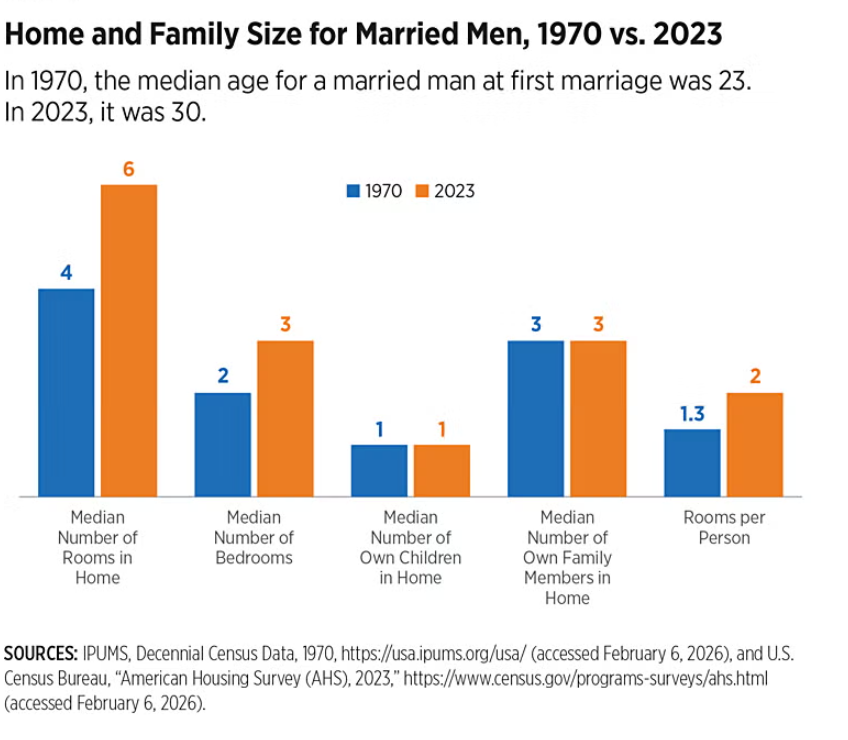
The median age at first marriage for men in 1970 was 23. It was 30 in 2023. Given this large shift in age over time, it’s not surprising that men today have better living conditions. But that’s also the point: in the past, people entered marriage with fewer resources.
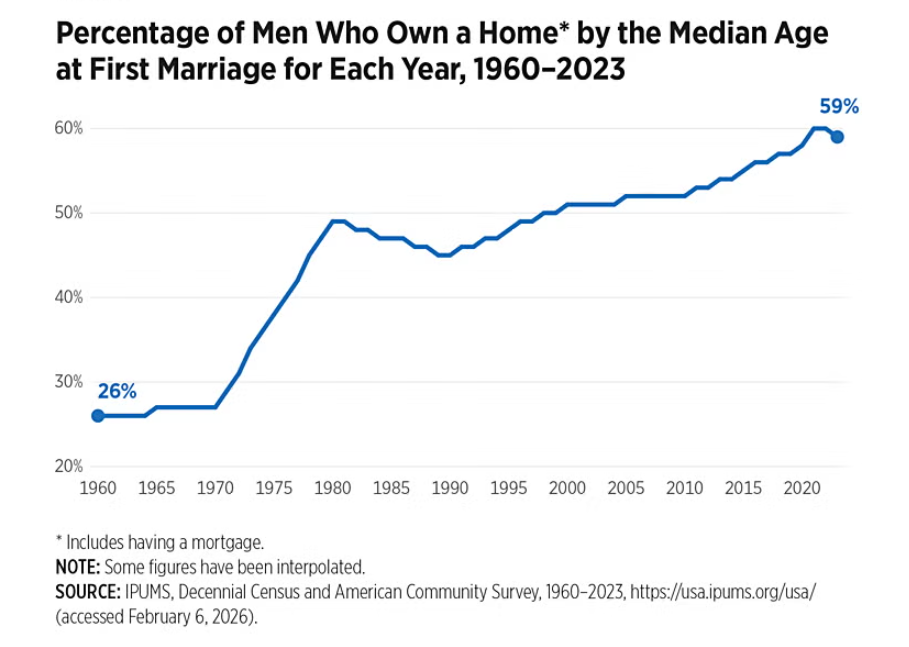
Among married men at the median age of first marriage in1970, only about a quarter owned a home, compared to nearly 60% in 2023.
In 1970, married men at the median age of first marriage also had smaller homes and fewer amenities than their counterparts in 2023. In 1970, homes had an average of four rooms, compared to six rooms in 2023 (not including bathrooms, which are more numerous today). Despite similar family sizes, homes were more crowded in 1970: a median of 1.3 rooms per person in 1970, versus 2.0 in 2023.
To account for the shift in median marriage age between periods, we can compare married 30-year-old men at both periods. Married 30-year-old men today are still better off compared to 1970.
Men at age 30 in 1970 were about as likely to be homeowners as married men today at age 30, but their homes had fewer rooms and more occupants.
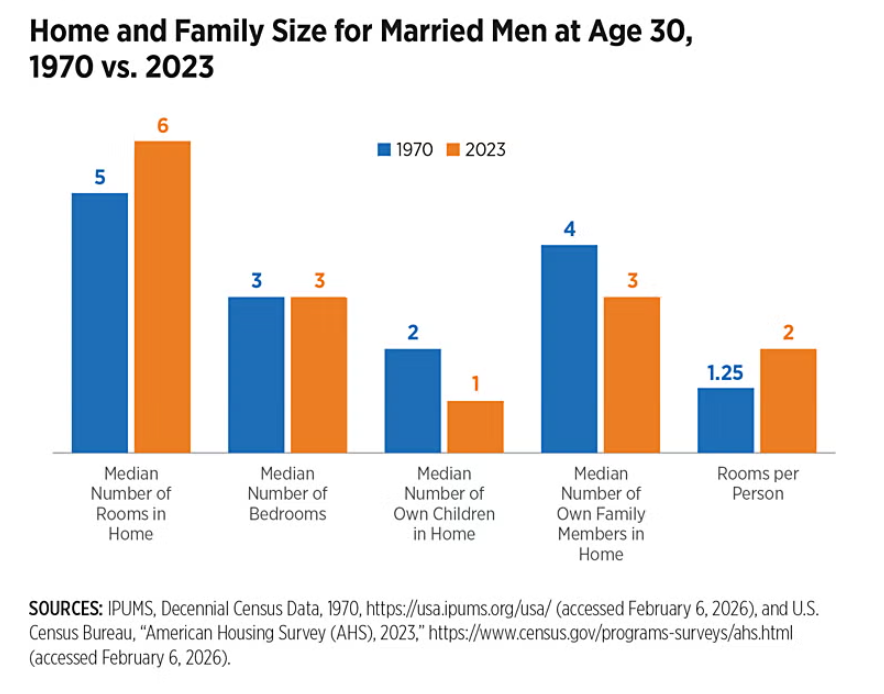
Homes today also have nicer amenities (not to mention technologies that didn’t exist in 1970, like computers, internet, and smartphones). While differences in material living conditions can’t tell us about expectations directly, they show that young adults in the past were much more likely to enter marriage with fewer resources. In 1970, even men likely several years into marriage had lower material living conditions than 30-year-old married men today.
It’s true that married men today are more likely to be in higher-income brackets, leading to higher living standards. But again, in earlier eras, having fewer resources was acceptable for marriage.
The decline in marriage also likely reduces the economic well-being of men. This is because researchers find that marriage boosts men’s earnings, so less marriage can mean lower earnings for men overall.
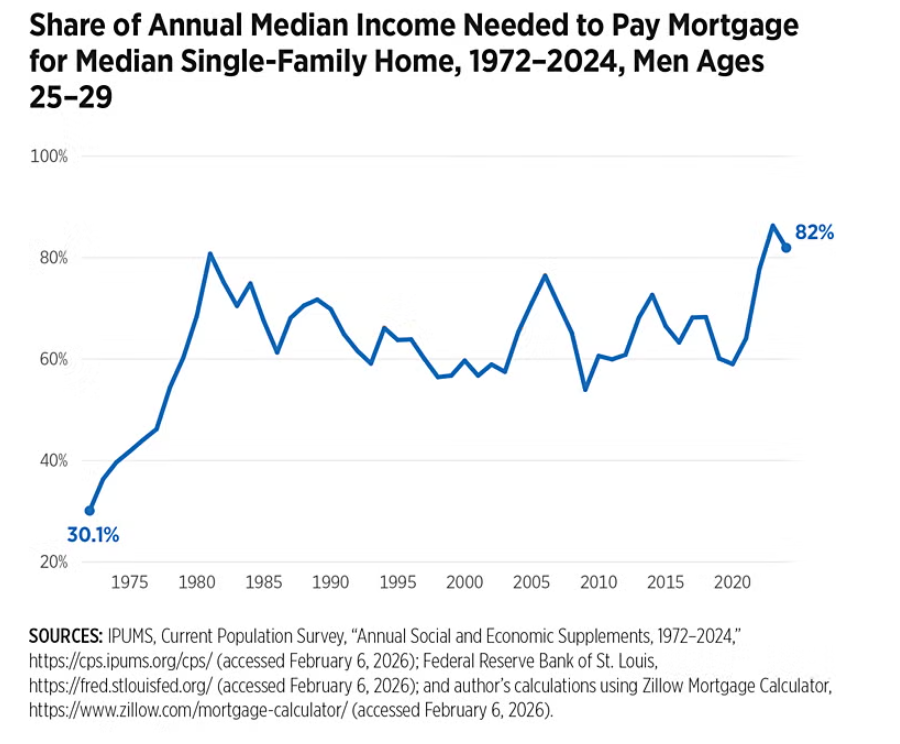
Is it possible that higher housing prices are driving the marriage decline? Home prices have soared in recent years. But the share of income needed for a median-earning young man to pay the median mortgage remained relatively stable for roughly four decades before rising sharply in the last few years. Housing costs may help explain recent marital declines but not the long-term trend.
Cultural Changes Matter
What has driven rising material expectations? One factor could be lower relationship stability. Higher divorce rates, no-fault divorce, and the proliferation of lower-commitment relationships like cohabitation contribute to a culture where marriage is considered less reliable. This makes achieving some financial independence before marrying even more important for men and women today.
Broader cultural changes that have reduced marriage overall—nonmarital sex, unwed childbearing, and cohabitation—have also had a greater impact on working-class Americans than their peers with higher education and incomes. Unwed births, for example, often carry lower opportunity costs for working-class women, increasing their likelihood. But unwed births also create family complexity, making it harder to form stable marriages later.
While men’s earnings have not declined, their connection to the labor force has. The share of prime-age men in the labor force fell from 97% in 1955 to 89% in 2024. Rather than a lack of opportunity being the driving factor, many of these men report they are not interested in having a job. Government disability programs have played a large role, with looser criteria leading to expanding disability roles. At the same time, the welfare system makes it easier for women to get by without a father’s income, reducing the expectation for men to provide.
Therefore, as I argue in my new paper, the economic divide in marriage has less to do with men’s wages and more to do with cultural shifts, rising material expectations for marriage, and government policies that have weakened work incentives. Addressing the decline in working-class marriage will require confronting all these factors, rather than simply focusing on the economy.
Rachel Sheffield is a Research Fellow in Welfare & Family Policy at The Heritage Foundation.
Editor's Note: The opinions expressed in this article are those of the author and do not necessarily represent the views, policies, or positions of the Institute for Family Studies.
*Photo credit: Shutterstock