
Highlights
- The number of years people can expect to live alone at the end of their lives is increasing, and this is particularly true for women. Post This
- Marital status is significantly related to the level of loneliness reported by an individual, with married people reporting the lowest levels of loneliness. Post This
In 1966, The Beatles released “Eleanor Rigby,” a song about a lonely older woman written by a young Paul McCartney, who sang: "All the lonely people. Where do they all come from? All the lonely people. Where do they all belong?" Since then, the problem of loneliness among older people has not disappeared. In fact, it is growing and likely to continue to increase in the U.S. and other industrialized countries in the future. For example, a 2025 AARP poll found that loneliness affected 40% of those ages 45 and over in the U.S., up five points from 35% in both 2010 and 2018.
The increase in loneliness is linked to several broader societal trends, including longer life expectancy and aging societies, the rise in living alone, and increasing childlessness. Unsurprisingly, living alone is a risk factor for loneliness in old age, and in the U.S., the number of people living alone in their eighties and nineties is set to soar. According to a recent report from Harvard University’s Join Center for Housing Studies, the percentage of households of people over 80 living alone in the U.S. will likely increase from 6% of all households in 2018 to 12% in 2028. This is partly a result of increasing life expectancies. Older people, women especially, often find themselves living alone after the death of a spouse, but whereas that used to happen when people were in their sixties, it is now happening at later ages so that people age 65 and over are now more likely to still live with their spouse than in 1990 (as noted by recent report from the Pew Research Center). Yet even adjusting for increasing life expectancy and the proportion of people in the population in older age groups, the number of years people can expect to live alone at the end of their lives is increasing, and this is particularly true for women.
More of the people living alone in old age will be childless, as childlessness rates have increased in the United States. Projections by the Institute for Family Studies show that as many as 30% of all women born in 1989 in the U.S. will likely remain childless.
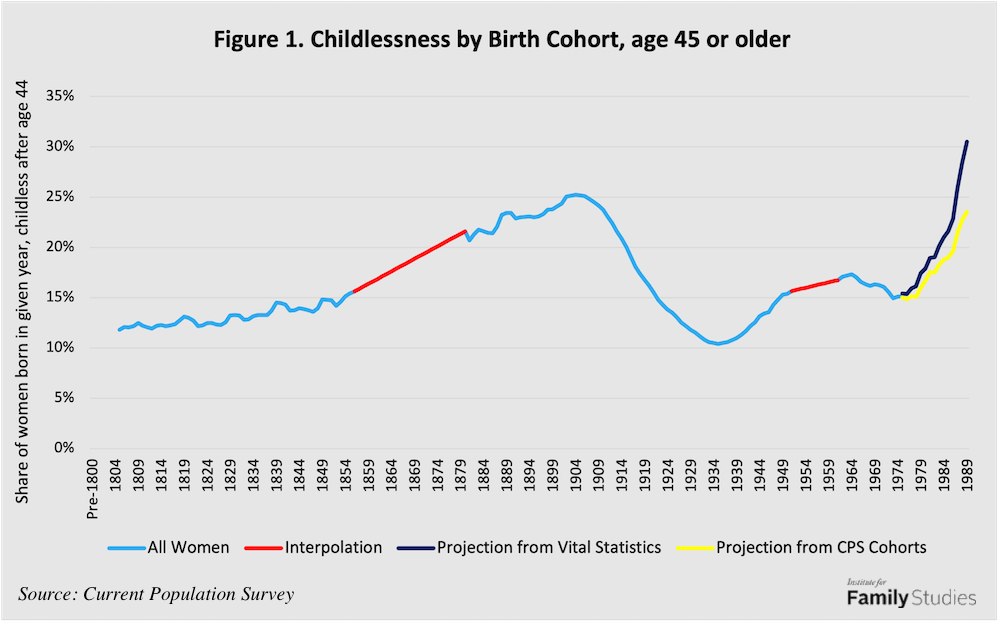
Data from other developed countries show similar trends. This increase in childlessness will likely intensify the problem of loneliness among the elderly because childlessness is associated with higher levels of loneliness in later life. A 2025 study in the journal The Gerontologist, based on representative data on Americans over the age of 50 from the Health and Retirement Study, showed that older Americans without living children reported a significantly higher level of loneliness compared to those with living children (an average loneliness score of 1.62 out of 4 compared to 1.52). While the difference appears modest, it was statistically significant and comparable in size to several other well-known predictors of loneliness such as not being married. Controlling for other factors that influence loneliness (age, sex, race and ethnicity, marital status, friend support, friend strain, education, employment, self-reported health, and household wealth) did not change this outcome. Childless older adults were significantly more likely to report loneliness net of all these factors.
As expected by the researchers, marital status was significantly related to the level of loneliness reported by an individual, with married people reporting the lowest levels of loneliness, all else being equal. As previous research has shown, marital status is an important marker of social integration especially among the old, with older separated, divorced, and widowed people more likely to report social isolation and associated loneliness than married people. Friend support was also found to be a protection against loneliness, especially for those without children. Older childless people with friend support get by with a little help from their friends, as another Beatles song memorably put it.
This contrasts with Nicholas Wolfinger’s finding that childless Americans ages 50–70 were no less likely than parents to describe themselves as “very happy.” (Wolfinger found that those in this age group with minor children still at home were much less likely to report being very happy). This discrepancy may simply have to do with the difference between happiness and loneliness. Although there may be links between the two emotions, they are not the same, and there is evidence that the pursuit of happiness can actually promote loneliness.
Individual happiness aside, in the U.S. and other developed countries, loneliness has always been a risk of growing older. The problem is that rates of loneliness are increasing among the old and are exacerbated by rising levels of childlessness, since the childless are more likely to be lonely in old age. As fertility declines and life expectancy rises, more older adults will enter late life without children and with fewer built-in sources of intergenerational connection. Sadly, growing numbers of older childless people in the U.S. and other developed countries likely means growing numbers of Eleanor Rigbys.
Rosemary L. Hopcroft is Professor Emerita of Sociology at the University of North Carolina at Charlotte. She is the author of Evolution and Gender: Why it matters for contemporary life (Routledge 2016), editor of The Oxford Handbook of Evolution, Biology, & Society (Oxford, 2018), and author (with Martin Fieder and Susanne Huber) of Not So Weird After All: The Changing Relationship Between Status and Fertility (Routledge, 2024).
*Photo credit: Shutterstock


