Highlights
On the same day last month, two prominent opinion writers both addressed the U.S. fertility decline: Louise Perry wrote in the Wall Street Journal that “Falling birth rates are a mystery,” while Jessica Grose at the New York Times stated that it is “not a mystery” why fertility rates are falling, pointing to the significant drop in teen births as the most likely culprit.
From a demographer’s perspective, the U.S. fertility decline is not a mystery at all. The data clearly point to the massive drop in the number of children women have during their 20s as the direct cause.
Between 2007 and 2025, the U.S. total fertility rate (TFR) dropped from a replacement level of 2.1 children per woman to 1.57 children per woman. And the drop in births among women ages 20 to 29 accounts for 78% of the overall decline in the total fertility rate.
Understanding the Total Fertility Rate (TFR)
The total fertility rate (TFR) is calculated from age-specific fertility rates of women in the current year, which are basically summed across each five-year age group and converted to a per woman rate. It answers the question “If today’s birth patterns hold, how many children would an average woman have over her lifetime?” It is a real-time snapshot of the current fertility level, similar in approach to how life expectancy is calculated.
Instead of getting fixated on the calculated TFR number, it is more important to look at the underlying data behind the TFR, the actual fertility rates by age. This shows a very clear picture of what is going on with declining fertility in the United States. The fertility rates for women ages 20 to 24 have been cut in half, from 105 births to 52 births per 1,000 women in this age group since 2007. The drop among women ages 25 to 29 is also very significant, at about a quarter (28%). Taken together, the fertility rate among women between ages 20 to 29 has declined 38% in the past 18 years.
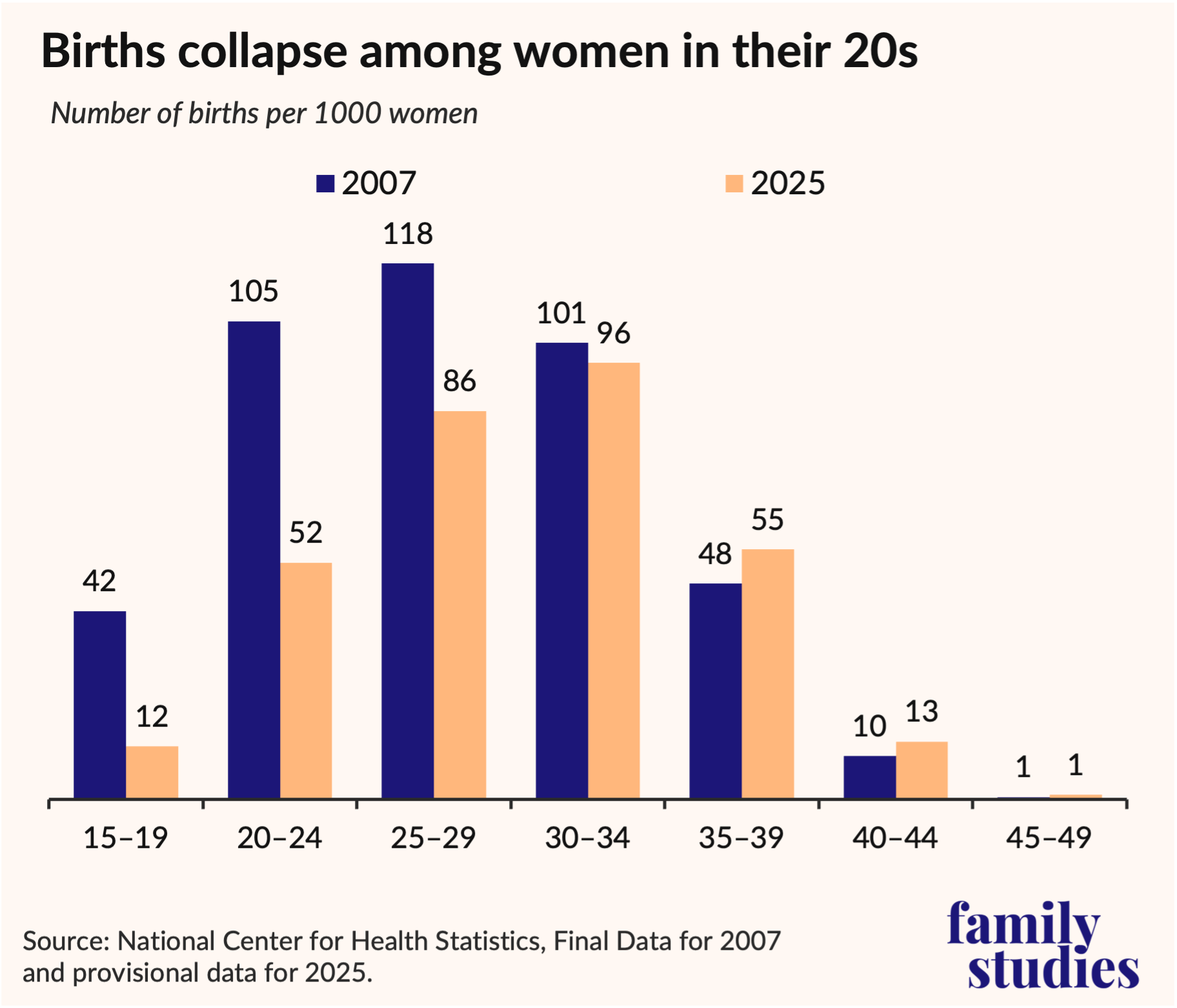
A drop by percentage can appear much more dramatic when the base for calculation is small. Fertility rates among teens dropped by 72% since 2007 (from 42 births to 12 births per 1,000 women ages 15 to 19), but the decline among women in their 20s was only 38%. Does that mean the decline in teen fertility rates is the main driver of the U.S. fertility? Absolutely not. Women in their 20s carry way more weight in determining the overall fertility trend than teens, because they are the ones who have the most births.
There is another measure demographers use to understand fertility levels: the complete fertility rate (CFR). It is the average number of children born to a group (cohort) of women by the time they finish their productive years, typically measured around age 45. This is a retrospective measure, and you can only calculate it after one generation of women has finished childbearing. This is the measure upon which the claim “most women eventually have two children” is based.
But CFR Data is at least 20 years behind the current trend. That’s why demographers rely on the total fertility rate (TFR) to track fertility changes. There is no reason to expect that today's twentysomethings will follow the paths of women in their 40s and end up having two children by the end of their childbearing years.
Childlessness is Near a Record High
In fact, motherhood is shrinking quickly in the United States. By 2024, the most recent year for which data is available, nearly 1 in 5 women reaching the end of their childbearing years (18.8%) had never given birth, approaching the record high set in 2006. In an earlier study tracking fertility trends, I first identified this uptick in childlessness: in 2020, just four years earlier, the share was 1 in 6 (16.5%).
Some may argue that modern reproductive technology, such as IVF or egg freezing, may reverse this trend. It is true that modern reproductive technology has enabled many older women who wanted children to become mothers. Between 2006 and 2016, childlessness among women ages 40 to 44 dropped sharply (from 20.4% to 14.4%). There is a good reason to believe that technology contributed to this decline: in 2012, the American Society for Reproductive Medicine removed the “experimental” label from egg freezing, making IVF and egg preservation more mainstream and accessible. That timing speaks volumes.
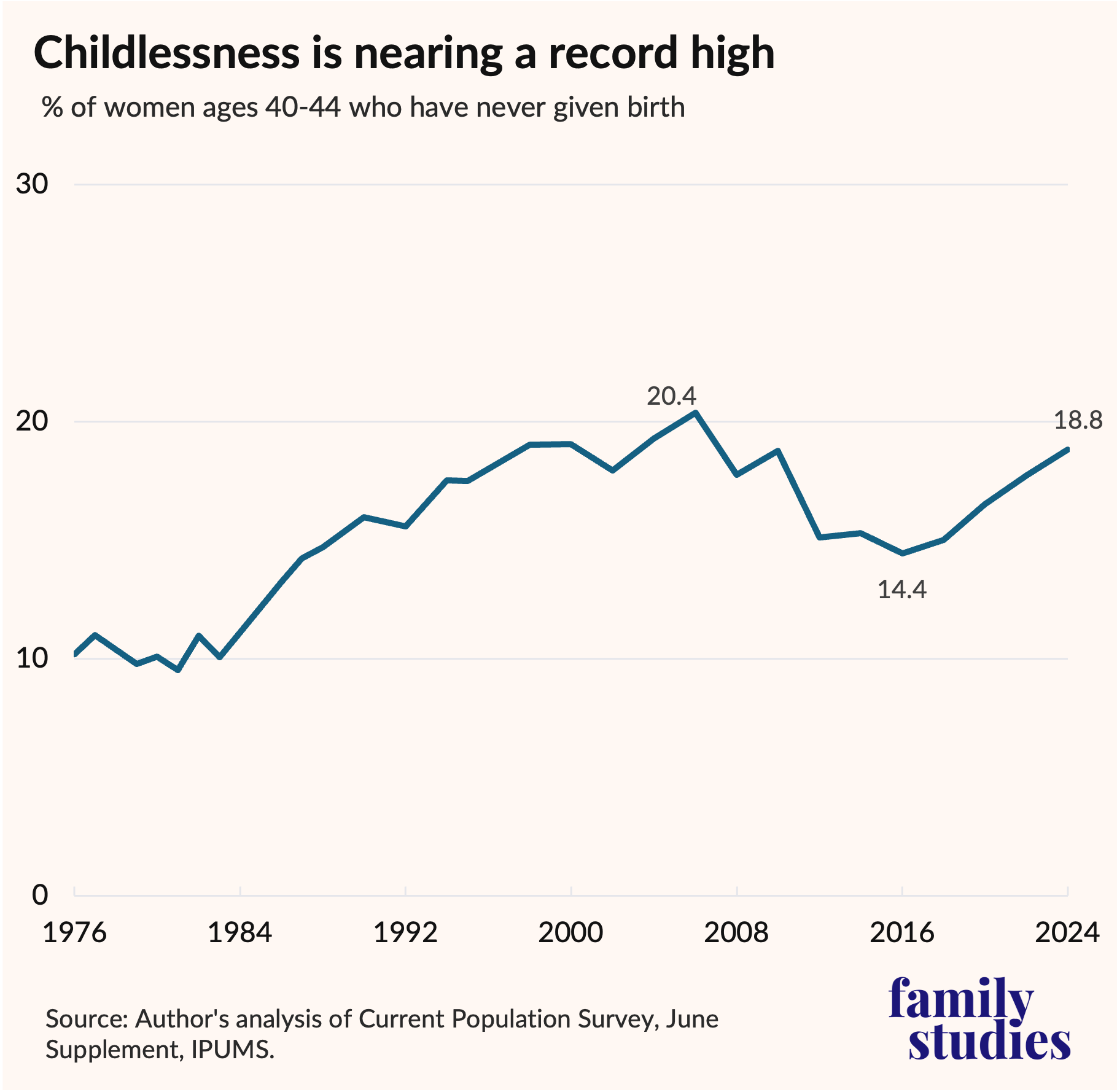
However, women who benefited from this wave of new reproductive technologies were born in the 60s and 70s (late Baby Boomers and Gen-Xers). As early Millennials (born in the 80s) enter their 40s in recent years, we have seen a steady rise in childlessness. Technology alone cannot explain this reversal. Much of this is likely driven by the decline in marriage among Millennials, which is another factor closely linked to fertility decline.
The U.S. fertility decline is shaped by many forces, but the data point to one primary driver: the collapse of childbearing among women in their 20s. Recognizing that is clearly the first step toward addressing it.
Wendy R. Wang is the Director of Research and Senior Fellow at the Institute for Family Studies, and an expert on demographic trends, marriage, family, and well-being.
*Photo credit: Shutterstock