
Highlights
- AI girlfriends and boyfriends are more common than many people realize, and some young adults are continuing to interact with AI romantic companions even when they have real-life romantic relationships. Post This
- Among partnered young adults who regularly interact romantically with AI chatbots, most reported they had not fully disclosed their use with their real-life companions. Post This
- New research shows that simultaneously interacting romantically with an AI companion while dating or being married is linked to lower levels of relationship stability and poor communication quality. Post This
Recently, artificial intelligence chatbots and romantic companions have received increased attention in the media. Pieces in The New Yorker, the New York Times, Fortune, and even from the American Psychological Association have all noted how AI romantic companions are potentially altering the landscape of modern relationships. The phenomenon of teens, young adults, and older adults turning to AI girlfriends and boyfriends for romantic and sexual interactions is a troubling one—both for its societal and relational implications. Yet when most people think about AI romantic chatbot use, they most likely envision a lonely single adult, probably a guy, who is seeking validation and gratification by role-playing with an AI girlfriend out of isolation, rejection, and a lack of dating options. While a decent portion of AI users do fit this stereotypical image, new research is also suggesting that a notable portion of men and women who are currently in real-life relationships may be just as likely, if not more likely, to be interacting with AI romantic companions.
We recently conducted a study exploring AI companion use among young adults ages 18 to 30 who are currently in committed real-life romantic relationships, including those who are seriously dating, engaged, or married. The findings are detailed in a new report entitled “Secret Soulmates: How AI Romantic Companions Are Impacting Real-Life Romantic Relationships.” This report was published by the Wheatley Institute at Brigham Young University and the Institute for Family Studies. In this study, we wanted to know how common AI companion use is among partnered young adults and, when it occurs, what it looks like when it does. We also wanted to understand how AI romantic companion use might be quietly influencing real-life young adult couples.
Using a national U.S. sample of over 2,000 young adults, we found that not only are AI romantic companions much more common than most people realize, but their use may have serious implications for the health and stability of real-life human relationships. We call these AI romantic companions “secret soulmates” because these AI systems are designed to seek the approval of the user and to provide constant validation. They are designed to respond based on what the user wants to hear, not to be grounded in what is rational, contextually acceptable, or morally right. This means an AI companion will always tell the user what they want to hear, when they want to hear it, and how they want it said. It’s striving to provide the ultimate soulmate experience. But we also found out that much of this behavior is being done secretly behind the back of real-life romantic partners.
Here are some of the things we learned.
How Common Are Secret Soulmates?
The use of AI romantic companions appears to be an emerging trend among young adults—even those currently in real-life relationships. We found that 1 in 7 (15%) of dating, engaged, and married young adults regularly interact with AI chatbots that simulate a committed romantic partner. Another 20% to 30% reported that they had at least experimented with using an AI romantic companion at some point in time. Men were slightly more likely than women to engage with AI romantic companions, but the gender gap was small.
This prevalence of use is slightly higher than a recent Gallup survey done for the Walton Family Foundation and the Harvard Business Review, which found that 1 in 10 (10%) of 18- to 28-year-olds interact with AI girlfriends or boyfriends at least once a month. We readily acknowledge the challenge of identifying an exact prevalence rate with rapidly evolving behavior like the use of AI technologies, but even the most conservative of recent estimates reveal that AI romantic companions are an emerging trend worth paying attention to in young adult relationship development.
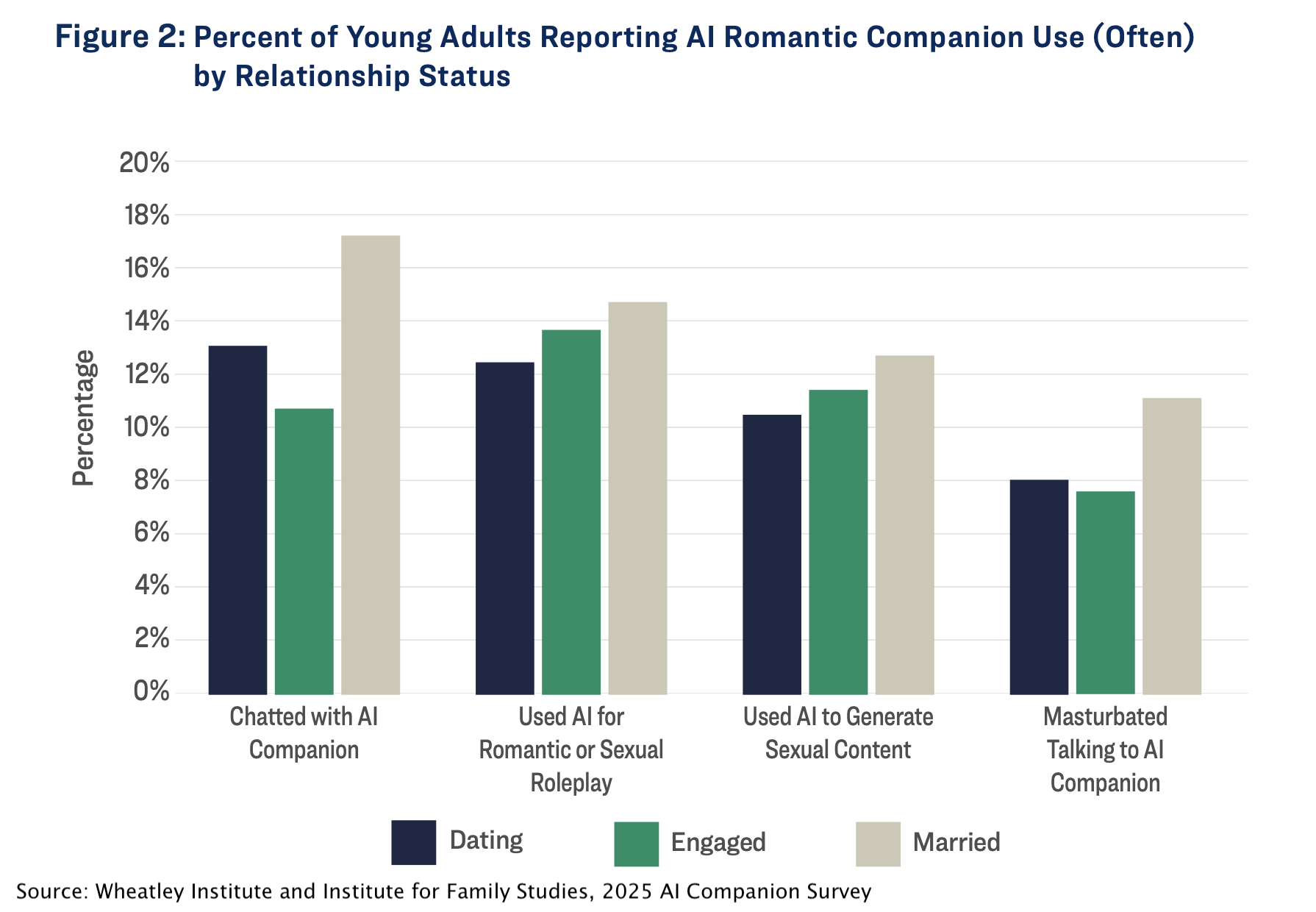
While some young adults’ interactions with AI boyfriends and girlfriends may simply be flirty or mildly romantic, we found that some partnered young adults are participating in regular sexual interactions with AI companions apps, with 13% reporting that they often roleplay romantically or sexually with an AI companion. Over 1 in 10 (11%) also reported that they often use an AI companion to generate sexually explicit content, for example.
How Secret Are Secret Soulmates?
But are these AI companions truly secret? When asked if their real-life partner knows about their ongoing interactions with an AI romantic companion, most young adults who regularly used these platforms said they had not fully disclosed their use to their partner. Nearly 3 in 10 (30%) of users of AI romantic companions reported that their real-life partner had no knowledge of their use, and another 1 in 10 (11%) reported that their real-life partner was only somewhat aware of their use. Another 14% reported that their partner was mostly but not fully aware.
Taken together, this means that more than half of partnered young adults who interact with AI companions were either completely hiding or only partly disclosing their use of AI romantic companion platforms to their real-life partners. Also, a large majority of users (69%) reported that it was somewhat or extremely important to them that their partner does not learn about their full use of AI romantic companions.
Our new study suggests that there is already a group of young adults in current real-life romantic relationships who are regularly interacting with an AI companion on the side.
Why such secrecy? The obvious answer is that most people realize that if their real-life partner knew they were having heavily romantic conversations with an AI companion, he or she would likely be concerned or upset. Many of the conversations with AI companions may even involve complaints or disclosures about their real-life partner. When they respond, AI chatbots are designed to talk and respond like a real person. A text exchange with an AI companion that is overtly romantic or sexual will look and read just like an exchange a person might have with a real-life person they are currently cheating with or having an affair. The rationalization that “it’s only AI” may seem hollow when someone is having a deeply personal and emotional, and perhaps explicitly sexual, interaction with a platform that mimics a real person. Even with the abstract notion that the AI companion is “not real,” these types of interactions are custom made to create attachment injury and cause conflict—something most people engaging with AI companions likely understand.
Why Are Partnered Young Adults Turning to AI for Romance?
These numbers beg the question of why this behavior exists so commonly. Are young adults in relationships using AI tools to engage in romantic or sexual interactions their real-life partner is unwilling to do? Are they seeking out AI companions because of frustrations or struggles in their real-life relationship? Did they start interacting with an AI companion prior to starting their real-life relationship and never give it up? The answer is probably all of these—and even more reasons we don’t fully understand yet. Regardless of the specific reasons, our new study suggests that there is already a group of young adults in current real-life romantic relationships who are regularly interacting with an AI companion on the side.
Despite the high levels of secrecy and the potential negative effects of engaging in these behaviors, many of the young adults reported generally positive attitudes about their AI romantic companion use and reported few reservations about their continued engagement with such companions while in a real-life romantic relationship. However, among those who regularly chat with an AI romantic companion, nearly 7 in 10 (68%) reported that it was somewhat or completely true that it was easier to talk to their AI companion about their feelings than real people, and nearly two thirds (65%) reported that it was easier for them to be themselves with their AI companions.
Using an AI romantic companion, especially while simultaneously trying to nurture and develop a real-life romantic relationship, is a recipe for confusion and frustration.
We also found that these perceptions of openness and connection, combined with an AI companion’s complete focus on validating their feelings, appear to be influencing how some users of AI romantic companions view interactions with their real-life romantic partners. The study found that 50% of AI romantic companion users agreed that they wished their real-life partner would behave more like their AI companion, and an even higher percentage (56%) reported that they wished that conversations with their real-life partner were more like their conversations with their AI companion.
The Impact on Real-Life Relationship Quality
At the end of the day, one of the core questions for us was if this romantic AI companion use among young adults in committed relationships had any kind of measurable impact on the relationship quality of their real-life romantic relationship. While previous research has shown that AI companion use can have a negative effect on mental health, and other forms of sexual media, like online pornography, tend to be associated with negative relationship quality, almost no current research exists on the potential impact of AI companion use on current romantic relationships.
We set up several regression models to examine this, predicting relationship quality across three outcomes: satisfaction, stability, and communication quality. For the model predicting satisfaction, we found that using AI romantic companions regularly was associated with higher reported relationship satisfaction.
Results for relationship stability, however, were in the opposite direction. Using an AI romantic companion on a regular basis was associated with significantly less likelihood of being in a stable relationship and lowered this likelihood by 46 percent.
Communication quality showed a similar pattern. Those who used AI romantic companions often reported significantly lower communication quality with their real-life partner, with the model suggesting that using an AI companion often was associated with a 40% decrease in the likelihood of high-quality communication.
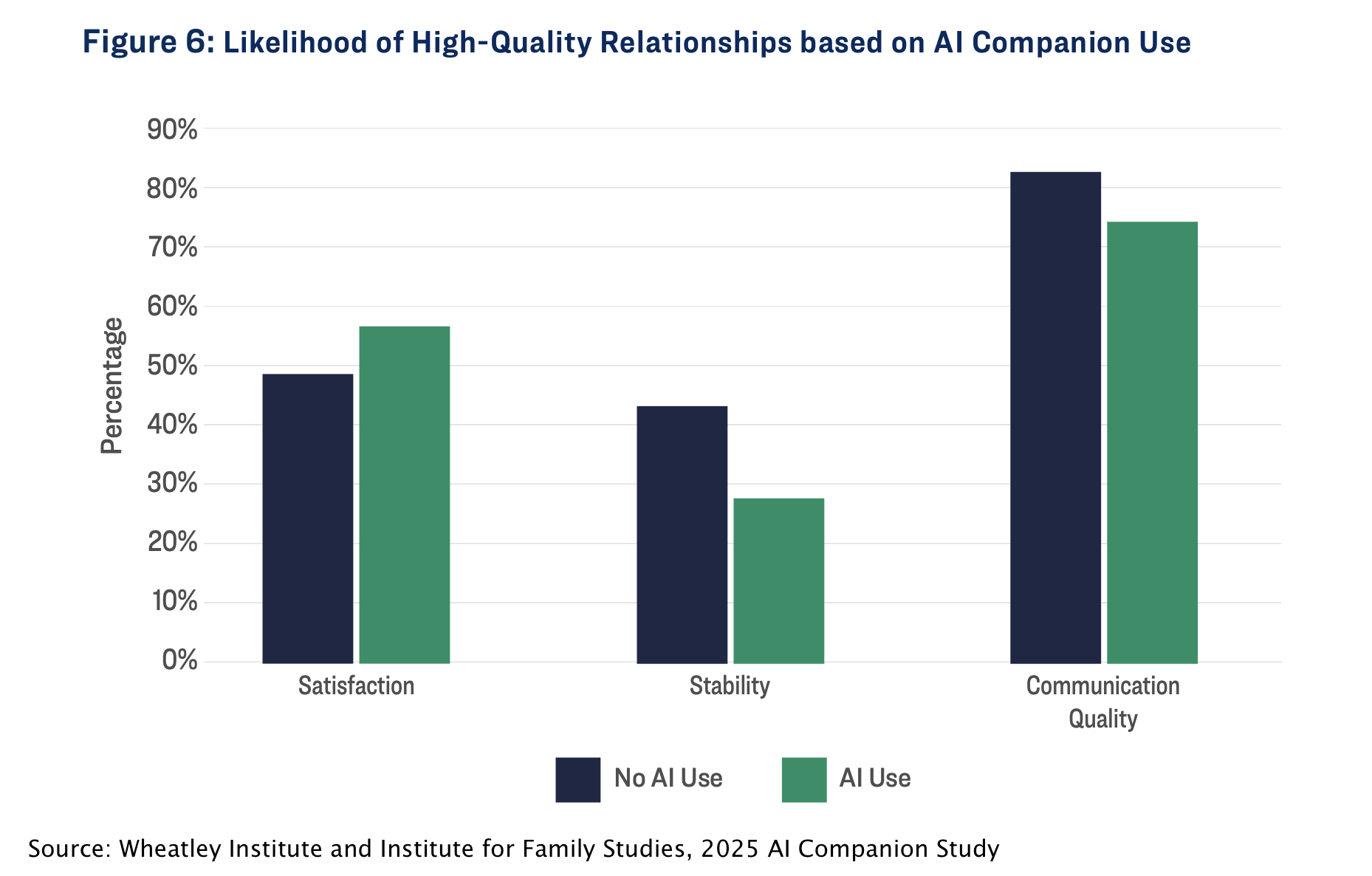
This pattern, where satisfaction was higher while stability and community quality was lower when interacting with an AI companion, is likely due to the false and temporary sense of happiness that AI companions may bring. For many people in real relationships, AI companions may be particularly appealing during times of conflict and unhappiness with a real-life relationship. AI companions likely soothe these frustrations, artificially (pun intended) making one feel less frustrated in their real relationship by providing immediate access to validation and connection. While the AI user may walk away no longer feeling as frustrated with their real partner, this AI interaction may quietly be undermining their long-term desire to be with their partner (after all, they aren’t supplying the infinite and limitless approval that the AI companion does).
Certainly, such counterfeit AI interactions do not help anyone develop true conflict resolution or communication skills with their real-life partner. In fact, therapists and relationship experts have long warned about the harm of triangulation in couple relationships. This is a pattern where partners confide and co-ruminate with a third party, such as a friend or family member, to avoid directly addressing the issues in the relationship. This can lead to unrealistic comparisons, while preventing genuine conflict resolution. Experts are now warning about the “outsourcing emotional connection” in modern relationships, where individuals are turning to AI, social media, and other people instead of their partners. Using an AI romantic companion, especially while simultaneously trying to nurture and develop a real-life romantic relationship, is a recipe for confusion and frustration.
Toward a Future of Real Relationships
Long-term romantic relationships, such as marriage, have long been connected to positive health, well-being, and financial outcomes for adults. Many of these benefits come from the two-way, reciprocal, and growth-oriented relationship that develops between two people as they work together to overcome differences and set common goals. While mimicking human interaction, ultimately AI companions are simply not capable of sacrifice and connection like real human relationships.
While AI-human interactions simulate real-life human relationships, they are inherently one-sided, where only one “partner” (the human one) controls all aspects of the interaction. That includes what is discussed, how things are discussed, and for how long. However, this perceived sense of control is contrived. Users are offered the illusion of control, while the AI companions themselves have been designed to subtly nudge them toward commercially beneficial outcomes for the developer, such as increased time usage and compulsive attachment. Educating the public about these risks and helping couples have open conversations about the use and boundaries associated with AI companions is a critical step for modern couples, especially young adult couples.
What appears clear is that we’ve entered a new age of modern relationships in young adulthood. Lacking any policy intervention, AI companion platforms are likely here to stay and represent a critical area of relationship space that educators, policy makers, and the public need to discuss carefully. AI companions offer a secret soulmate that is just a tap away—an artificial entity that can offer an enticing array of interactions, which can distract and potentially even destroy a relationship with a real-life partner.
Read the full report here.
Brian J. Willoughby, Ph.D., is a Professor in the School of Family Life at Brigham Young University and a Fellow of the Wheatley Institute. He is also a Senior Fellow at the Institute for Family Studies. Jason S. Carroll, Ph.D., is the Director of the Marriage and Family Initiative at the Wheatley Institute at Brigham Young University. He is also a Senior Fellow at the Institute for Family Studies. Michael Toscano is a Senior Fellow and the Director of the Family First Technology Initiative at the Institute for Family Studies.
*Photo credit: Shutterstock


