
Highlights
- Red states are losing less ground on fertility and gaining ground on marriage and family stability, per the 2026 Family Structure Index. Post This
- #1 on the Family Structure Index, Utah has the highest share of married prime-age adults, the highest share of teens in married-parent homes, and the sixth highest total fertility rate in the U.S. Post This
For years, America's elites have argued that blue states—with their generous family policies and better-educated populations—are better equipped to foster strong families. But according to the 2026 Family Structure Index, a new interactive report from the Center for Christian Virtue and Institute for Family Studies, the demographic trends tell a different story: red states manage to attract more families and foster higher marriage and fertility rates.
Families Leaving Blue States
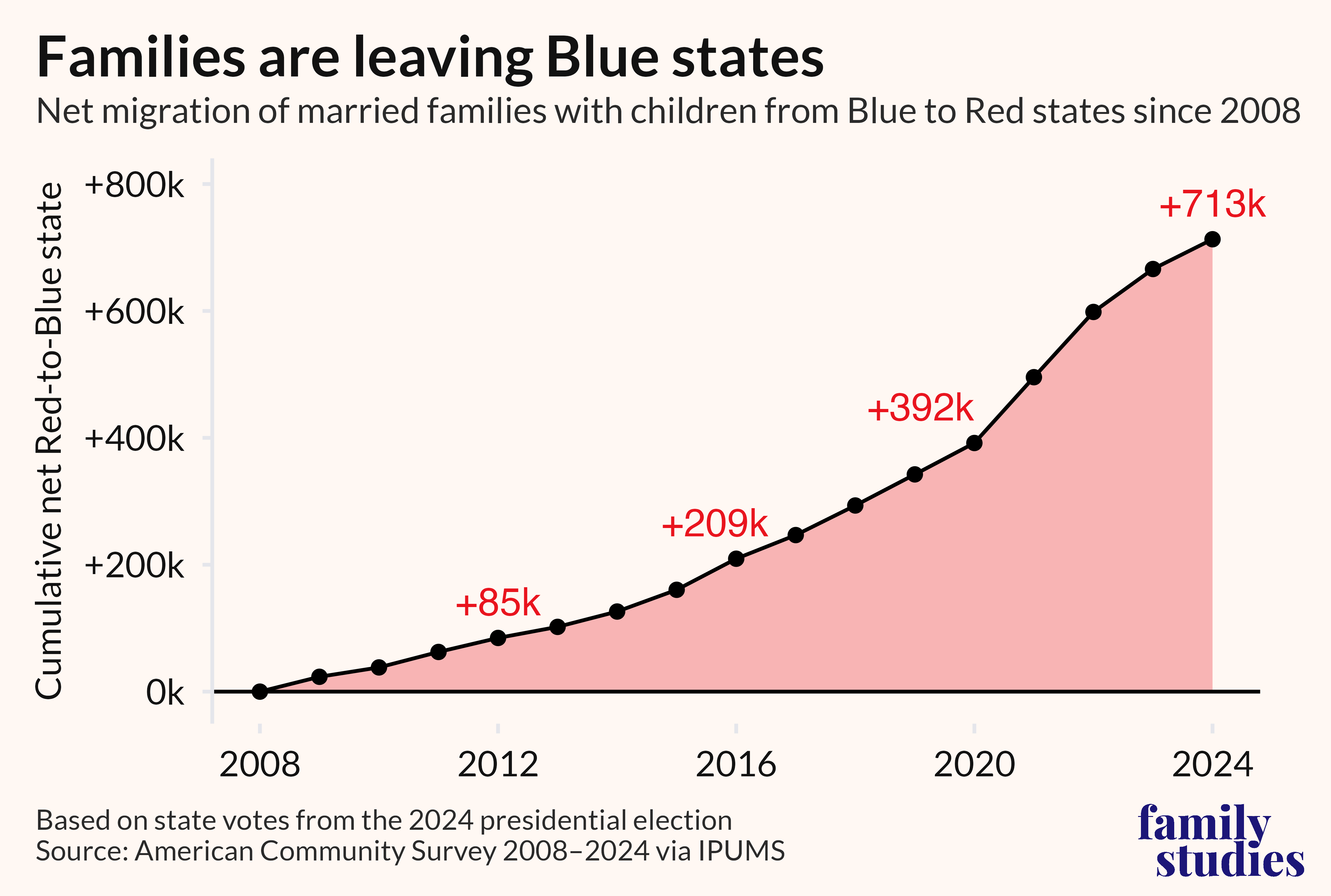
The 2026 Family Structure Index spotlights red states’ growing dominance on the family front. Take family migration. From 2019 to 2024, there has been a steady exodus of families from Blue to Red America—370,000 families from blue to red states. In fact, going back to 2008, a net total of 713 thousand married families with children left blue states for red states over 16 years.1
The Great American Family Sort
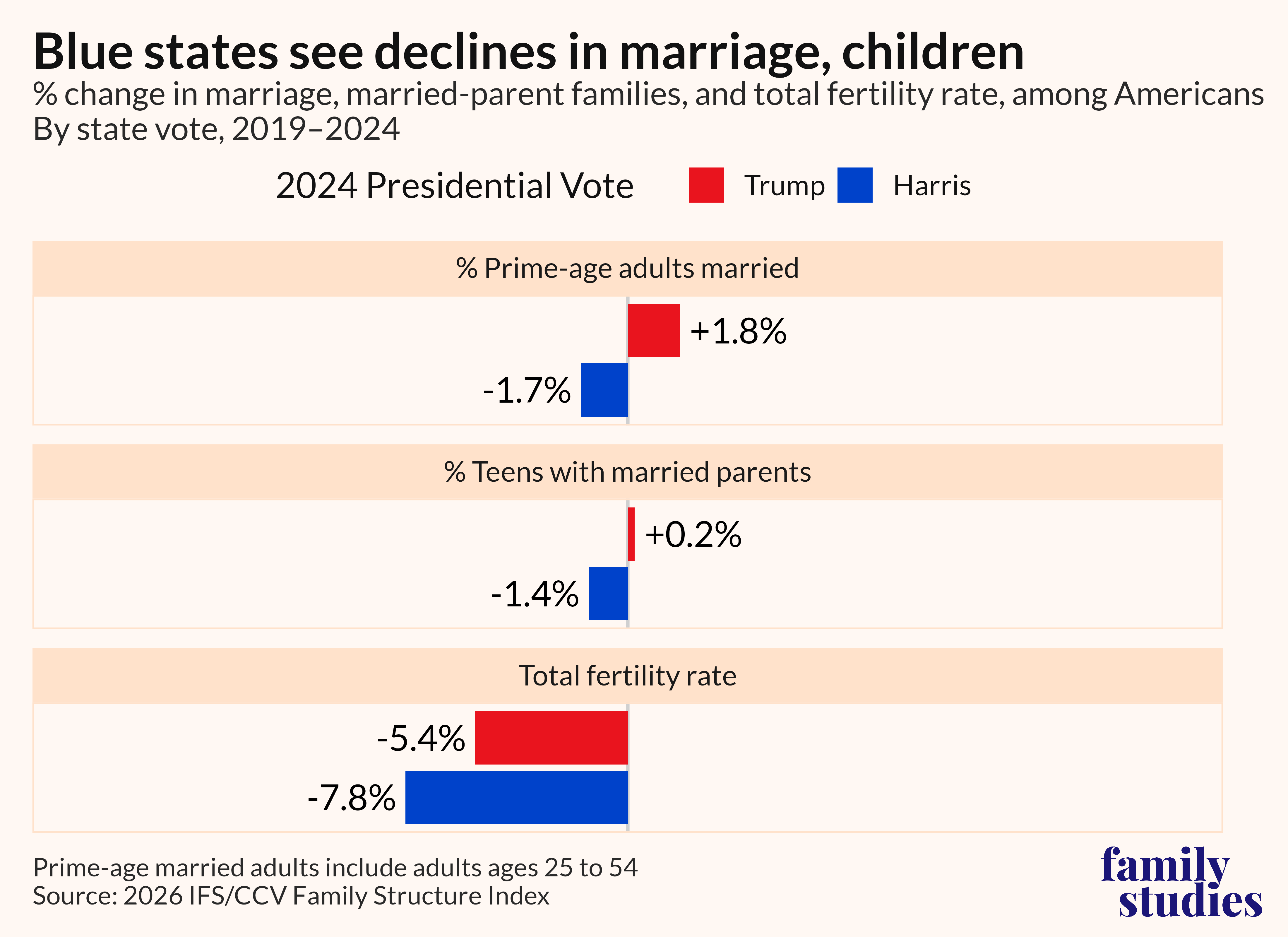
The report also finds that marriage and family trends moved in opposite directions in red and blue states. From 2019 to 2024, red states saw the share of prime-age adults who are married rise 1.8 percentage points and the share of teens in married-parent families rise 0.2 points; blue states saw both figures fall. Fertility declined across the board, but the drop was steeper in blue states. Taken together, there is a “Great American Family Sort” unfolding, where Americans are increasingly likely to get married and have and raise their kids in Red America.
Religion, Housing Affordability, and Fertility
These family trends are partly driven by regional religious differences. Drawing in part from the 2022–2023 Pew Religious Landscape Survey, we found a strong connection between religiosity and childbearing at the state level. Indeed, frequent religious attendance explains 57% of the variance between state-level total fertility rates.
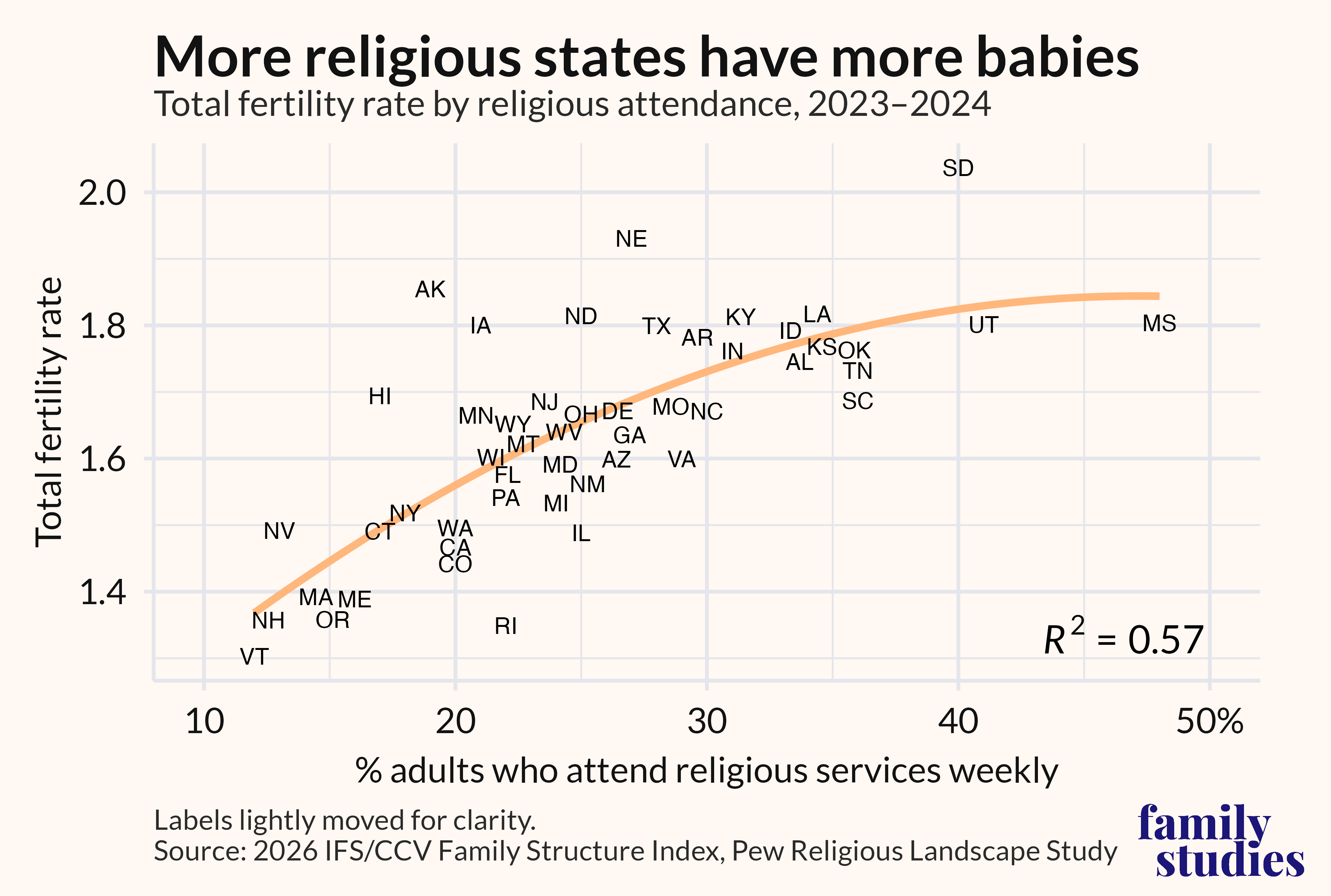
Northeastern states like Vermont, New Hampshire, and Massachusetts have less than 15% of their adult population frequently attending religious services and have fertility rates at or below 1.4. By contrast, states like South Dakota, Utah, and Mississippi have at least 40% of their adult population frequently attending religious services and have total fertility rates at or above 1.8.
In addition to religiosity, we find that unaffordable housing is linked to lower birth rates. We examined the typically priced 2-bedroom home for each state and divided this dollar amount by the median income of adults ages 25 to 54 working full-time. Using this price-to-income ratio, we find that expensive 2-bedroom housing explained 25% of the variance in total fertility rates between states.
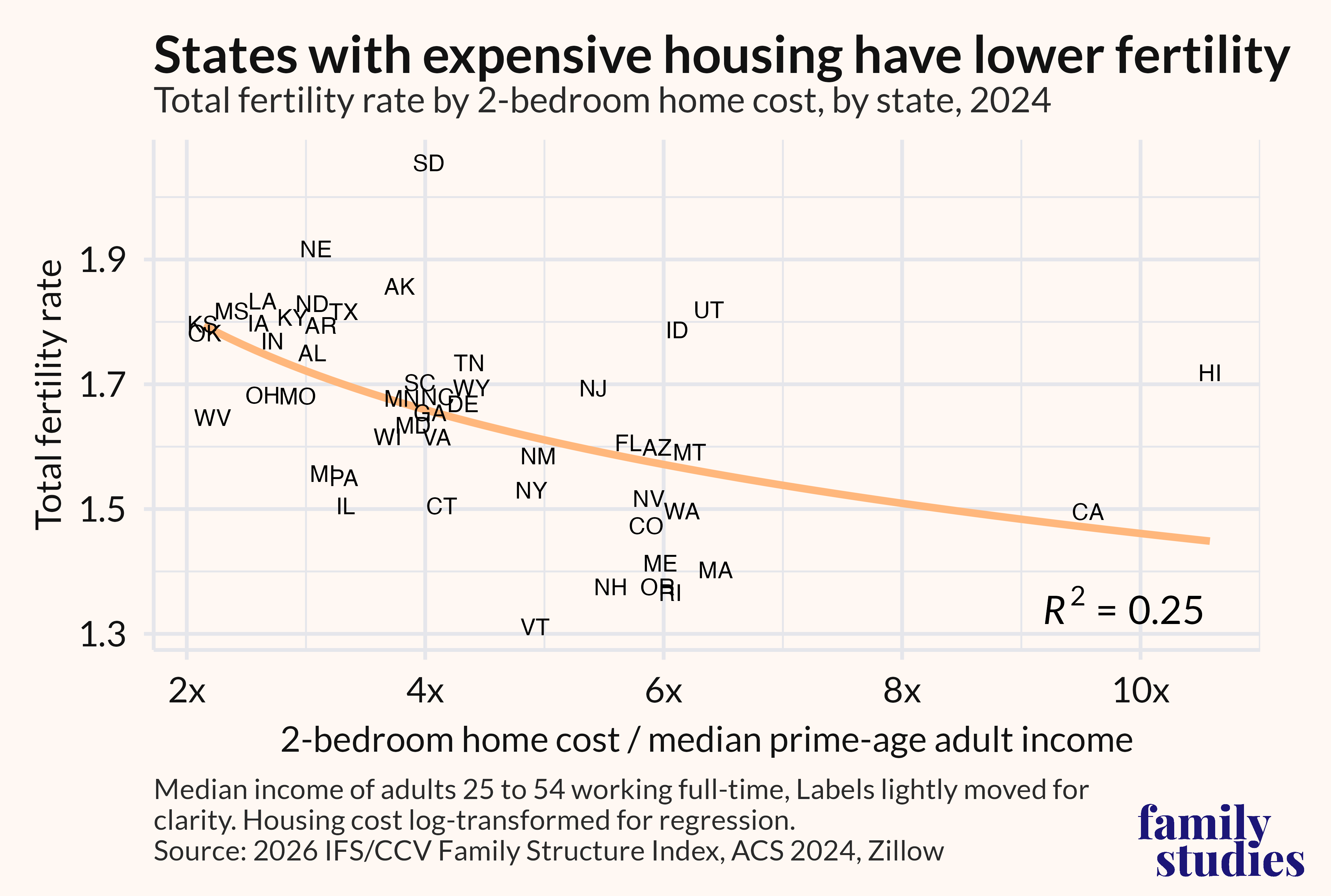
California and Hawaii are outliers in expensive housing, with typical 2-bedroom homes costing 9.5 and 10.4 times the median salary for prime-age adults, respectively. States like Kansas, Oklahoma, and Louisiana have higher fertility rates and lower housing costs, by comparison.
Our new report, then, indicates that red states are more likely to be first in family, compared to blue states, partly because they tend to have more affordable homes and more religious people.
Ranking States by Family Structure
These regional trends also show up in our 2026 Family Structure Index (FSI), which is composed of three variables: the share of prime-age married adults, the share of teens living with married parents, and the total fertility rate. Combining these measures, we calculate a state Family Structure Index score and find that Utah stands out as the top state when it comes to family structure. Ranking #1 in the Family Structure Index, Utah has the highest share of prime-age adults married, the highest share of teens in married-parent homes, and the sixth highest total fertility rate in the union. With a family structure score of 103, Utah is the only state to keep its composite score above national levels from 2000. Idaho, Nebraska, and South Dakota come in 2nd, 3rd, and 4th respectively. South Dakota, notably, is the only state in the Union with a total fertility rate above 2 today.
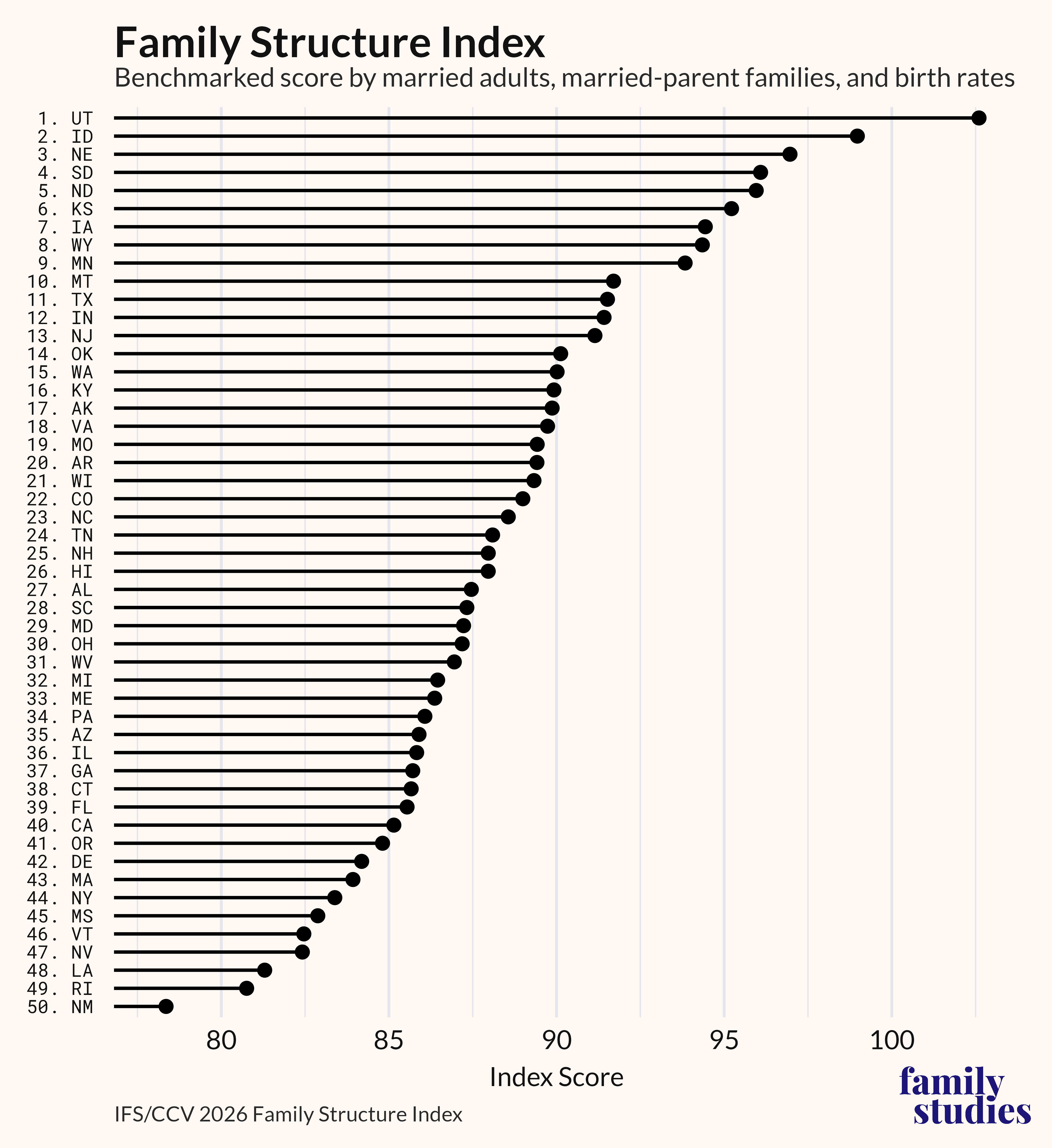
New Mexico ranks last in the 2026 Family Structure Index. In many low-ranking states, low levels of religion, a tradition of family instability, low education, or a high cost of living are associated with scoring lower on one or more measures of the FSI.
Not every red state performs well on the FSI—Louisiana, for instance, ranks third from last. And not every blue state struggles—Minnesota ranks ninth. But the overall pattern is clear: red states are losing less ground on fertility and gaining ground on marriage and family stability.
The implication is straightforward. Americans who put family first are increasingly making their home in Red America.
View the 2026 Family Structure Index here.
1. Blue and Red states defined by 2024 presidential election votes.


