Highlights
Conventional wisdom holds that children bring a special kind of existential purpose into the lives of their parents. A Pew survey of 17 countries found that “family and children” was by far the most commonly selected source of meaning in life, and a survey of Greeks found that 87% of parents marked “giving meaning to life” as an advantage of having children.
However, having children can be difficult, which may explain why, for some parents at least, well-being actually tends to dip when there are young children in the home. In one sense, this is completely unsurprising. If happiness is viewed in terms of what is known as hedonic pleasure—the pleasures of life like sleep, spare time, and fun out on the town—then it makes sense that children can feel like a net negative. Children are not fun in the same way as a night out dancing or playing a videogame.
What about the other forms of happiness and contentment? In technical terminology, this is known as eudaimonic well-being. This covers more transcendent, existential well-being, such as a sense of purpose and meaning in life. Somebody can have very little in terms of pleasures but still feel very anchored; conversely, wealthy people with all the toys and pleasures of life can still feel listless and unmoored.
But do most people with children really report higher meaning in life? While some of the larger surveys include a happiness question, and some research has shown that parents actually report lesss happiness (although earlier research of mine has shown that this is not true for religious parents), not a lot of these surveys include questions that tap into these more existential, purpose-driven aspects of well-being. However, the recently released Baylor/Harvard Global Flourishing Study has just that measure.1 Specifically, it includes a multi-item flourishing scale, of which one sub-scale is the “Meaning and Purpose” measure, which includes two questions: 1) The Things You Do in Your Life Are Worthwhile (0= Not at all worthwhile, 10=Completely worthwhile); and 2) You Understand Your Purpose in Life (0=Strongly disagree, 10=Strongly agree).
This same survey asks about the number of children under age 18 in the household.2 To adjust for the fact that older people are significantly less likely to have children in their household, only people 18-39 years old are considered in this analysis, which is based on U.S. data.3 These measures are dichotomized between whether they indicate 6 or higher (suggesting general agreement above the neutral “5” level on the 0-10 scale).4
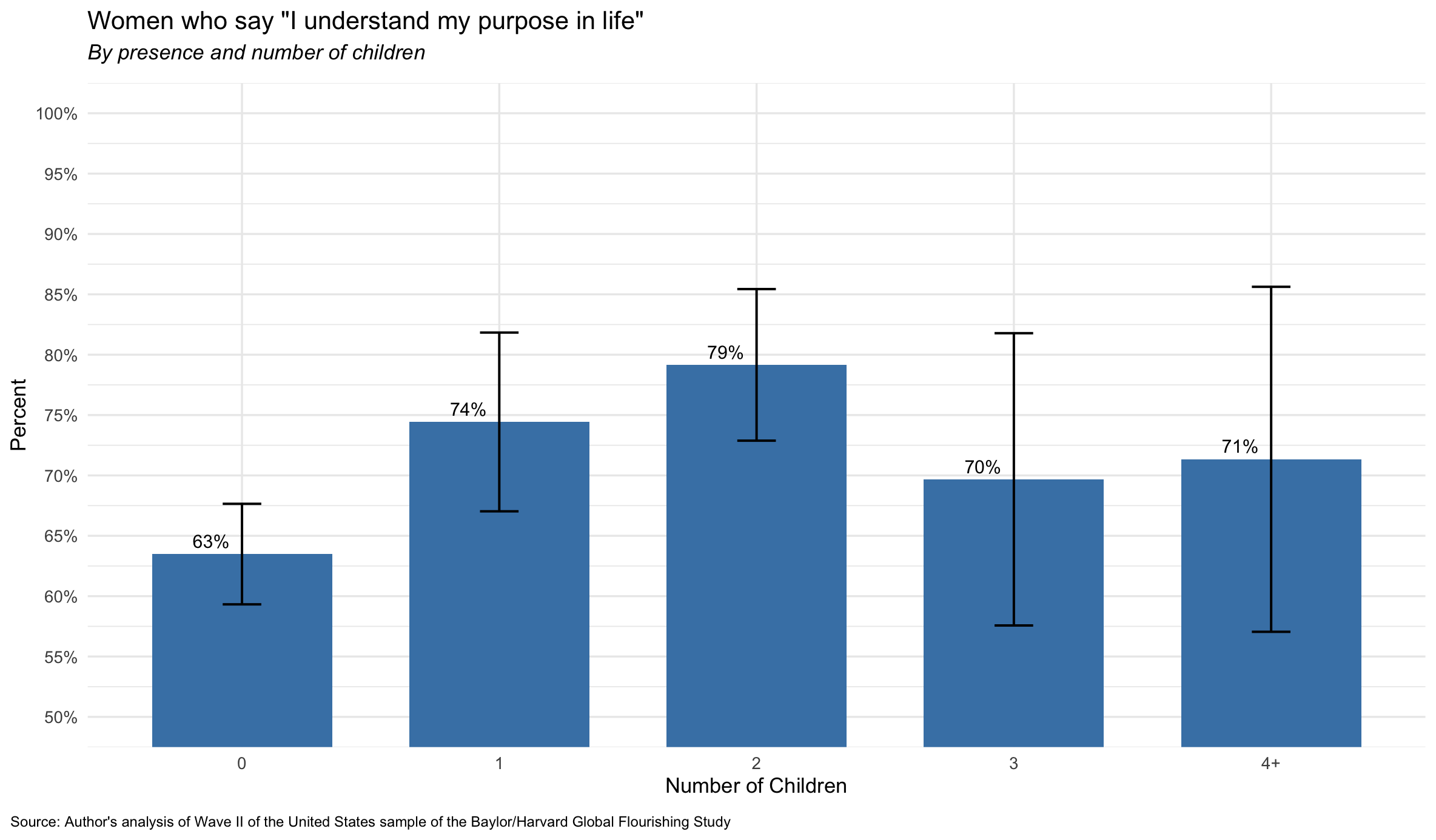
So, do parents under 40 have more purpose and meaning in their life than those with fewer or no children? The answer is clearly yes—for both men and women. While the relationship curves at the higher number of children—so that the difference from, say, 3 to 4 is slightly negative (although the smaller sample sizes make it difficult to know how much of that is noise)—even at these levels, both men and women are reporting more sense of purpose and life meaning than their childless counterparts.
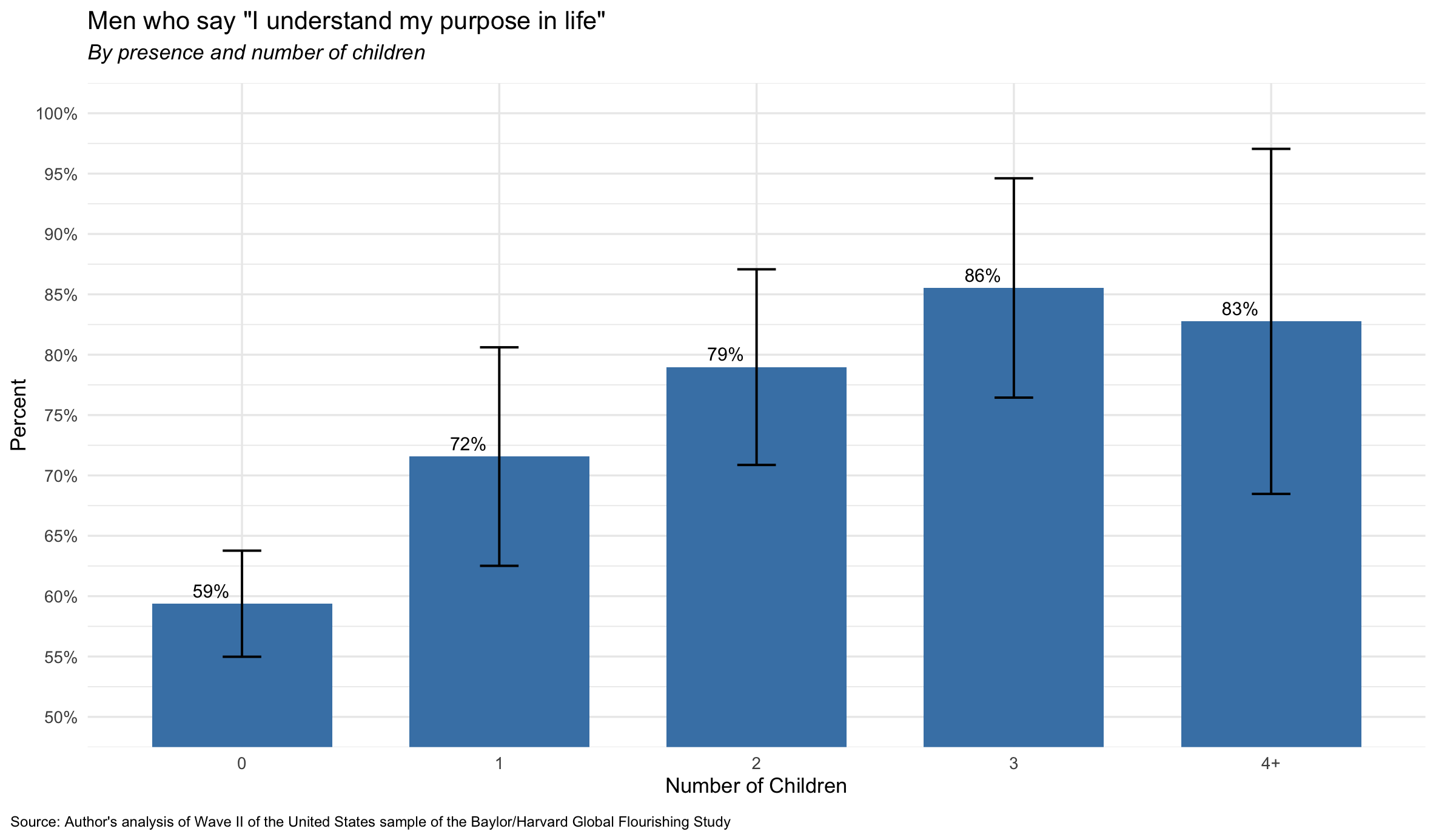
Both men and women are increasingly likely to say they understand their purpose in life as their number of children increases (up to 2 children for women and up to three children for men).
Furthermore, women and men who have more children are more likely to say that “the things I do in life are worthwhile” up to two children for women, and up to three children for men.
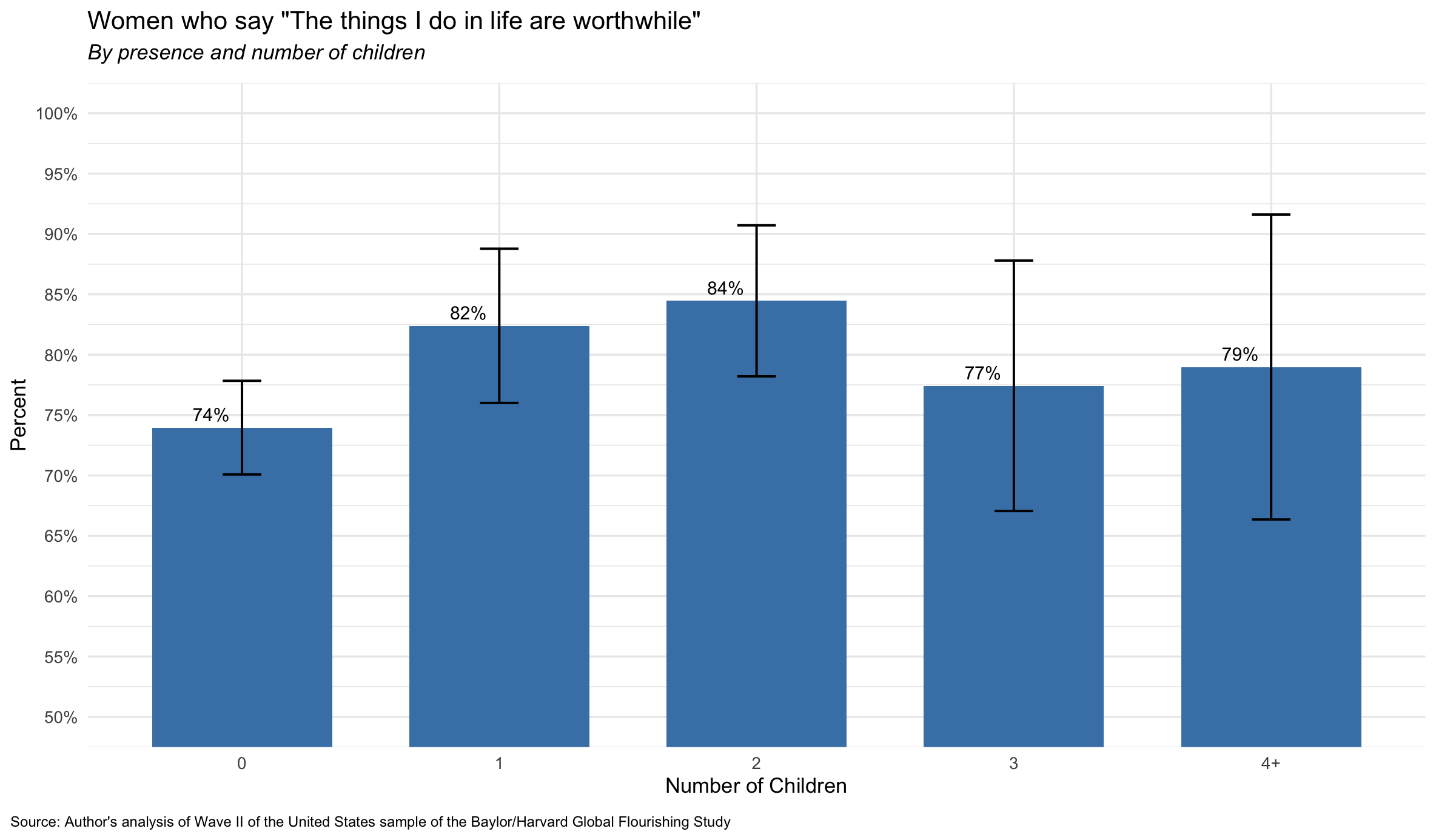
For both men and women, those who have no children are the least likely to say that the things they do in life are worthwhile.
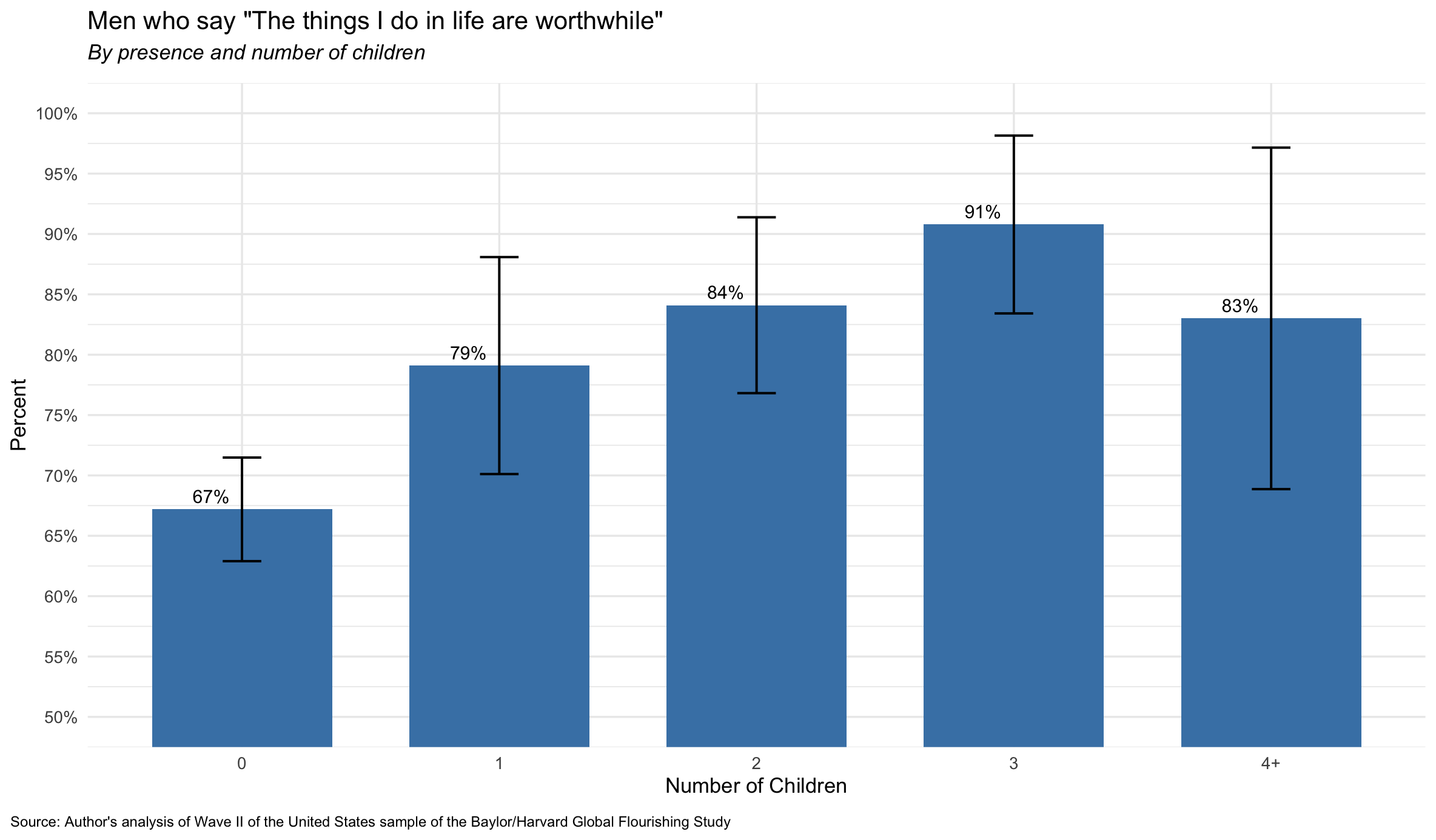
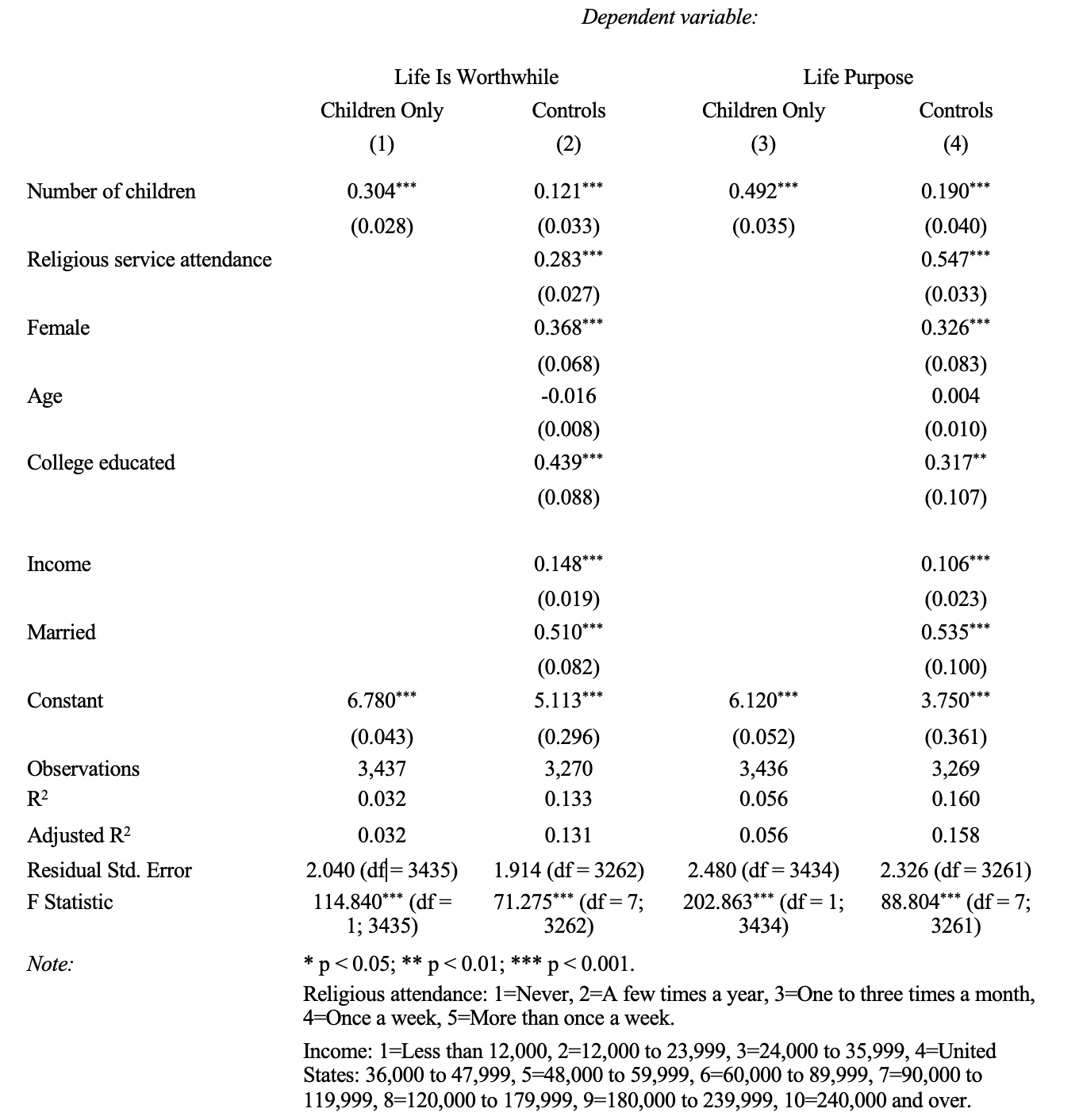
Of course, some of these findings may be because people with children are more likely to be married and religious, for example, so people with more children might have a more grounded sense of purpose because they are the kind of people who have children. When I perform a regression controlling for basic socio-demographics and religion and using the continuous 0-10 measure, a sense of purpose and life meaning are still strongly significant even when controlling for these factors, even though a lot of the “parenthood is connected to meaning” effect is from the fact that parents are more likely to be married, go to religious services, and the like (see Appendix below for more on this).
While there has been a lot more research using measures like “happiness,” the results here do match up with other studies on the topic:
- A report from the Institute for Family Studies/Wheatley Institution that draws on a survey of 3,000 women found that married women with children were the most likely to strongly agree that “my life has a clear sense of purpose” (unmarried women with children were in second place, above married women without children).
- A study from Social Psychology Quarterly (also discussed by IFS) that uses time-use data shows that parents report higher meaning from their time than non-parents.
- European parents report higher meaning in life than their childless counterparts.
- Losing a child decreases one’s purpose in life.
- Another survey of Portuguese found that “parents reported significantly higher levels of presence of meaning and engaged life, and lower levels of search for meaning.”
- A Finnish study measured the same people across time (a very robust design), and found within people that their sense of purpose increased right before and during the early stages of having children before stabilizing.
- A more recent study that drew on 10 countries found that parents reported higher eudaimonic well-being.
Overall, it appears that the conventional wisdom is borne out empirically with the latest data from the Global Flourishing Study. Children, while expensive in many ways, tend to contribute a higher meaning to their parents’ lives not already provided by the typical pleasures of life. While previous research has found as much, here I show that it’s not only parenthood per se that contributes to sense of purpose, but that up to a certain point, additional children continue to do so as well.
Stephen Cranney is a data scientist who occasionally teaches at the Catholic University of America.
Editor's Note: The opinions expressed in this article are those of the author and do not necessarily represent the views, policies, or positions of the Institute for Family Studies.
*Photo credit: Shutterstock
Appendix
Table: Children, Meaning, and Purpose
Endnotes
1. Here I use the United States Wave II data (the most recent publicly available data).
2. This is clearly related, but not perfectly correlated, with total number of children. Still, by focusing on children who are currently being raised by the individual it taps into parenting and sense of purpose, and not just the act of having children.
3. One person reported 33 children at home, and one person reported 66. These outliers were removed as it is assumed they are indicative of a data quality problem for those particular responses.
4. Provided weights are used for the summary statistics, because the models include covariates the regression analysis is unweighted.