
Highlights
- The well-being struggles of young working-class men are real, consequential, and at least partly rooted in childhood family experiences. Post This
- Class differences in well-being among younger working-class men are partially explained by family experiences, especially the relationship with the father. Post This
Men in America are not 'alright.' Whether it is men falling behind in the job market, not attending college, or never leaving their childhood home, American men are clearly in trouble. But not all men have been equally hit. Working-class men have especially faced the brunt of the happiness recession.
Experts from all leanings have provided explanations for why men, especially blue-collar men, are doing so poorly. Economists point to data that show how the working class has been left behind. Journalists suggest that insidious ideologies among the less educated share the blame. And some influencers argue that it’s the crisis in masculinity that explains male discontent. But woefully missing from this conversation is a factor hidden in plain sight: the family.
In a new IFS research brief, we look at the latest data from the Global Flourishing Study, a survey with over 200,000 participants in 22 countries, to explore how family conditions in childhood explain the well-being gap between college-educated and working-class men in adulthood (see the Appendix for the Data and Methods section).
Focusing on men in the United States, we find that childhood family conditions—particularly the relationship between father and son—provide a key explanation for why so many working-class men are struggling. The family variables we look at do not completely explain the gap between blue-collar and college-educated men, but they spotlight an important factor on the map: family structure matters for working-class men.
Working-Class Men Are Struggling
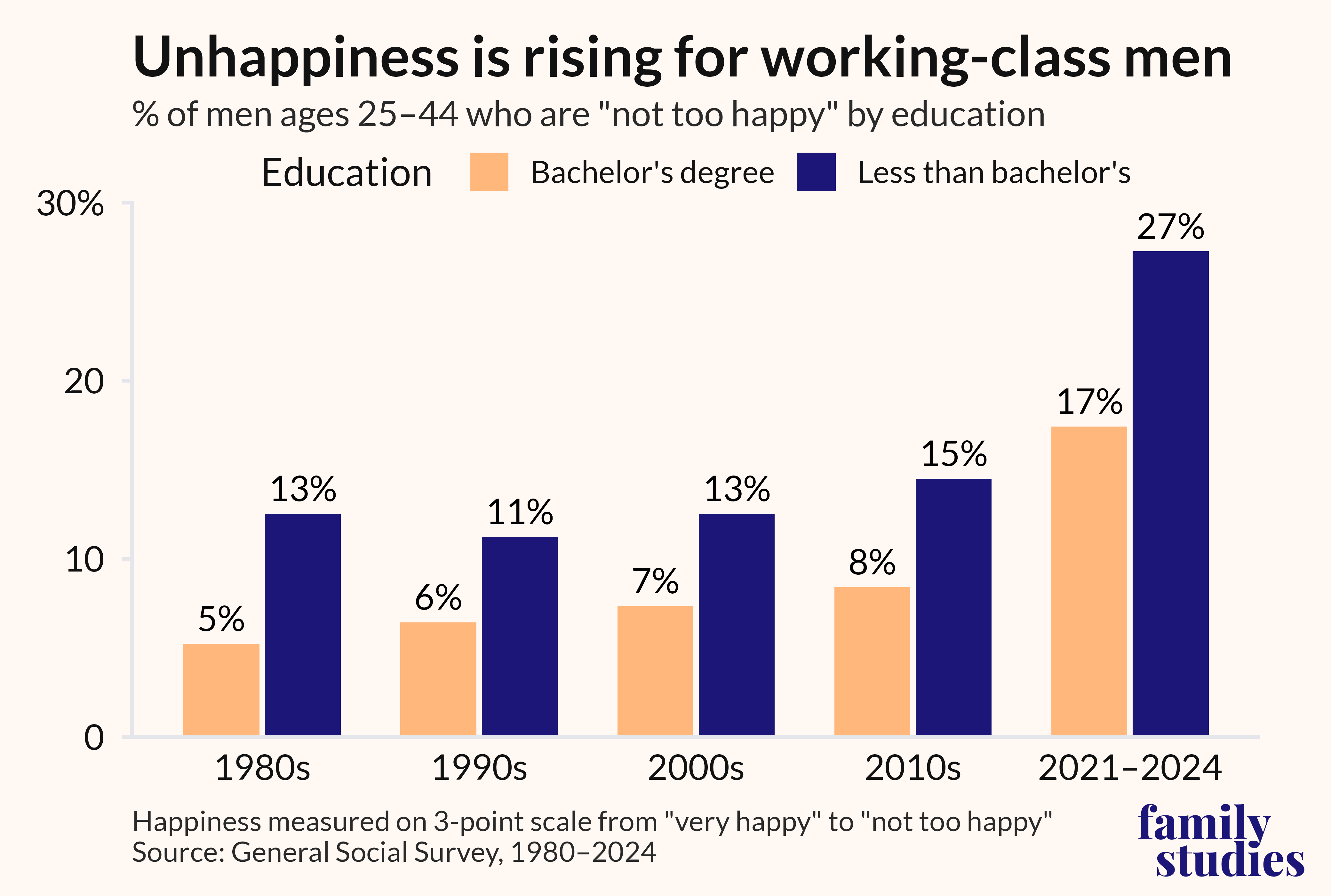
The well-being gap between working-class and college-educated men is panning out in nearly every well-being metric measured by sociologists and economists. Take just one example. Data from the General Social Survey (GSS) show that the share of men ages 25 to 44 who are “not too happy” has risen from 11% in the 1980s to 24% in the most recent years. Both college-educated and working-class men have seen declines in happiness. But men without a bachelor’s degree fare far worse, with 27% reporting they are “not too happy,” compared to 17% of college-educated men.
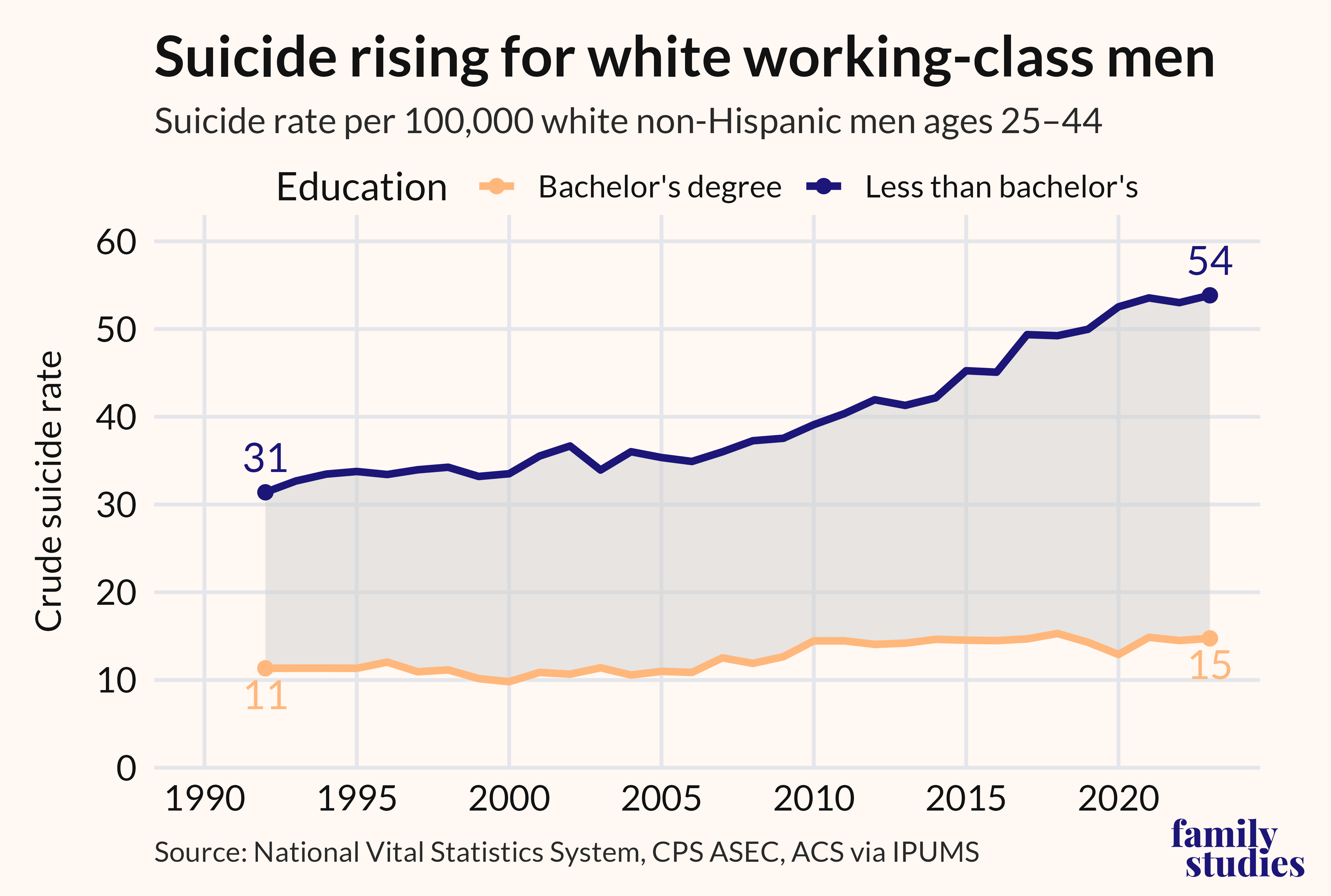
The class disparity in happiness is nothing new. The GSS data reveal that college-educated men were happier than their less-educated peers going back to the 1980s. And while the GSS shows somewhat steady levels of happiness from the 1980s through the 2000s, other well-being metrics suggest rising discontent in earlier decades. Mortality data, for instance, shows a steady and concerning rise in what researchers call “deaths of despair”—fatalities attributable to drug overdoses, suicide, and alcoholism. The rise in “deaths of despair” has been especially dramatic among white working-class men. Our analysis of death records and population estimates finds that the suicide rate per 100,000 white non-Hispanic men ages 25 to 44 has risen from 31 in 1992 to 54 in 2023, a shocking 71% increase over just three decades.
The roots of this crisis are partly economic. The collapse of manufacturing in the early-to-mid 1980s eliminated millions of stable, well-paying jobs that had long anchored working-class communities. Men without college degrees were hit hardest. Since 1970, their real wages have declined relative to their college-educated peers, and their labor force participation has fallen sharply—a trend that shows no sign of reversing.
But while the economy plays a role in the rise of working-class male despair, many economists miss a key factor: the family. In a recent Institute for Family Studies report, we documented the troubling collapse in family formation among men without college degrees. In 1980, men in their prime working years were roughly equally likely to be married and living at home with children, regardless of educational attainment. Since then, marriage rates have declined for all men, but the drop among non-college-educated men has been far steeper. The share of working-class men ages 25 to 44 who are married fell from 73% to 42% from 1980 to 2025, according to the Current Population Survey. The share of younger working-class men who are married with children at home fell from 61% to just 30 percent. This rising group of untethered men are disconnected from the stabilizing institutions of marriage and fatherhood that research consistently links to better health, purpose, and longevity.
This not only matters for the men themselves, but for the children they are raising in stable or unstable homes. We know that family of origin has a profound impact on well-being across the lifespan. Childhood experiences, particularly those within the home, shape how people assess the quality of their lives and whether they believe their futures hold promise. Working-class communities have now endured nearly 45 years of declining marriage rates and family instability, and the consequences are compounding across generations.
In our new research brief, we draw on data from the first wave of the Global Flourishing Study (GFS), a large-scale multinational survey fielded in 2023, restricting our analytic sample to U.S. male respondents ages 25 and older (n = 18,178). We define working-class men as those without a bachelor's degree and examine three well-being outcomes—hope, sense of worthwhileness, and purpose—using linear regression models that control for age, race, rurality, and nativity. We then employ a coefficient attenuation framework to assess the extent to which the well-being gap among young working-class men (ages 25–44) is explained by childhood experiences, including parental marriage, quality of relationships with mothers and fathers, perceived parental love, and parental religious attendance.
In plain terms, this approach asks how much of the well-being gap between working-class and college-educated men shrinks once we account for differences in their childhood family experiences. You can read more about the methods in the Appendix (available for download, here).
Differences in Well-Being by Class
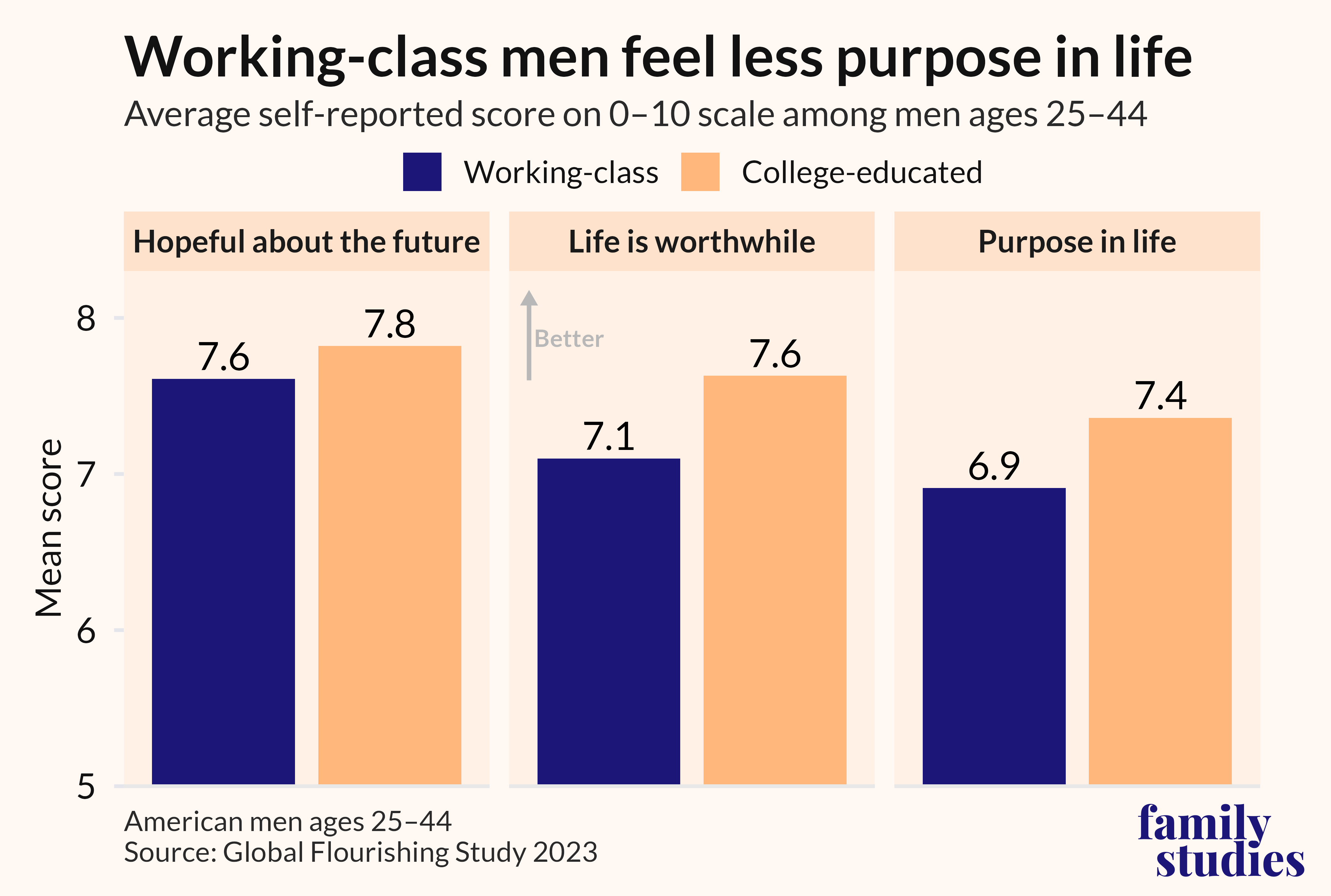
Consistent with other studies, we find that working-class men report lower levels of well-being than college-educated men. Specifically, on a 10-point scale, they report .21 lower scores on “hope,” .52 lower scores on “life worthwhile,” and .44 lower scores on “purpose.” These differences are relatively small-to-moderate in magnitude, but even small effect sizes can carry practical significance when examining population-level disparities in well-being.
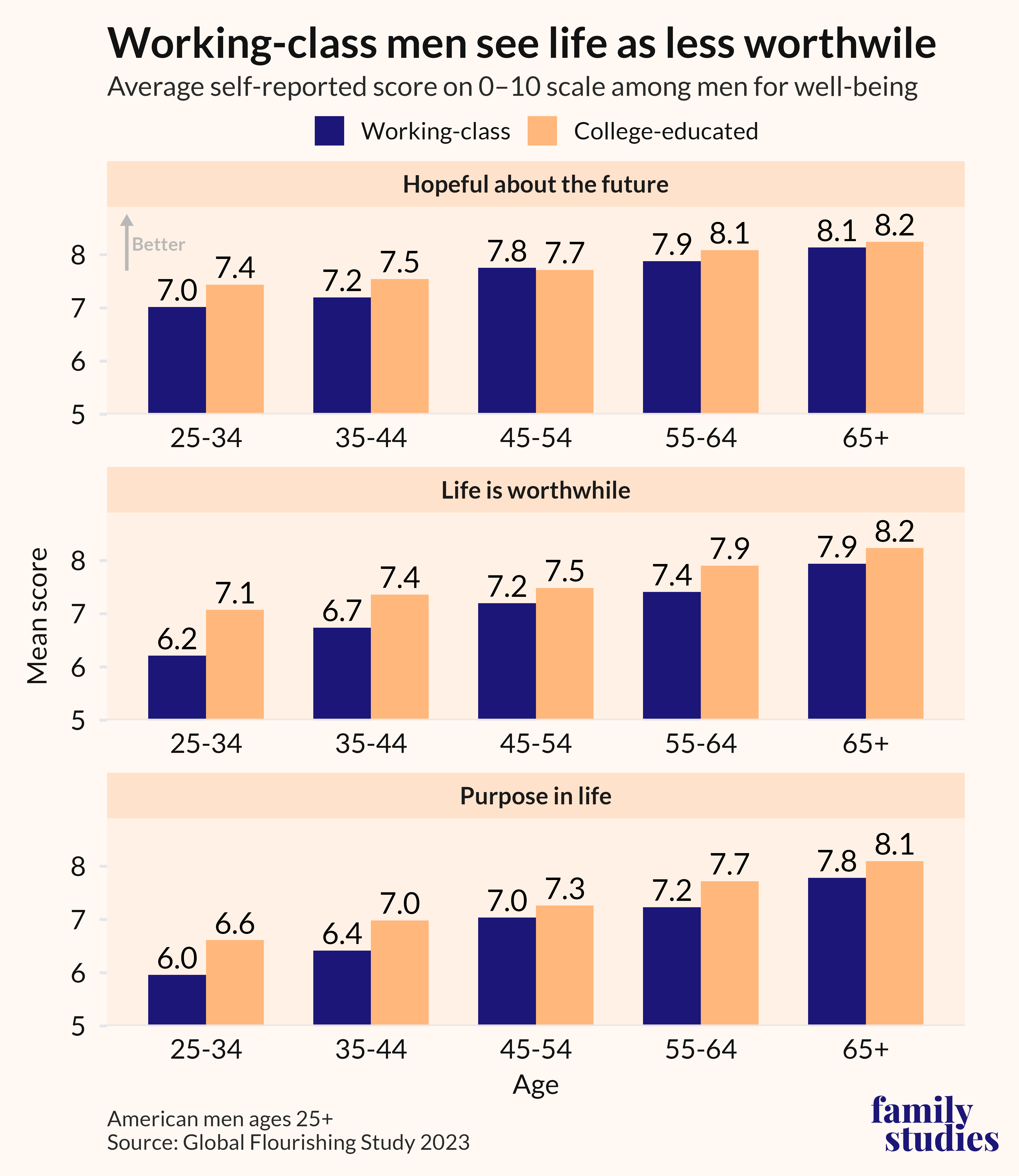
These overall variations, however, mask meaningful variation by age and class. As shown in Figure 4, two patterns emerge: (1) well-being scores increase with age, and (2) class differences in well-being are substantially attenuated at older ages. As a result, young working-class men report the lowest scores across all three scales. When comparing young working-class men to older men, effect sizes are quite large; when compared to their same-age college-educated peers, the effect sizes are moderate. Among men ages 45 and older, working-class and college-educated men report relatively similar well-being scores.
Class Differences in Well-Being: Family Structure
Class differences in well-being among younger men are partially explained by family experiences, especially the relationship with the father.
We find that young-working class men ages 25 to 44 are much less likely than their college-educated counterparts to have positive family experiences. These men score lower on all variables, and the differences are statistically significant for every variable.
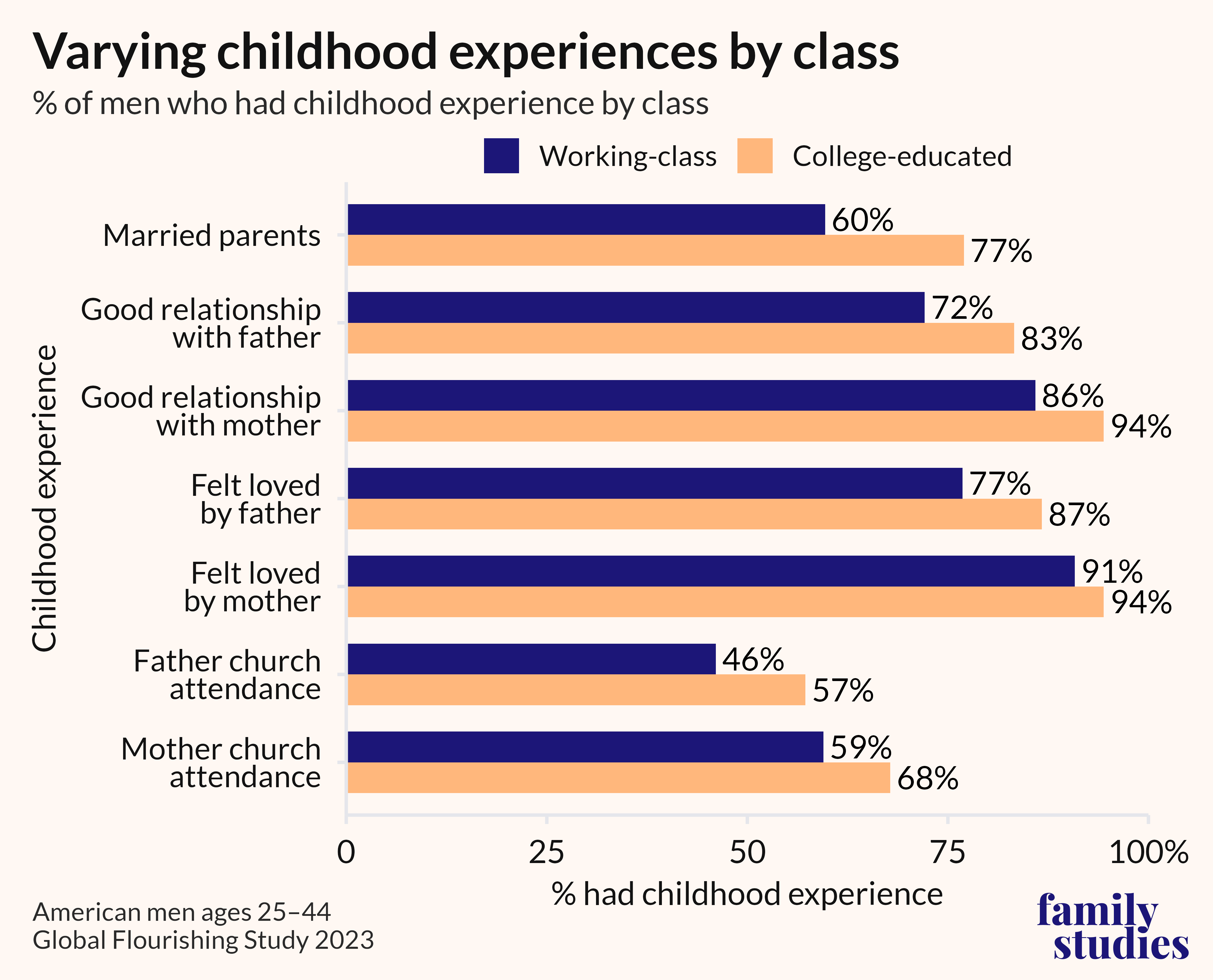
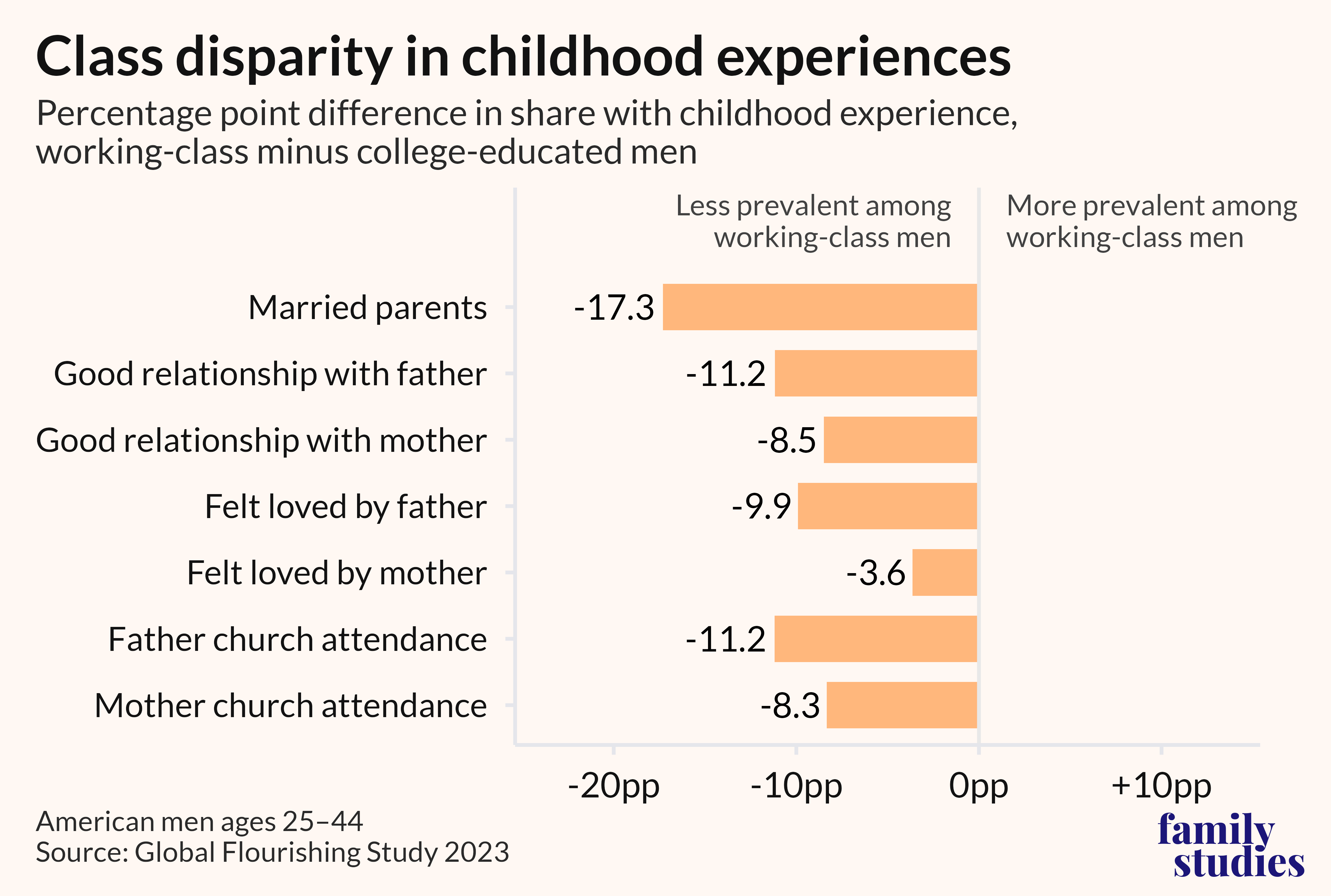
Compared to college-educated men, working-class men are 17 percentage points less likely to have grown up with married parents, 11 percentage points less likely to have had a good relationship with their father, and 10 percentage points less likely to have felt loved by their father.
Working-class men are also less likely to have had a good relationship with their mother, felt loved by their mother, or had church-attending parents. Such family variables demonstrate consistent, statistically significant correlations with the well-being outcomes—meaning that better childhood family conditions significantly predict later-life well-being. Previous studies suggest that relationships of this kind are at least partially causal.
Next, we focus on men ages 25–44 and examine differences in outcomes across the various family-related variables described in the methods section (see Appendix). The “baseline model” coefficient represents the relationship between the well-being outcome of interest and class. The subsequent variables represent the relationship between well-being and class after accounting for the family variables.
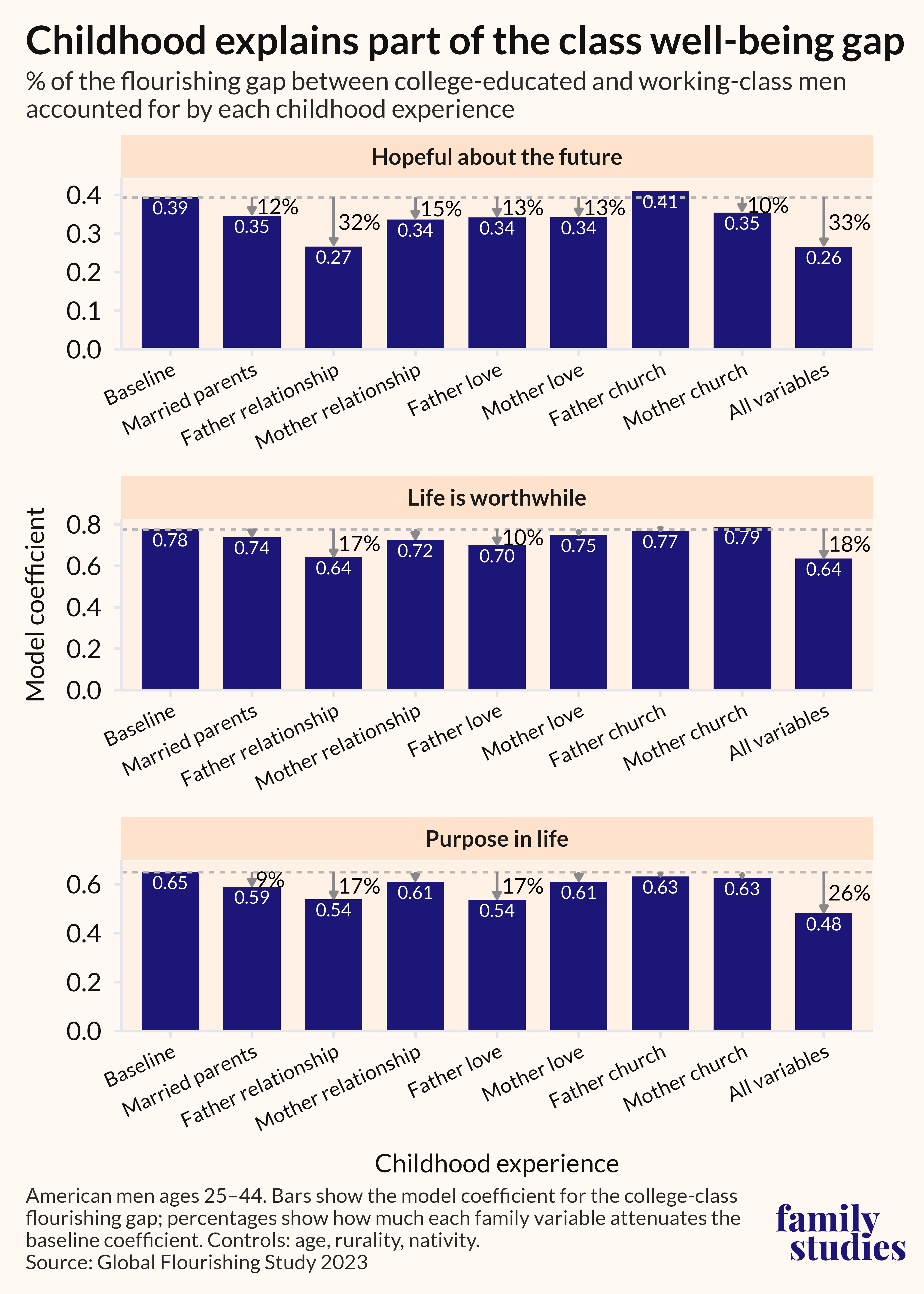
We find that differences in well-being between college-educated and younger working-class men are significantly explained jointly by the family variables, ranging from 18% to 33 percent. Hope is the most significant factor explained by the family variables, whereas assessments of life as worthwhile and a sense of purpose are explained less by family variables.
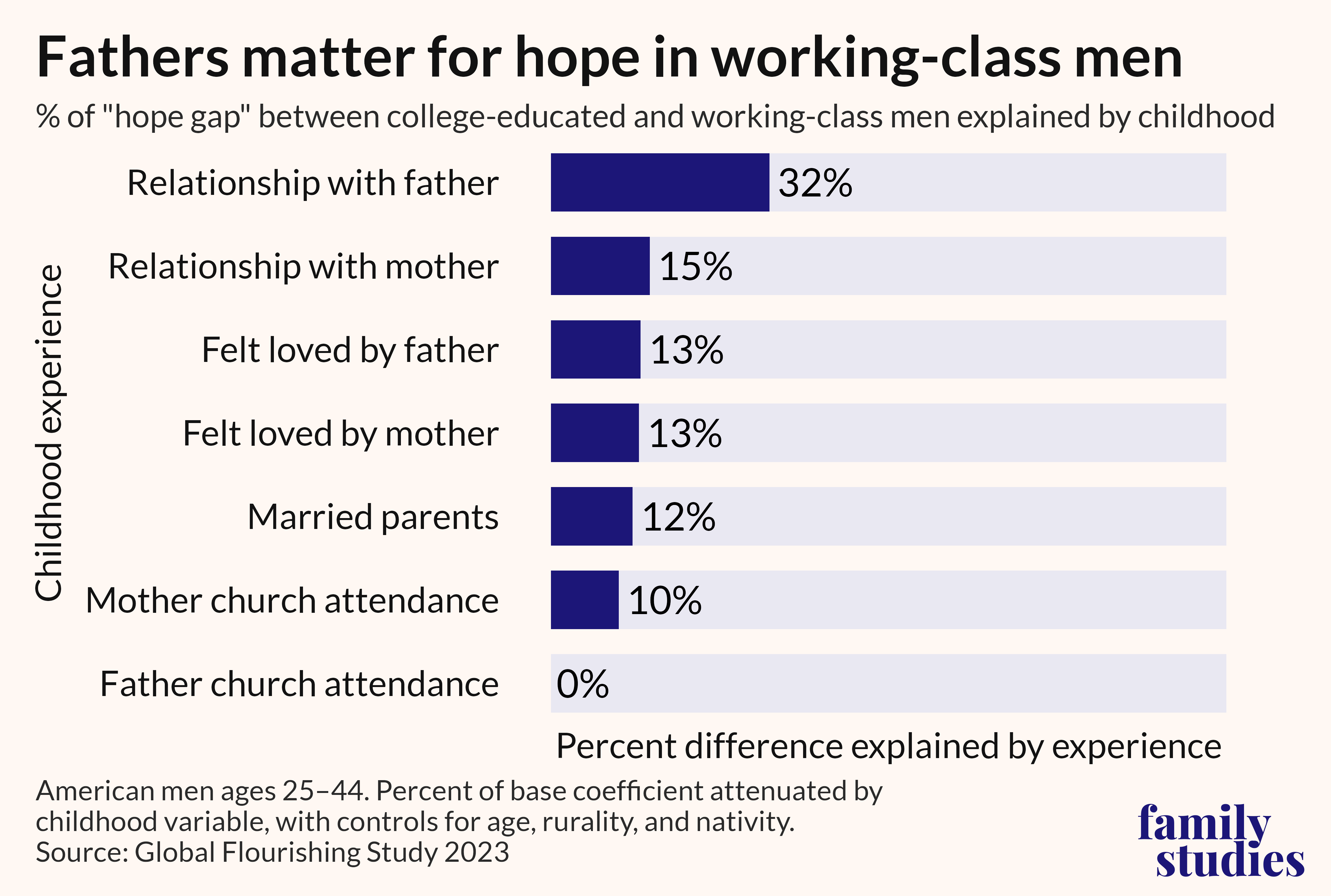
Across all models, relationship with the father is the most significant explanatory variable of the association between class and the outcomes of interest. It explains nearly one-third of the difference in hope between college-educated and working-class young men. In sum, feelings of hope for men in young adulthood and into middle age are connected to childhood family conditions, with the father-son relationship being particularly salient.
Discussion
We find statistically significant differences in well-being outcomes by class, though it is worth noting that effect sizes in the overall models are small. While these differences are real and merit serious attention, care should be taken not to overstate the plight of working-class men as a whole.
That said, meaningful differences do emerge when we stratify by age. Younger working-class men are considerably less hopeful than their older counterparts. While it is impossible to cleanly distinguish age from cohort effects with the data available, it seems plausible that many of these younger men will grow more hopeful as they move through adulthood and accumulate the stabilizing resources—relationships, careers, community—that tend to come with time. What is clear, however, is that the class gap in well-being is pronounced among younger men in a way that it simply is not among older men. Young working-class men rate their well-being substantially lower than young college-educated men across the outcomes we examine, and this disparity deserves to be taken seriously.
To make sense of these findings, it is essential to situate them within a broader structural context. Over the past four decades, family life in working-class communities has undergone significant and well-documented erosion. Rates of family instability, father absence, and household economic stress have risen sharply in these communities relative to their college-educated counterparts. It is against this backdrop that our results take on their full meaning. Across every family-related variable in the dataset, young working-class men report consistently lower scores than young college-educated men. These differences reflect accumulated disadvantages in the family environments in which these men were raised.
For [working-class] young men, the relationship with their father emerges as arguably the single most influential factor shaping their sense of hope.
Critically, these lower family variable scores partially explain the relationship between class and well-being, helping to clarify why young working-class men fare worse on the outcomes we examine. The largest and most consistent attenuation effect is observed for hope. The seeds of hope are likely planted early in life, nurtured within the family environment. For these young men, the relationship with their father emerges as arguably the single most influential factor shaping their sense of hope. A similar pattern holds for assessments of life being worthwhile and for a sense of purpose, though the attenuation is somewhat less pronounced for these outcomes. Taken together, the findings suggest that family of origin—and the father relationship in particular —plays an important role in transmitting, or in failing to transmit, the psychological foundations of a hopeful and meaningful life.
Conclusion
The well-being struggles of young working-class men are real, consequential, and—as this analysis shows—at least partly rooted in childhood family experience. While economic forces have undeniably shaped the landscape of working-class life, the research points to something closer to home, namely the relationships with parents. The father-son relationship in particular stands out as a powerful driver of whether young men grow up with hope, purpose, and a sense that their lives matter.
Reversing the tide of working-class male discontent will require honest engagement with this reality. Stronger family stability, father involvement, and support of the relational foundations of childhood are not peripheral concerns. They are central to any serious effort to help the men being left behind.
Note: Download the full research brief to read the Data and Methods information.
*Photo credit: Shutterstock


