

Highlights
- My analysis for the CSJ estimates that the Finnish reform reduced the number of couples marrying and cohabiting, while also reducing fertility. Post This
- The reduction of the first marriage rate and the total number of working-age adults living together coincided with a fall in the fertility rate more drastic than other Nordic countries. Post This
The marriage certificate is more than just a piece of paper, even in countries like Finland, according to new research from The Centre for Social Justice (CSJ) in London, which confirms that the process of formally saying ‘I do’ still matters.
The British government is currently soliciting feedback and ideas on plans to grant property rights to cohabiting couples on the grounds that this change will protect people in unformalized romantic unions. The details of the proposed reform are yet to be confirmed as they are in consultation; however, the consultation includes a stated desire by the government to strengthen financial rights for cohabiting couples at the dissolution of their unions, treating the breakup of a cohabiting couple more like an actual divorce, giving partners the right to make claims on each other's resources.
Some might think that such reforms will help coupling by encouraging unmarried couples make strong commitments to each other through the de facto pooling of property rights—if breaking up a cohabiting relationship is harder to do, then maybe those relationships will be more stable and invested. Unfortunately, research I conducted for the CSJ finds that when Finland implemented similar reforms in 2011, several negative outcomes ensued.
FINNISH-ED WITH MARRIAGE?
In Finland, beginning in 2011, individuals in a cohabiting partnership that last longer than 5 years or who have a child with their cohabiting partner have the right to demand financial compensation for unpaid household work, similar to the laws allowing married couples in a divorce to do so. This is very similar to what is being considered in the UK, so it’s worth asking what happened in Finland.
My analysis for the CSJ estimates that the Finnish reform reduced the number of couples marrying and reduced the number of couples cohabiting, while also reducing fertility. Making cohabitation more like marriage, especially for cohabiting parents, resulted in a broad-spectrum shift away from family life. Some people used the strengthened cohabitation rules as a replacement for marriage, some cohabiters avoided having kids to evade those rules, and some people were scared away from moving in together at all. The proposed reform in Britain, intended to protect cohabiting couples, could therefore likely prompt a slew of dissolved unions, unions never formed, and Britons never born.
The CSJ report investigated this through the synthetic control method, which takes a weighted average of the other variables to create a ‘synthetic control’ for comparison after the intervention has occurred. The following graph shows the decline in women’s first marriage rate in Finland relative to a synthetic counterfactual. By 2018, Finnish women’s first marriage rate was 23% lower than the estimate of what it would have been had the reform never happened. This is not too surprising : by increasing the property ties individuals can have without marrying, the reform may have reduced the perceived value of marriage in the eyes of many Finns.
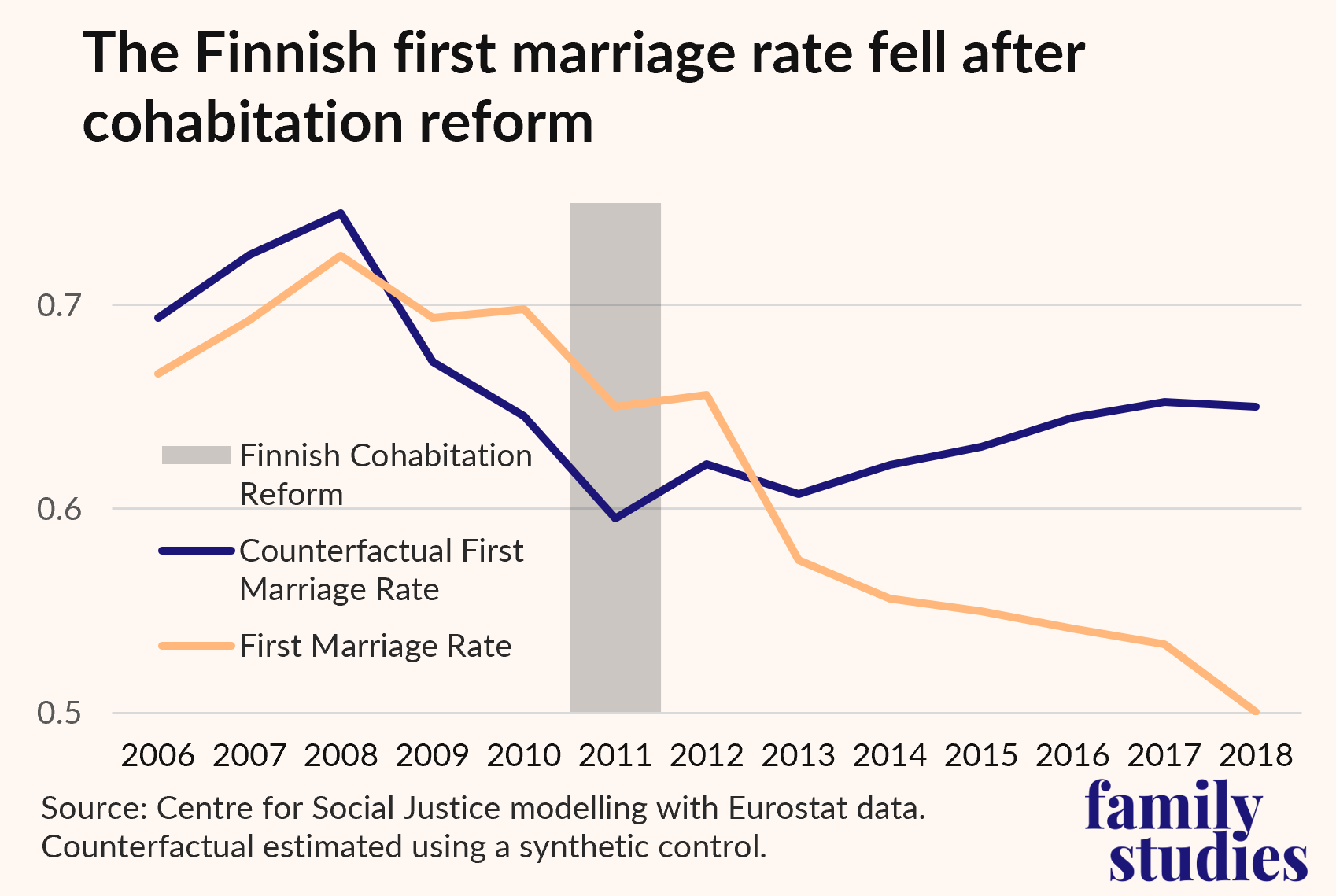
This is a big problem: as the IFS has found, there is a consistent positive association between marriage and overall well-being, including happiness and having a clear sense of the future.
However, many people in the UK are unconcerned with the marriage rate. The designers of the proposed reforms likely were not concerned with the effects on marriage, instead hoping to extend the protections of the public marriage vow to cohabiting couples.
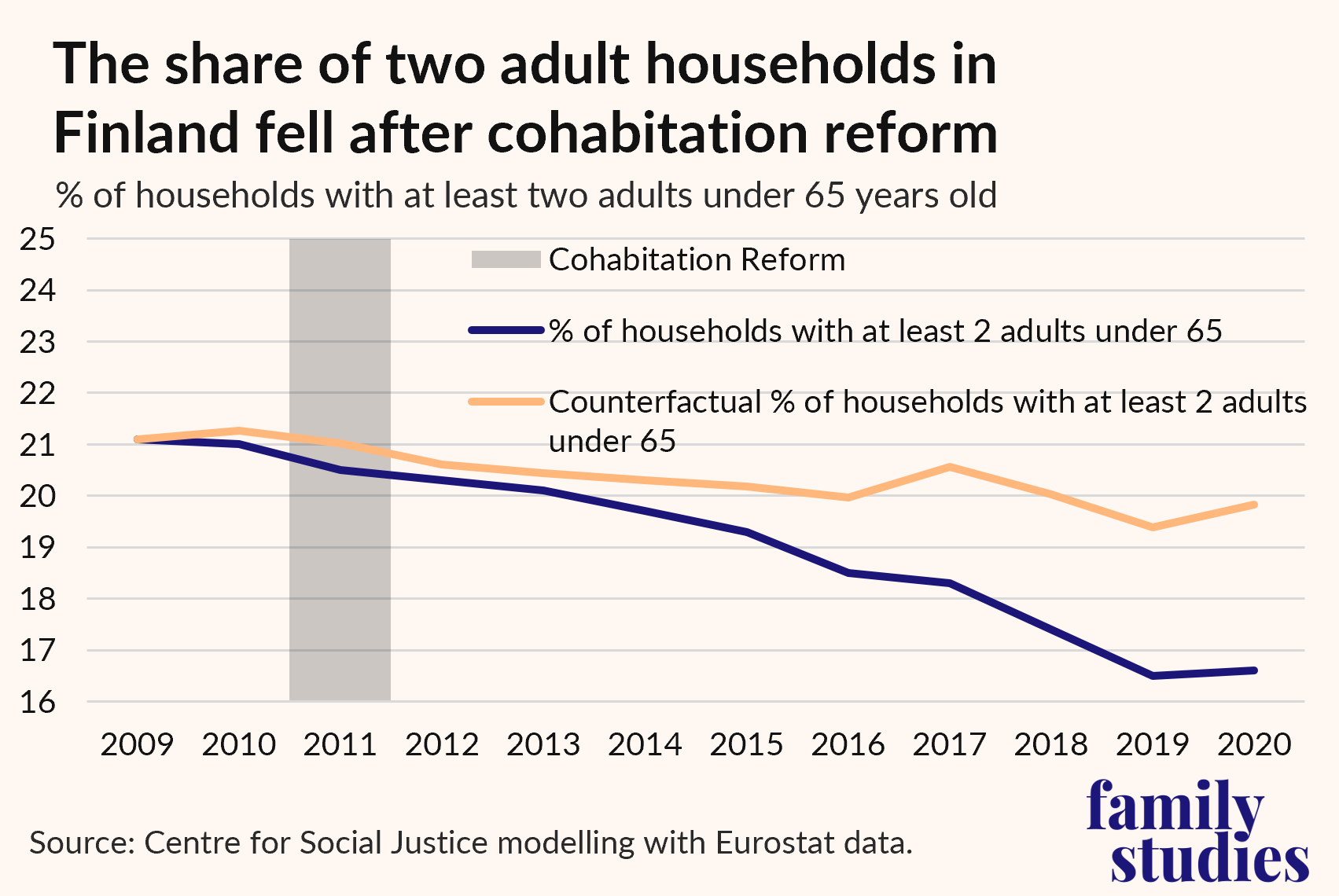
But when the Finnish reform was passed, the proportion of households consisting of at least two adults under the age of 65 years old declined relative to a synthetic control in the years after, falling 13% under what it would have been by 2018 had the reform never been implemented. This suggests that the cohabitation reform did not merely trade off the uniqueness of marriage for greater security for cohabiting couples—rather, the total number of people living in couples of any type fell more in the period afterwards than it might have had the reform never happened. This should be reason for pause among advocates of the current proposals for cohabitation reform in the UK.
The cohabitation reform could also have reduced the total number of marriages through reducing the marriage rate. There is good reason to think that marriage might impart stability benefits for reasons other than pooled property rights: marriage is a public and legal commitment, which raises the personal and reputational cost of exit (even social conventions like surname-sharing may influence divorce rates).
Rather than giving cohabiters security, the proposed cohabitation reform could weaken both relationship formation and stability in the UK, as we see in Finland’s experience.
There are also other mechanisms through which the cohabitation reform may have damaged coupling. In introducing pooled property rights for cohabiting couples after a few years, it may have placed a de facto deadline on cohabiting relationships in the eyes of many. This would explain why the divergence between the Finnish proportion of young two-adult households and that of the synthetic control’s began to accelerate around 2014 or 2015, 3-4 years after the cohabitation reform and therefore just before the 5-year deadline before property rights became more pooled under the cohabitation reform for couples who moved in with each other after the reform had passed.
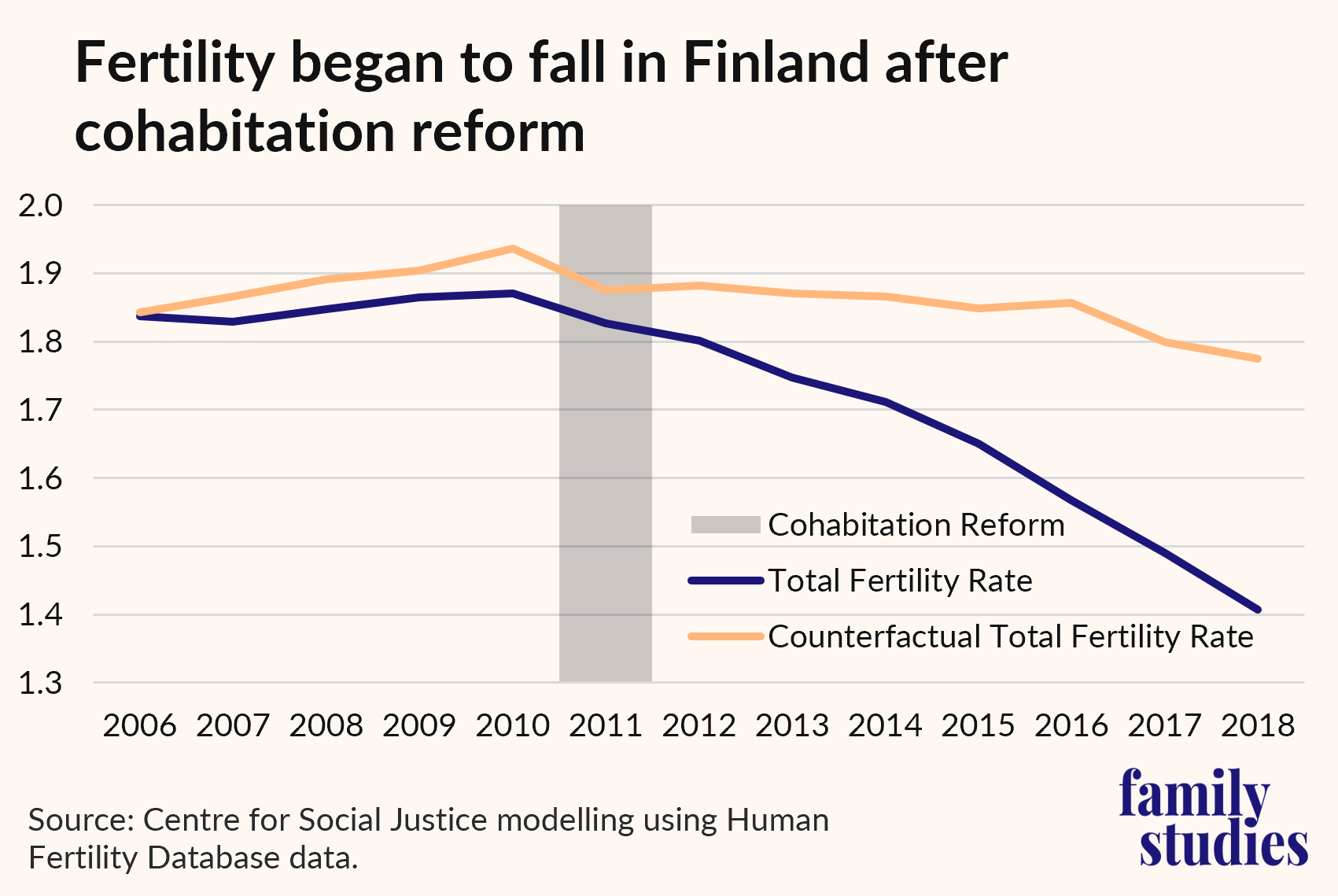
As one might expect, the reduction of the first marriage rate and the reduction of the total number of working-age adults living together coincided with a fall in the fertility rate more drastic than that of Finland’s peer countries. Today, most people have children in the context of either marriage or a cohabiting romantic relationship, and those who never had children most frequently report not having a partner as a main reason, while couple instability has been associated with lower fertility. Measures that harm coupling will likely also harm fertility rates for this reason, and Finnish fertility did begin to drop against an estimate of what would have happened without the cohabitation reform and was 21% below what it would have been without the reform by 2018.
Lessons from Finland
So what might we learn from Finland’s cohabitation reform? It turns out, making cohabitation legally more similar to marriage does not help anybody. Singles may be scared off from relationships, cohabiters may break up more or delay or avoid having children, and the relative usefulness of marriage may decline. A law that is linked to a drop in the total number of unions and to a decline in fertility is a surprising law to emulate. Yet, the UK currently has similar proposals in consultation at present. While doubtless well-intentioned, formalizing relationships that are—by their definition—informal might result in the opposite of what is desired. Rather than giving cohabiters security, it could weaken both relationship formation and stability, as we see in Finland’s experience.
If governments want to help young people acquire stronger relationship protections, there’s a simple option: promote and encourage marriage for those who desire it. Marriage has a tried and tested record as a commitment-enhancing institution. Making cohabitation more like marriage seems to make coupling in general worse, suggesting that there is no current substitute for the institution. Meanwhile, a marriage-year tax rebate in the UK could cost less than a third of a thousandth of a percent of GDP and potentially increase the number of marriages by as much as 11%, without a tradeoff in marital outcomes. That’s an evidence-backed action the UK government should get behind to support young couples today.
Peter Foreshaw Brookes is Research Associate of the Pronatalism Initiative at the Institute for Family Studies. He is also the Director of The Centre for Family and Education and of Foreshaw Brookes Education.
*Photo credit: Shutterstock


