Executive Summary
The American Enterprise Institute's Housing Center has spent the past five years proposing solutions for the housing supply shortage in cities and states around the country. In large part, these solutions revolve around ending the ban on starter homes—making it legal to build naturally affordable homes that young and working families can afford to buy and rent. Legalizing starter homes is the single most important action local governments can take to improve housing affordability for young and working families.
However, there's another path to affordability for individual Americans: getting married. In Rings to Roofs, the AEI Housing Center and the Institute for Family Studies examine how increasing marriage rates would make housing more affordable, both for people getting married and for everybody else.
Marriage has three benefits for the housing market. First, increasing marriages would decrease the number of homes required in the housing market, by consolidating two households into one. This acts like a supply-side solution, reducing our national shortage. Second, when two working people get married, their household income rises, meaning they can afford to live in larger and higher-quality homes. Finally, the homes that would be freed up by a marriage recovery are among the most affordable in the country, making marriage both an affordability and supply solution.
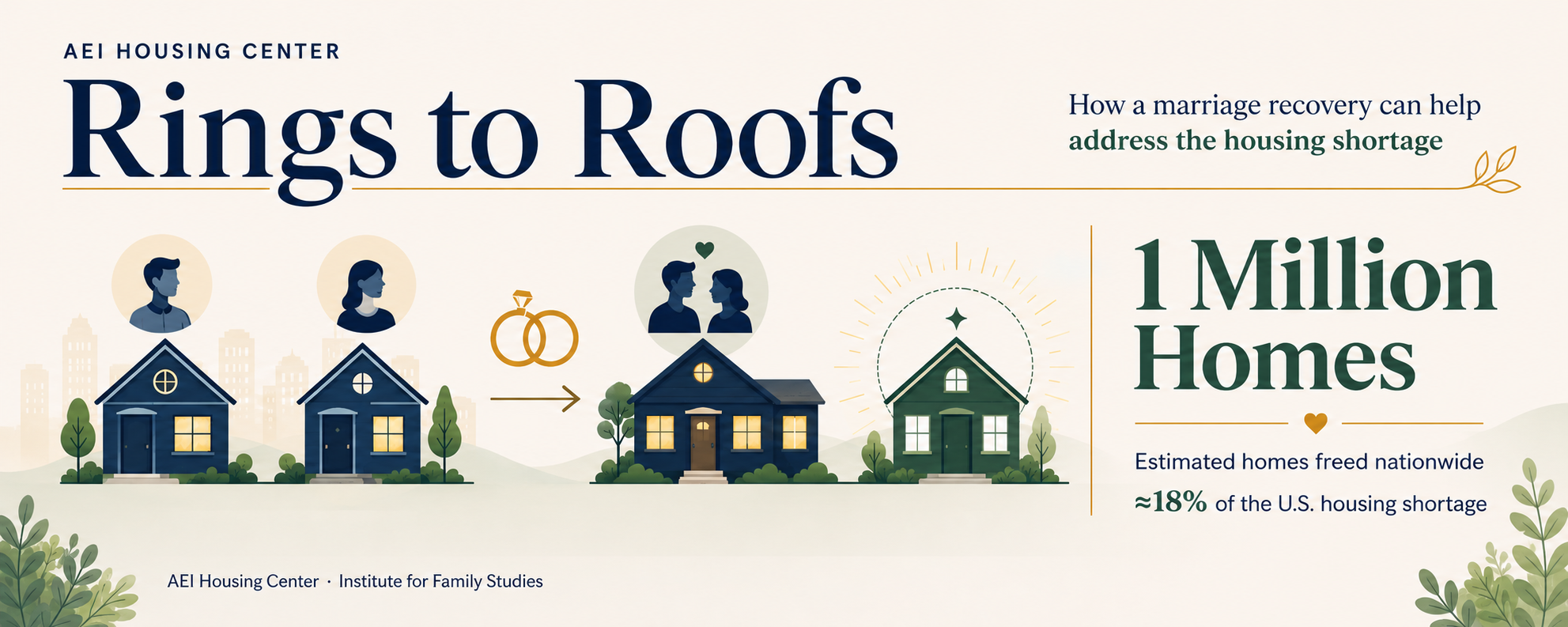
In Part I of Rings to Roofs, we focus on the supply-side benefits of marriage. If marriage recovered to its 2000 level among working-age adults, it would be the equivalent of building one million homes in metros experiencing a housing shortage. Beyond the benefits of getting married itself, a marriage recovery should begin with Americans themselves, and entire markets would reap the rewards.
Key Takeaways
- 1 million homes would be freed up by returning marriage to its 2000 level among working-age adults, about 18% of the national housing shortage.
- The partnered-share gap opened over 24 years, from 2000 to 2024. Closing it over the same span annualizes to 44,800 homes a year and lifts the refined marriage rate from 31.2 to 33.9 per 1,000 unmarried women (age 15+).
- Returning to 1980 levels of marriage would reduce the shortage by 2 million homes.
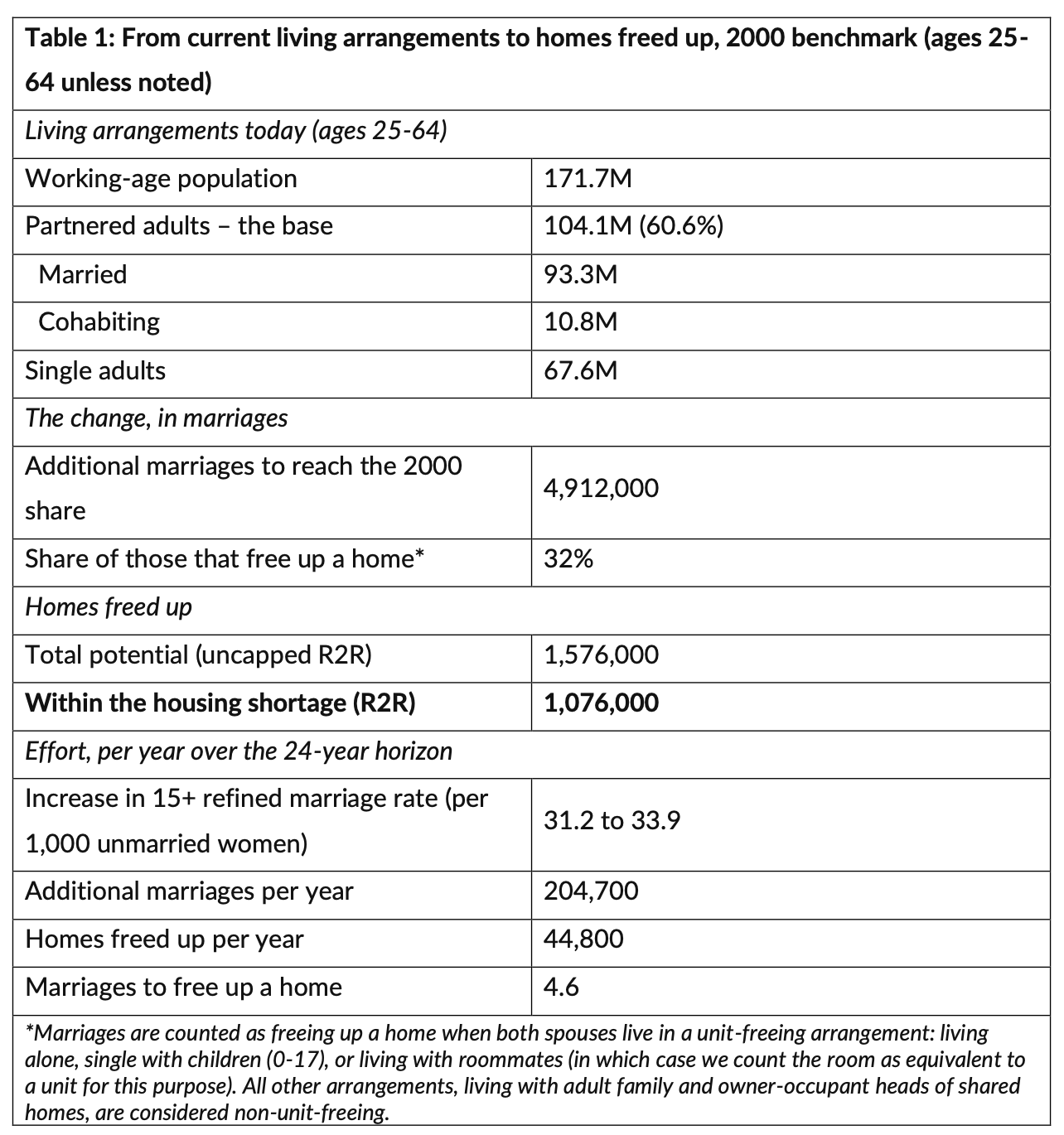
- Reaching the 2000 benchmark takes about 4.9 million additional marriages and frees about 1.08 million homes, roughly one home per 4.6 marriages.
- Homes freed up by marriage tend to be smaller, less expensive, and rented: about 82% are rentals at a median rent near $1,070 (the 28th percentile of local rents), and over half sit in multifamily buildings.
- The annual Rings to Roofs estimate equates to roughly 80% of new Low-Income Housing Tax Credit (LIHTC) construction. In subsidy-equivalent terms, Rings to Roofs produces a value of roughly $2,700 per marriage annually (vouchers), or a one-time federal $30,000 cost (LIHTC).
- Marriage differs from other demand-side solutions. It raises a household's buying power while simultaneously reducing the number of households, creating affordability and easing a shortage instead of bidding up prices.
- The Rings to Roofs data dashboard shows the benefits of a marriage recovery on the housing shortage and the new couples in states and metros throughout the country.
Introduction
The married share of working-age Americans has been falling for over 50 years. At the same time, the American family has been shrinking. Average household size has fallen by 21%, from 3.11 persons in 1970 to 2.46 today. The number of single adults (25-64) has risen from 18 million (20 percent) in 1970 to 68 million (39 percent) in 2024. We are not only bowling alone, as Robert Putnam famously put it. We are increasingly living alone.
The United States has a housing shortage of roughly 6 million homes (estimates range from 2 million to 8 million). Shrinking household size sits behind part of that demand, along with a growing overall population. Much of the housing debate responds to the shortage as a problem of construction, how to build more, and more affordably. The AEI Housing Center has spent years on that side of the ledger, documenting how restrictive zoning and land-use rules suppress the starter homes young families can afford, and showing how starter homes and by-right development could unlock naturally affordable supply without subsidy. The legalization of by-right starter-home construction remains the single most important (and popular) policy change available to close the housing shortage.
But supply is only half the story, and many advocates also propose demand-side solutions to housing affordability, mainly subsidies, vouchers, and lower interest rates. These efforts would give households more buying power. When supply is constrained, however, that buying power capitalizes into price: the family that receives the benefit may be helped, but overall affordability holds flat or erodes, because more money is now chasing the same fixed stock of homes. We saw this in the late 2010’s, when home prices climbed as the market responded to falling interest rates. This is the curse of demand-side solutions in a shortage environment.
A marriage recovery avoids that curse. It raises buying power, because two incomes combine. But marriage also reduces the number of households, because two families become one. So, unlike a voucher, marriage lowers the total quantity of homes demanded even as it raises what each remaining household can afford. Increasing marriage reinforces the downward pull new construction exerts on prices, rather than working against it, which suits it to a shortage in a way ordinary demand-side policy is not suited. Marriage shrinks the shortage and strengthens the family at the same time.
Rings to Roofs, Mapped
The housing supply benefit of marriage is simple. For example, James and Elizabeth each rent their own apartment. They marry, move in together, and one of the two apartments goes back on the market for the next household in line. Two homes become one. With a million such marriages, the housing shortage falls by a million homes.
Not every marriage would do this, and in fact most would not. A home is freed up only when both partners give up a home of their own, so that two people who occupied two homes then occupy one. A couple where one person was living with parents, for example, might not free up a home at all if that person’s former room remains vacant. Among single working-age adults, about 57% live in arrangements that would free a unit, so if marriages formed at random, only about a third would free up a home.
Rings to Roofs measures the effect of moving today’s partnered share back to its level in 2000, across states and metros. In 2000, 66% of working-age adults (ages 25 to 64) were married or cohabiting; today 61% are. Closing that 5-point gap implies 4.9 million additional marriages, involving 10 million adults. Counting only homes freed up in markets that actually have a shortage (a home freed up where there is no deficit does not count), the result is over 1 million homes, or 18% of the national shortage. Over the 24 years the gap took to open, that is about 44,800 homes a year.
Of the roughly one million homes, about 989,000 are in metropolitan areas, which hold 5.7 million of the six-million-unit national shortage. As single adults cluster in metropolitan areas, Rings to Roofs tends to free up homes largely where the shortage is worst. In over 100 large metros— including Philadelphia, Chicago, Minneapolis-St. Paul, San Antonio, and Detroit—a return to 2000 partnering levels would close the housing shortage entirely. These tend to be metros where the shortage is small relative to population, not necessarily where the marriage decline has been steepest: a metro’s housing shortage-to-size ratio predicts whether Rings to Roofs closes the gap better than the depth of its marriage decline does.
Who Frees a Home, & Which Homes Get Freed Up
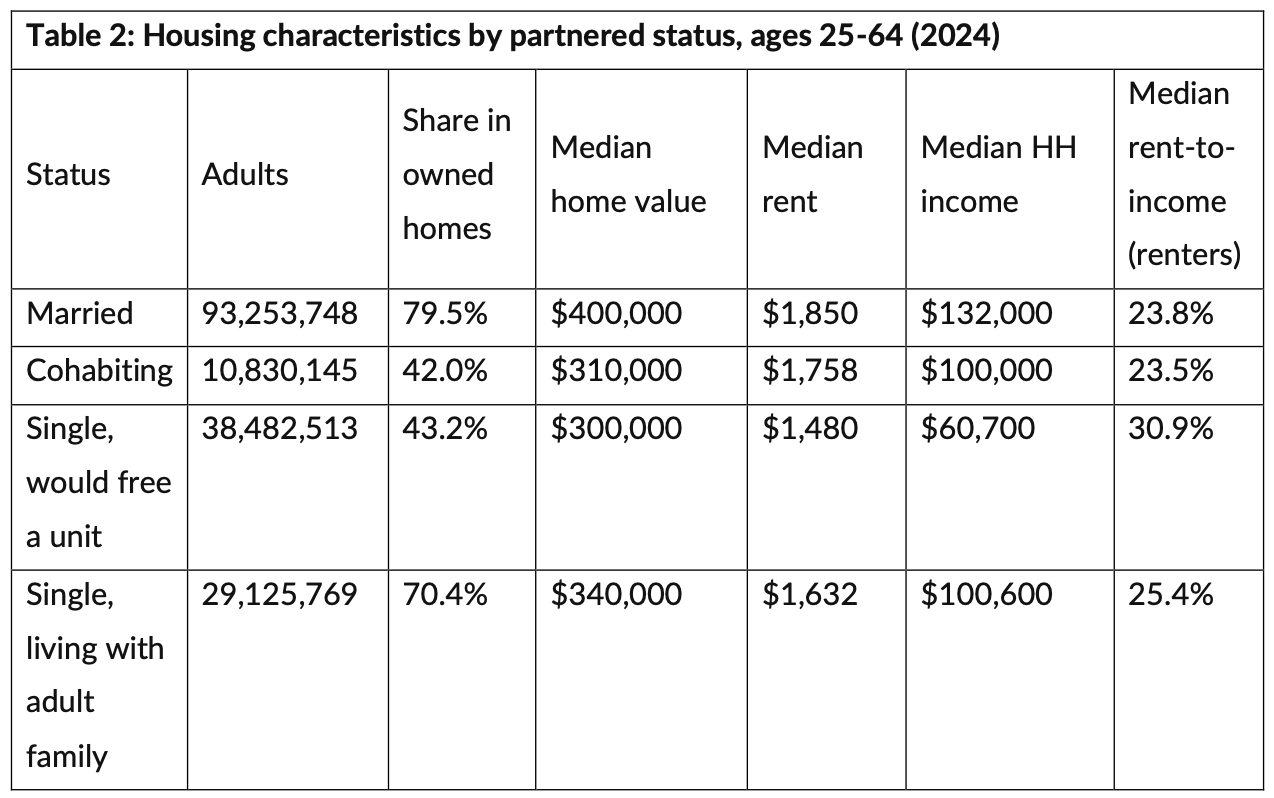
Above, we deal exclusively with the supply-side effects of a marriage recovery on housing. Next, we carry Rings to Roofs to its logical next step: how would increasing marriage affect the income—and therefore buying power—of the people who would get married? Table 2 describes the current population of married, cohabiting, and single adults, the latter split by whether those single adults live in unit-freeing arrangements.
To say anything about people’s income and buying power after marriage, we must also model who might marry in a marriage recovery. We match the 4.9 million implied marriages, assortatively, sorting partners by income and education the way real marriages tend to, and report the outcomes for the resulting marriages. That lets us describe both the overall population the marriages are drawn from and the particular people most likely to marry.
These 39 million unit-freeing adults, as individuals, are not high earners on average. Their median personal income is about $45,000 and their median household income about $61,000, compared to $132,000 for currently married couples, who pool two incomes. About 37% hold a college degree and 53% of the renters are rent-burdened. They already occupy the less expensive end of the housing stock: they are mostly renters who rent at $1,480, against $1,850 for married households.
When two current singles marry, we assume the couple gives up the least valuable of their two homes, the lower-rent unit when both rent and the rental when tenure is mixed, since owned homes turn over less readily. Profiled that way, the freed homes tend to be smaller, less expensive, and rented. About 82% are rentals, at a median rent of $1,070, the 28th percentile of their local rental stock; the owned remainder has a median value of $200,000, the 27th percentile. Furthermore, 58% are in multifamily (2+) buildings, and about 31% are studios or one-bedrooms. The picture barely changes whether we assume that couples pair at random or sort by income and education, so the result does not depend on guessing who marries whom.
Marriage does more than free up a unit. By combining two incomes, it also moves many of these couples up the housing ladder, turning renters into plausible starter-home buyers. That complementarity, between building starter homes and increasing marriage rates, is the subject of our next report.
What a Million Homes Are Worth
Large federal programs already exist to provide subsidies to reduce the rent burden on lower-income households, and they make a natural yardstick for the homes Rings to Roofs would free. The comparison can be drawn two ways: as a share of the housing those programs supply, and in the dollars to provide a unit.
As a share of supply, a million homes is a large amount on any measure. Counted as a stock, it equals about 47% of the entire Housing Choice Voucher program, the nation's largest rental-assistance effort, which serves about 2.3 million households. Counted year by year, the roughly 44,800 homes freed up annually equates to about 80% of new LIHTC construction, the largest federal program for building affordable rental housing, which places some 50,000 to 60,000 newly built units in service a year.
We can also quantify the value of a unit gained by increasing marriage, in dollars saved in annual subsidies.
- A voucher is an operating subsidy, about $12,100 per household each year for as long as the household holds it; the million freed homes through increasing marriage would supply as much housing as roughly $13 billion a year in federal spending on vouchers.
- LIHTC is a production subsidy, paid once and claimed over 10 years; building the equivalent supply would run about $11 to $13 billion a year in total development cost, roughly $250,000 to $300,000 per unit and far more in coastal markets, about half of it a federal contribution.
- The two subsidies are not always alternatives, since about 50% of LIHTC tenants need monthly rental assistance, usually in the form of a voucher, on top of the credit to afford the restricted rent.
The same arithmetic can be reversed to price the value the government should place on marriage for housing. Rings to Roofs proposes about 4.9 million marriages to free up about a million homes, so each additional marriage is worth, in housing terms, roughly a fifth of a home. Valued as the voucher subsidy it spares, that is about $2,700 a year in perpetuity per marriage, almost all federal money. Valued as the cost of building the equivalent LIHTC unit, about $55,000 to $65,000 once, of which roughly $25,000 to $35,000 is federal. Those are the housing-supply dividends of a single marriage, before counting anything marriage does for the couple themselves.
One consideration matters for how literally to read these amounts. Housing vouchers and LIHTC are means-tested, aimed squarely at very-low-income households. Rings to Roofs does not target any income group. The homes it frees reach the lower-cost segment through filtering rather than through an eligibility rule, and a later report will show that the couples involved are themselves disproportionately lower-income. The programs and the marriages therefore serve overlapping, rather than identical populations; the dollar figures reflect the value of the supply rather than equating a freed-up home with a subsidized unit household for household.
Why Marriage?
The housing policy discussion has, generally, not paid enough attention to the role that marriage plays in driving demand and supply. But the “white picket fence” trope—the idea that owning your own home is a crucial piece of the American Dream and the Declaration’s Pursuit of Happiness—is based on fact. Homeownership has always stood in for security and success in the American imagination, and it still does: 94% of Americans say owning a home is part of the American Dream, ranking it behind only financial security and personal freedom among what success means to them.
For many Americans, marriage is what turns that dream into a plan. Getting married pushes people to actually go looking for a house, not just admire the idea of one. Part of it is that married couples are far more likely to have children, and parenthood is a well-documented trigger for seeking out a single-family home with a yard and a school district, as Brad Wilcox and Maria Baer have shown. Part of it, too, is the pooling of two incomes and two sets of savings, which puts a down payment within reach in a way it is not for a single earner, as Scott Winship has pointed out.
But marriage doesn’t just make the math easier when it comes to affording a home—it changes the people doing the math. Married men work more hours, get fired less often, and earn a well-documented “marriage premium” over their single peers, whether from specialization at home, added workplace stability, or some combination of the two. That extra income shows up alongside new habits of saving, budgeting, and delayed gratification—the accumulated sacrifices that make a mortgage, and then years of mortgage payments, sustainable in a way they rarely are for one person alone. In all these ways, “putting a ring on it” makes it easier to put a roof over your head.
Conclusion
Rings to Roofs reframes part of the housing shortage as a question of family formation. Since 2000, working-age Americans have married and partnered less, and a population that lives in smaller groups needs more homes to go around. Restoring the partnered share to where it stood a single generation ago would free up roughly a million existing homes, and they would tend to be the smaller, less expensive rentals where the shortage runs deepest and where neither private builders nor public subsidy reach easily.
All this is possible because marriage makes it easier for men and women to afford a home and increases their motivation to seek a home of their own. But marriage is also a good in its own right, in addition to its benefits for the housing market. Married adults report higher levels of happiness, financial security, and stability for themselves and their children than their unmarried peers. So a housing agenda that makes marriage easier to choose, rather than harder, does more than just advance housing. It also makes the American Dream and the Pursuit of Happiness more accessible to countless men, women, and children across the nation.
Marriage should be treated as a first-order concern in solving America’s housing crisis.
Editor’s Note: This is the first in a series. Later reports will cover how building more starter homes reinforces marriage, and why marriage and starter homes are particularly effective solutions for the lowest-income Americans in the housing market.
*For a footnoted copy of this report, download the PDF below.