Highlights
- Yes, growing up with a married mother and father gives kids a leg up in life—even more than it used to. Post This
- In general, Americans, and especially the most privileged liberals, increasingly discount the value of married parents. Post This
- If anything, Melissa Kearney and the Future of Children’s conclusions may undersell the value of a stable, two-parent family for kids today. Post This
“Isn’t divorce less of a big deal for kids these days?” A colleague’s wife asked me this question as we hiked down Parkman Mountain last summer while taking a break from an academic conference. She asked the question after she learned that I studied American families. “After all,” she added, “we’re more accepting now of all sorts of families.”
My hiking partner’s theory was this: because kids in nontraditional families are less likely to feel ostracized or stigmatized nowadays, they are also less likely to be harmed by family breakdown than they would have been a half-century ago.
Her view is increasingly common. Many people, especially well-educated, left-leaning people like my Maine conversation partner, think marriage and a stable family are less important for children and adults in the contemporary world than they once were. Either because they adhere to progressive ideas about family diversity—the notion that love, not marriage, makes a family—or the individualistic belief that flying solo is just as good as flying with a copilot while raising kids, growing numbers of Americans now discount the value of stable marriage for children.
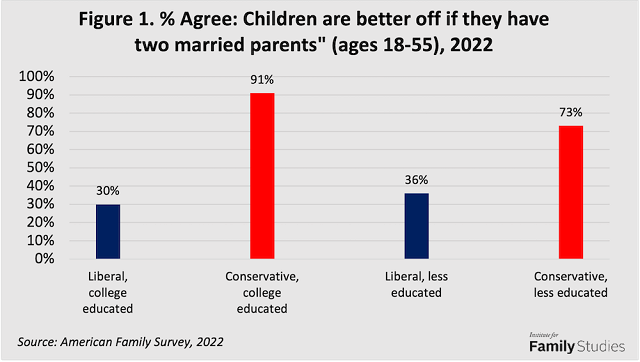
For instance, from 2006 to 2020, the share of adults who said it is “important” that unmarried couples who have had a child together “legally marry” fell from 76 percent to 60 percent, according to Gallup. This trend was especially pronounced among well-educated liberals, according to the 2022 American Family Survey. Only 30 percent of college-educated liberals aged 18-55 said “children are better off if they have married parents,” as did only 36 percent of American liberals without a college degree. By contrast, more than 70 percent of conservatives—especially college-educated conservatives—took the view that marriage matters for children. But in general, Americans, and especially the most privileged liberals, increasingly discount the value of married parents.
Continue reading at City Journal . . . .