
Highlights
- Both sexes place a high value on shared values, a positive relationship dynamic, communication style, intelligence, and a sense of humor. Post This
- Women, on average and across cultures, place greater weight than men on a potential spouse’s financial prospects and ability to provide for a family. Post This
Biology is not fair. Women’s biological investment in offspring is so huge—a large gamete, nine months gestation, and then a period of energy intensive nursing—that the human body becomes less capable of this great effort as it ages. Consequently, the period during which women can be reasonably confident of having a healthy child is substantially narrower than it is for men. When women become aware that the time is ticking if they want to have a family, some take active steps toward family formation by actively seeking a partner—perhaps by joining a match-making site, such as Keeper.ai. As I noted in yesterday’s post, Keeper caters to people seeking marriage and family life, and its gender composition differs markedly from that of most dating platforms. Whereas sites such as Bumble, Hinge, and Tinder are typically majority male, among those who complete Keeper’s onboarding process, women outnumber men by roughly 5 to 1. In my last post, I looked at Keeper’s data about men using the site. Here, I will look more closely at the data for women.1
Age Matters
Women who use Keeper may be unusual in recognizing the need to act while they are still relatively young (the median Keeper woman is about 21-22 years old at signup, versus an average of 24-30 years old on many dating apps). Other women may be less likely to do so, in part, because human psychology did not evolve under conditions in which people consciously planned their families years in advance. Throughout most of human evolutionary history, effective contraception was absent, so survival and sexual activity typically led to reproduction. As a result, there was not much opportunity for natural selection to favor a distinct psychological trait of consciously “wanting a family” in the modern sense.
Men also face age-related declines in reproductive capacity, but their reproductive window is considerably broader than women’s. Historically, men did not generally need to focus explicitly on acquiring a wife and children. Instead, they had to be concerned with attaining status—as warriors, hunters, landowners, skilled workers, or successful providers, depending on the society. Marriage and children typically followed from such achievements. Consequently, there was likely little or no selective pressure for a distinct psychological trait centered on actively pursuing family formation.
Today, young men still compete for status relative to other men, but status competition often occurs in new arenas, including video games and organized sports. Unfortunately for young women seeking family-oriented partners, success in these domains does not necessarily translate into an ability to support a family. Men remain strongly interested in women, however, which likely contributes to their disproportionate participation on mainstream dating web sites.
What Women on Keeper Want in a Spouse
Among the self-selected women who join Keeper because they wish to marry and have children, what characteristics do they seek in a husband? The stereotype of “prince charming” is that he is tall, dark, and handsome. The “tall” component does appear in the data from users who complete the site’s onboarding process. Approximately 95% of women specify an ideal minimum height that is at or above their own height, with a median of about 4 inches taller than herself. About 89% of women specify an acceptable minimum of at or above their own height, with an average of about 2.5 inches taller.
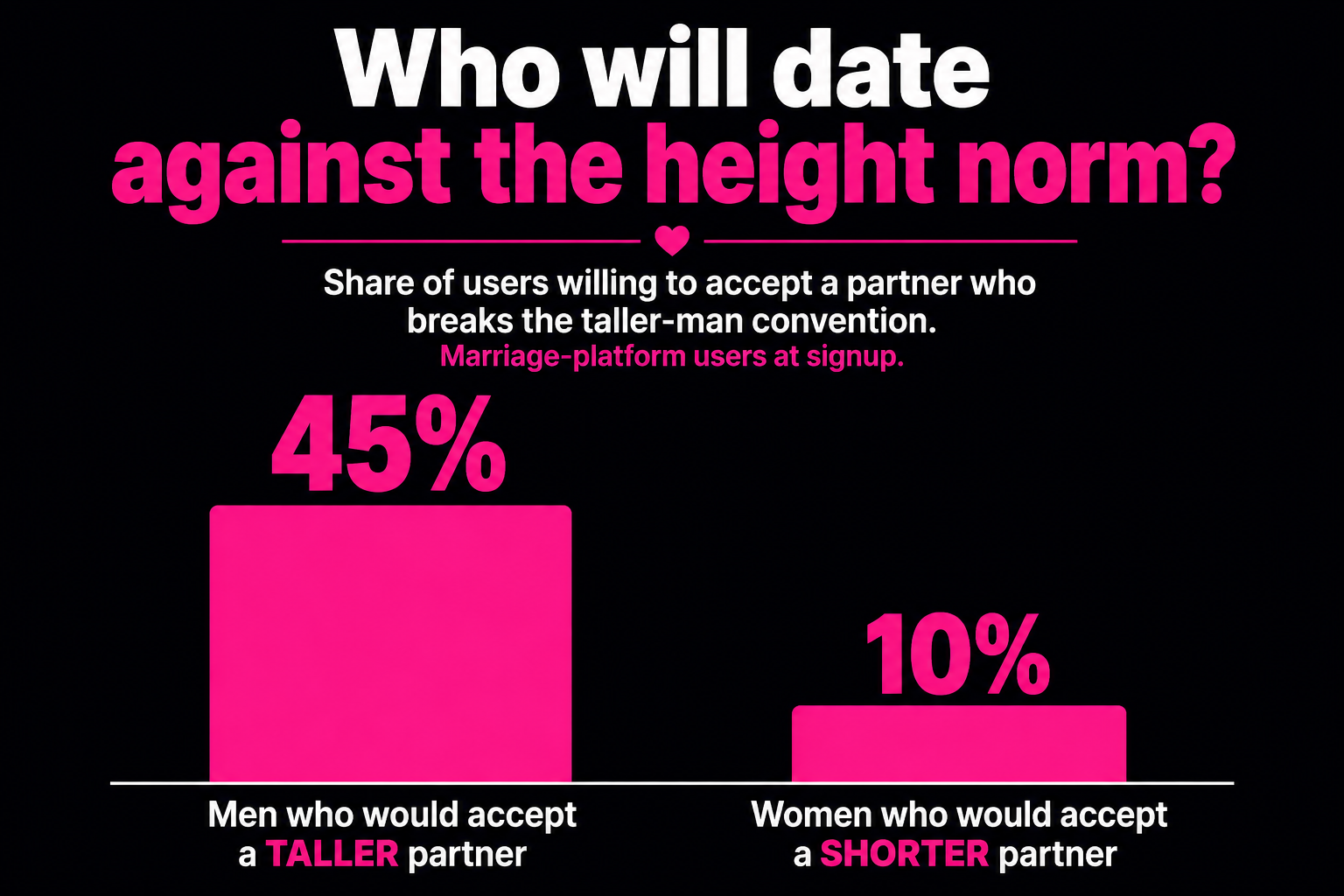 Source: Keeper.ai
The “dark and handsome” aspects appear to matter less. The 10 characteristics most frequently mentioned by women when describing an ideal husband are, in order from most mentioned to least mentioned: 1) values, 2) sense of humor, 3) relationship dynamic, 4) communication style, 5) intelligence, 6) ambition, 7) lifestyle, 8) physical health, 9) hygiene, and 10) intimacy. These preferences exclude preferences for age, height, location, ethnicity, personality and appearance because they are addressed in separate structured prompts. Men’s rankings (aside from the structured prompts) are remarkably similar, as I noted in my article on men’s preferences.
Today's young men still compete for status, but competition often occurs in new arenas, including video games. Unfortunately for young women, success in these domains does not necessarily translate into an ability to support a family.
When describing a prospective spouse’s appearance in the structured prompt, women are somewhat more likely than men to mention specific physical attributes such as body build, hair, and eyes (15.1 vs 6.1 %, 16.9 vs 8.4%, and 10.0 vs 5.4%, respectively of the women vs the men). However, they are somewhat less likely than men to flag appearance as very important or not-negotiable (50.9% of all the women do vs 56.0% of all the men).
What about a man’s ability to provide? Research in evolutionary psychology consistently finds that earning capacity and resource acquisition are more important in women’s long-term mate preferences than in men’s. Yet financial capability does not appear among the top five characteristics women explicitly mention in the Keeper data, although intelligence—one of the top-ranked traits—is positively associated with earnings. In addition, ambition ranks sixth among women’s preferences and is often linked to future economic success. Consistent with findings from evolutionary psychology, ambition is somewhat less important to men, ranking eighth in their preferences, and more women than men state a preference for ambition in a partner. Women are also about 1.3 times more likely than men to mention finances in their description of a preferred spouse. Last, there is evidence that height is positively associated with earnings, suggesting that women’s preference for taller men may partially reflect a preference for indicators of provisioning ability.
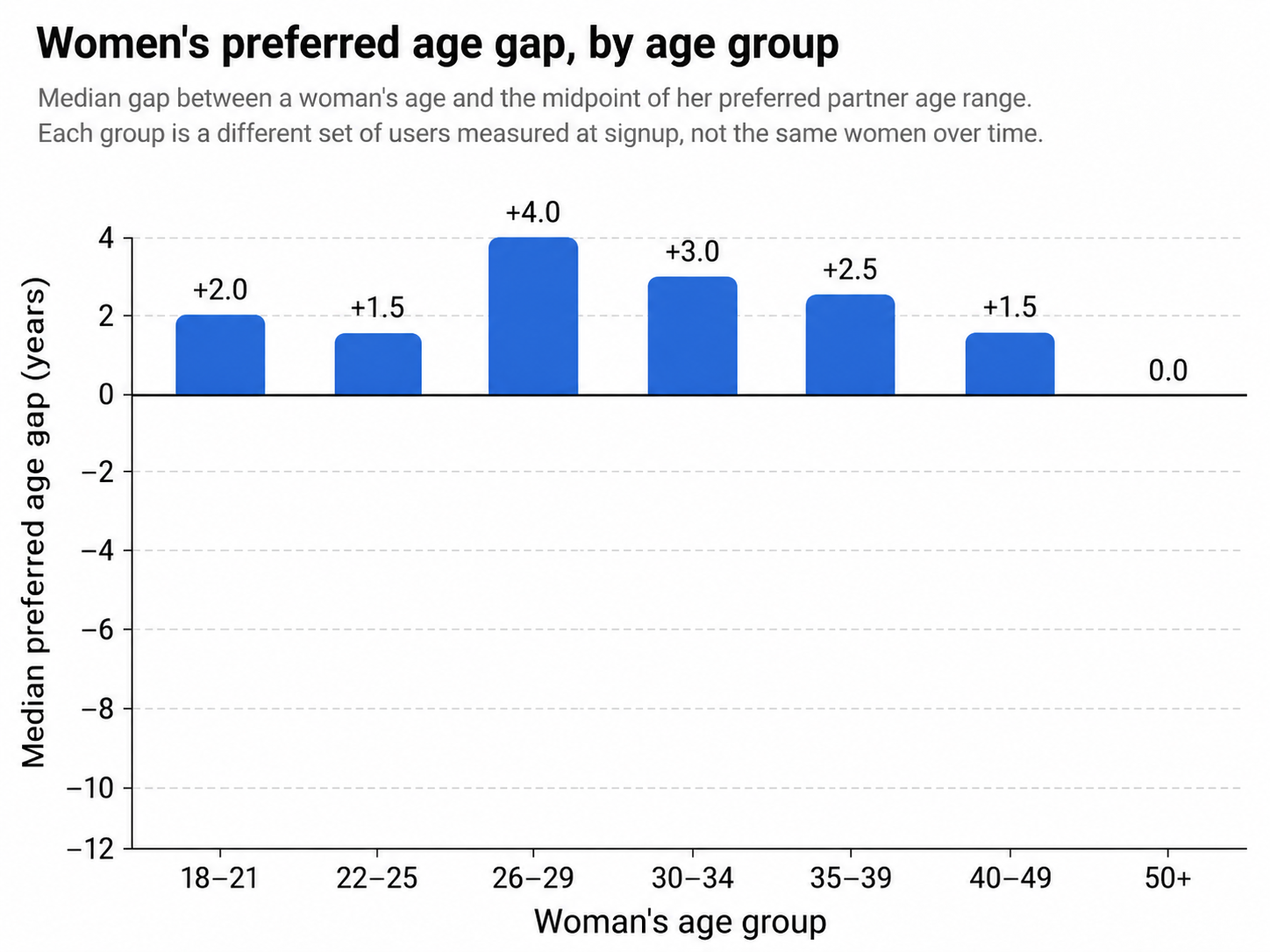
In addition to height, users specify preferred ranges for age, appearance, location, and ethnicity. With regards to age, the data align closely with findings from the evolutionary psychology literature. Women generally prefer men who are approximately their own age or somewhat older. This preference is somewhat more pronounced among younger women: women aged 18 to 21 seek a spouse a median of about two years older than themselves, women aged 26 to 29 seek a man who is a median four years older than themselves; while women aged 40-49 seek a husband who is a median of only 1.5 years older than themselves. National data indicate that husbands in the United States are approximately 2.2 years older than their wives (an average that likely reflects a compromise between husband’s and wife’s age preferences).
Women also appear more willing than men to relocate for a partner. About 26.7% of men report that they are unwilling to relocate, compared with only 14.0% of women. Women are also somewhat more likely to express a specific preference regarding ethnicity: approximately 26% of women and 23% of men specify a preferred ethnic background for a prospective spouse.
In a second, optional stage of the onboarding process, users can designate various characteristics as “nice to have,” “very important,” or “non-negotiable.” Many users skip this step, but a total of 50.9% of all the women specify appearance as very important or not-negotiable, compared with 56.0% of all the men, as noted above. Age, by contrast, is not a characteristic that women are especially likely to flag in this way: only 1.4% of all the women do so, compared with 16.1% of men. From an evolutionary psychology perspective, this sex difference is unsurprising. Adult men can father children throughout most of their lives, whereas women face a much narrower reproductive window.
What Women Don’t Want
Some of the women also specify characteristics they do not want in their general description of what they are looking for in a spouse. In general, women list more specific “don't wants” than men, suggesting that women may be somewhat more selective in their mate preferences. The most common undesirable characteristic identified by women is “rude,” cited by 7.9% of all women. This is followed by “overweight” (5.8%), “short” (5.4%), “mean” (3.9%), and “arrogant” (3.5%). The appearance of “short” on this list is somewhat redundant, since, as noted earlier, the vast majority of the women have already specified a preference for a taller partner.
Key Takeaways
Taken together, the Keeper data suggest several conclusions.
First, substantially more women than men join a matchmaking platform explicitly devoted to marriage and family formation.
Second, women’s preferences for a spouse are quite similar to men’s. Both sexes place a high value on shared values, a positive relationship dynamic, communication style, intelligence, and a sense of humor.
Third, women appear somewhat less concerned than men with age and physical appearance, although they generally prefer partners who are somewhat older than themselves. This finding is also consistent with research in evolutionary psychology, which finds that men are more likely to be concerned about age and appearance in a spouse than women are.
Fourth, women identify more undesirable characteristics in prospective spouses, suggesting greater selectivity in long-term mate choice.
Finally, the Keeper data indicate that women place greater emphasis than men on height and ambition, both of which are positively associated with a man’s ability to acquire resources and provide for a family. In this respect, the Keeper findings are consistent with a large body of evolutionary psychology research showing that women, on average and across cultures, place greater weight than men on a potential spouse’s financial prospects and ability to provide for a family.
Rosemary L. Hopcroft is Professor Emerita of Sociology at the University of North Carolina at Charlotte. She is the author of Evolution and Gender: Why it matters for contemporary life (Routledge 2016), editor of The Oxford Handbook of Evolution, Biology, & Society (Oxford, 2018), and author (with Martin Fieder and Susanne Huber) of Not So Weird After All: The Changing Relationship Between Status and Fertility (Routledge, 2024).
*Photo credit: Shutterstock
1. The information in this essay comes from Keeper.ai. Thanks are due to Jake Kozloski for providing the data, graphic, and figure.


